
Performance
LNA
The most important thing I can advise is to make sure the low-noise amplifier (LNA) is on unless you have a reason to turn it off. The LNA is always off when the radio powers up, so you have to remember to turn it on (double tap the button lower left of the display). When on, the icon LNA appears on the display to the left of the battery status icon. With the LNA off, I got not a single MW station. LNA will be turned on for all testing.
Antenna
There are three things one might call “antenna” on this radio. The obvious one is the 10 segment 82 cm telescopic antenna on top. It’s quite a serious physical object, and appears robust. Absent any other antenna, it supports all bands including MW.
The second antenna is the earphone cord plugged into the 3.5mm TRS (tip-ring-sleeve) jack on the top, presumably for use when the radio is in a shirt pocket or the like.
The third antenna is one you plug into the bottom — a rather awkward place if you expect to stand the radio vertically. This jack supports both AM and shortwave reception with the former in the form of a ferrite loop antenna and the other a long wire. Of course one might experiment on what else might work. On MW, I have had good results in the past with a ferrite rod antenna that came with my Zhiwhis ZWS-C919 that I believe is the same as their model T-20 Antenna sold separately. The ZWS-C919 is also sold by Raddy as the RF919.

Longwave
Not much LW in North America just a few non directional beacons. I’ve had more luck with long wire antennas and a ground than ferrite loops. The Algerian station I once received has a frequency of 153 and the nearest easy to receive NDB is on 353.
I went out on the patio where the 20-foot wire up a tree (WUT) antenna sits. The NDB was strong on my Qodosen DX-286 but only the faintest hint was heard on the ATS200 (and yes, the LNA was on). So I rate it not all that good.
Medium Wave
I test MW with my midday band scan. I just set the radio outdoors on an insulating table and count the number of stations I can pick up around midday. This is a special case because this test is always conducted with the radio’s internal antenna, which doesn’t exist on the ATS200. I made an exception and used the big Zhiwhis that came with the C919. In this test, the radio is flat on the table, so the antenna stuck in the bottom isn’t a issue.
I expected poor results, but hope with the huge T-20 MW antenna that I would get something. It didn’t. 3 miserable stations was all: one OK, one poor and one barely audible. It was a total bust. With the MW antenna, there was a raucous background noise that got worse when I touched the screen, and went away when I held the case. The test was performed holding the case. This antenna uses a stereo plug with the connection to the tip and the sleeve of the plug.
I live in a weak MW area, and other radios have also exhibited abysmal performance too (see chart proceeding). My top-performing Sangean ATS-909 received 25 stations.
I also tried connecting the radio to a long wire antenna, 20 feet diagonally up a tree and an earth ground. I fully expected a radical improvement and was not disappointed — 58 stations! I note that the ferrite rod test is done with the radio oriented fixed NW / SE toward the strongest signals, while the long wire is essentially nondirectional.
It also became obvious in this test that the encoder knob doesn’t always work. Some clicks leave the frequency unchanged. I’ve had to click as many as 3 times to advance the frequency.
FM
Somehow I expected FM to be a strong point of this radio. There just seemed to be more focus.
Reception was mediocre in my midday test, receiving a total of 57 stations. In 3 cases, a strong local station bled over onto a weaker one.
RDS was a little of a disappointment because it shows only the PS and RT segments but not PI. Also be cautious relying on RDS data, as this radio will leave the RT data shown from a previous station.
Shortwave
The first test I make with any shortwave is WWV and CFRX in Toronto, a 1 kW station about 400 miles north of me. I tried this indoors in a high electrical noise environment. WWV on 5 and 10 MHz were audible and CFRX was also there. If I were giving a SINPO rating, CFRX would get a 3 out of 5 on the ATS200 with telescopic.
To compare, I picked another vertical pocket radio, the Zhiwhis ZWS-A330 (also sold as the Raddy RF780), and of course my fast ATS daily driver, the Qodosen DX-286. I let the Qodosen pick the stations because it’s very good at that and scans all the broadcast bands in under 2 minutes. It’s also a radio that lots of folks have.
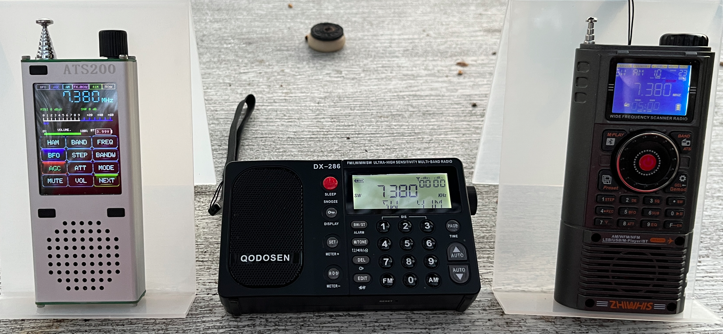
The test was done outdoors, away from any structures, using the 20′ WUT antenna, a little after sunrise when the Chinese stations were starting to fade. The first problem appeared immediately — I couldn’t plug in the antenna to the ATS200 on the stand because the jack is on the bottom, so it was time for Plan B:
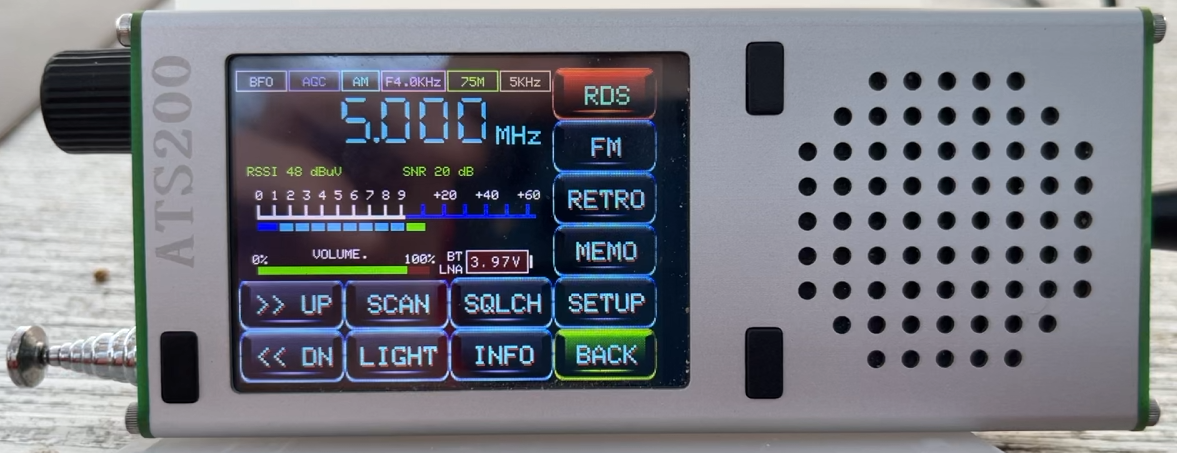
First I got WWV on 5 MHz as a starting benchmark. Note RSSI values on the DX-286 and the ATS200, the latter much smaller.
Here are some weaker Asian bits:
Finally a nice signal from CFRX in Toronto:
My observations after the SW test were:
- ATS200 reception is OK on strong and moderate stations, but useless on weak ones
- The lack of ATS on the ATS200 is a definite disadvantage
- The speaker lacks low tones
- The ZWS-A330 and DX-286 are notably better
Shortwave SSB
The third test was SSB, against it again the ZWS-A330 and this time the Tecsun PL-330, another radio lots of folks have that supports SSB.
Fine tuning on the ATS200 can be accomplished either by touching the 100 or 10 Hz digit position on the frequency display to allow the tuning knob to adjust that digit, or pressing the BFO button to display a numeric offset display. There is a difference.
When fine-tuning the receiver, the entire passband shifts relative to the frequency the DSP filter is moved as well. With BFO, it’s the product detector insertion frequency that changes, while the DSP filter remains fixed on the frequency tuned. Also on this radio, fine tuning has a 10 Hz precision while BFO is 25 Hz.
In my quick test, I used fine tuning and when I tuned an amateur radio transmission on the 40m band, the signal was fairly clear and only improved slightly by upping the frequency about 20 Hz, meaning the radio calibration is good.
The Tecsun PL-330 also implements SSB through fine tuning, likewise showing the 100 Hz and 10 Hz frequency digits. The digit being tuned is selected by repeated presses of the STEP button.
The ZWS ATS-330 doesn’t have digits more precise than 1 kHz and implements SSB solely through a BFO setting of +/- 100, undocumented units.
I then went on an expedition to the pond, and that was a total bust. First, the whole area was blanketed by electrical noise. Second, the sun was too bright see the display on the ATS200. All in all, I got nothing worth reporting. I was reminded, however, just how very readable the Tecsun PL-330 is in the sun, and that the ZWS-A330 can also be read in bright light, except that it’s tiny.
The next attempt was an amateur radio net called the “7240 Club” that operates (duh) on 7240 kHz at 10:30 – 11:30 in the morning, Eastern time, Monday – Saturday. Last time I tuned in, I got the impression that they were in the southeastern US, and particularly in North Carolina. This was my second experiment with my WOP (wire off porch) antenna, a long wire draped off my porch railing to the ground, just over 12 feet. It did a great job receiving a DRM broadcast.
I turned on the PL-330 and was surprised to hear an SSB signal, without tuning anything. The The frequency was 18640 kHz USB. The operator said he was about 30 km northeast of London. He went off the air and I proceeded to try 7240 kHz LSB. There was nothing strong, but I did pick up a signal on the ATS200 after I remembered to turn on the LNA (grrrr). What I failed to do was to pick up up anything useful on the A330. I could tell that there was some speech there, but enough to identify a language.
I went into troubleshooting mode on the A330. First I checked the attenuator to make sure it was set to DX mode. It was on LOCAL. By the time I got outdoors to test, the net had shut down. I tell this story to emphasize the operational issues with the radios. The A330 uses number keys for settings, and if one somehow presses “8” the radio switches to LOCAL mode with a microscopic display indicator. The antenna jack on the A330 is recessed and I going to rewrite my antenna connector to make double sure it makes a proper connection. And the ATS200 turns on the equivalent local setting every time it’s powered up with tiny indicator that is very hard to see in daylight.
I’ll drop narrative mode and say that test results found that the PL-330 has clearly earned its reputation for SSB reception, proving itself highly capable. I found the ATS 200 usable, but the ZWS-A330 was massively frustrating because:
- The BFO is controlled by a large center wheel, and it’s stiff to operate. One has to turn and turn and turn to get anywhere
- BFO control automatically disengages after a timer
- It appears that the bandwidth setting isn’t sharp, allowing adjacent channels (outside the set bandwidth) to be heard, confusing what can and cannot be tuned
- The display is tiny.
- The antenna jack is too small.
After much frustration, I got recordable signals on all 3 radios and that result follows in video, including a cameo appearance of the MLite-880:
Shortwave CW
Just for grins, I tried CW. The advantage to an explicit CW mode is that one can tune to the specified frequency and listen to the signal. On other SSB capable radios one has to subtract 1 kHz and pick upper sideband. The 40m amateur band is good for CW. I snagged this indoors with just the telescopic antenna. When I picked CW mode, the radio automatically shifted to the 1 kHz bandwidth.
Pro tip: You can access or dismiss the BFO either by pressing the BFO soft button or long pressing the tuning knob.
CB
Here the ATS200 bests its competition on usability. All of my other radios with a CB band, including the ZWS-C919 and ZWS-A330, lack a 10 kHz step option, which is the channel separation for CB. It’s also nice that SSB is directly accessible as a Mode on this band. FM, however, isn’t supported. CB is treated as just another slice of the SW frequencies.
Air Band
“Air band” is somewhat misleading. Some marketing material describe the ATS200 as supporting AM reception over the 118-137 MHz frequency band but in fact, coverage actually includes 50 – 200 MHz, for example the 6m ham band, and the radio will allow SSB mode to be engaged; however, the tuning step cannot be set finer than 1 kHz. (The 1 kHz has to be set in AM mode and then switched to LSB/USB; otherwise it’s 5 kHz.)
I tuned Air Band and picked up some traffic. I also tested the squelch with Air band and that worked. Every Air Band radio I’ve tested works, and this one works too. It’s not my specialty.
The radio itself does not tune AIR band directly, but internally down converts the frequency to something around 10 MHz. That process is transparent to the user except for 2 problems. The first is that the AIR band frequencies are not stored with the MEMO station list, but rather their down converted ones. Second is that one cannot enter the last digit of an air frequency, but rather has to get it to the nearest 10 kHz and then tune it with the knob. The value displays; it just can’t be entered.
Audio
There are three options for audio output: speaker, earphone and Bluetooth.
The built-in 1W speaker is somewhat tinny — while perhaps suitable for to voice in a shortwave transmission, definitely not something one would rely on for music. It’s not terrible and it can be turned up reasonably loud.
I tried Audio Technica ATH-M50 studio headphones and the sound was strikingly good. I was impressed. 💎
Bluetooth pairing was a little erratic. I tried to connect to a device that previously paired, now without success. I pressed the BT button on the radio to no effect. Finally, I powered the radio off and back on and it connected. The Bluetooth audio was OK, but I was not impressed, perhaps because my Bluetooth speaker is biased towards the bass.
Bugs
- Several functions on the keyboard override the mute and turn audio back on. Whether or not this is a benefit is a matter of opinion, but failing to turn off the mute indicator (on the screen soft button) when the audio returns is a bug.
- I think the LNA setting should be retained between sessions, rather than always being off when the radio is turned on. Repeatedly I have turned the radio on and noticed it was receiving nothing, and been immediately reminded to turn the LNA on. FM is the only band where I can sometimes get by without the LNA.
- And of course there is the fiasco of the FM soft button discussed in Part 1.
- It’s not possible to directly enter a 6-digit frequency, such as used by AIR band. The best I could do was enter 126.87 and set the trailing 5 with the tuning knob.
- Sometimes under SSB mode, the radio just goes dead silent. Recovery requires power the radio off and back on (don’t forget the LNA when it comes back on). It also happened once on FM.
- When tuning FM the RDS RT segment data remains from a previous station until another with RDS is tuned.
- The MW band is extra long, extending to 1800 kHz. The next click goes to 514 kHz and then to 524 stepping 10 kHz, but not on real stations.
- Air Band frequencies are stored in memory as down converted, not the actual signal freqency.
Use Cases
The obvious use is as a travel radio. Its small. It has a good telescopic antenna and there is a jack for a reel antenna. It gets the major bands of interest. It has SSB if you require it. And who doesn’t need another flashlight when traveling?
It could be a walking/jogging radio. Earphone experience excels. Again, the small size is a boon; however, note that the display is unreadable in the sun.
But as a serious shortwave radio, no. It is buggy and temperamental. There are better options. In vertical format, maybe a Tecsun PL-368 or even a ZWS-A330.
Conclusion
I want to separate my concluding thoughts into two parts: hardware and software.
The hardware is fine. It feels good in the hand. The speaker is acceptable and headphones great. The display is reasonably readable, although problematic outdoors under sun or sky. The telescopic antenna is quite long. Battery life seems good. I wish it had a clock. The placement of the antenna jack down on the bottom of the radio is awkward.
The software (firmware) is broken and unfinished. It’s stuck at the last free version from 2022. There are newer versions of software for the ATS series, including the 25, 100, 125 and 200. They require an activation key and since they come from Russian Federation, purchases are both technically and ethically tricky. An activation license costs around US$10. Some online suppliers of the ATS200 warn that the Russian firmware does not work. That firmware requires activation, and the activation uses an internet connection (there’s no indication that the ATS200 from Raddy even has internet capability).
For the sale price of $69.99, it’s OK. The firmware (4 years old) seems antique and unfinished, like development was interrupted before the final QA step and user feedback. MW reception with a ferrite rod antenna is almost nonexistent, although a long wire works. There’s no ATS. The manual is garbage.
Still, the display is attractive, the size is compact if you need that, it supports a Bluetooth speakers to compensate for the small tinny speaker, headphone audio is outstanding, it has SSB, and there is a flashlight. It supports Bluetooth headphones and speakers. I daresay mine will be rarely used because it doesn’t stand out in any category. It will end up in the big box of small radios.