
Someone made a comment on the Official SWL Channel Facebook group:
So I’ve got the modern raft of DSP and SDR radios, just the same as anyone else. I was wondering whether, in 2025, there’s any point in picking up an older PLL shortwave radio. … Tell me, is there any real advantage to a dual conversion PLL shortwave portable over one of the flagship DSP based radios or an SDR radio in 2025?
Group founder Gilles Letourneau replied:
There is no real reason to get one, except that you want one.
A wise answer. He should know, given his vast experience with all types of listening on many types of radios — and I have no reason to dissent — but I just like to compare radios, so I want one, or two, or five.😳
I bought 3 of those older dual conversion PLL radios (used) this year partly out of curiosity, but mostly from nostalgia. The Grundig G4000A is one them; it’s a good radio but it didn’t outclass my modern DSP receivers like the Qodosen DX-286 on a visit to the park a while back (see: Grundig G4000A: Observations Part 2). I added two more, the Sangean ATS-909 and the Kaito KA1101.
I have said that my Tecsun PL-660 is my most sensitive radio on shortwave, but that is a dated opinion, formed prior to the PL-990. Would it still hold today?
The Contenders
Here are the 5 radios, listed in order of their date of introduction.
Grundig G4000A
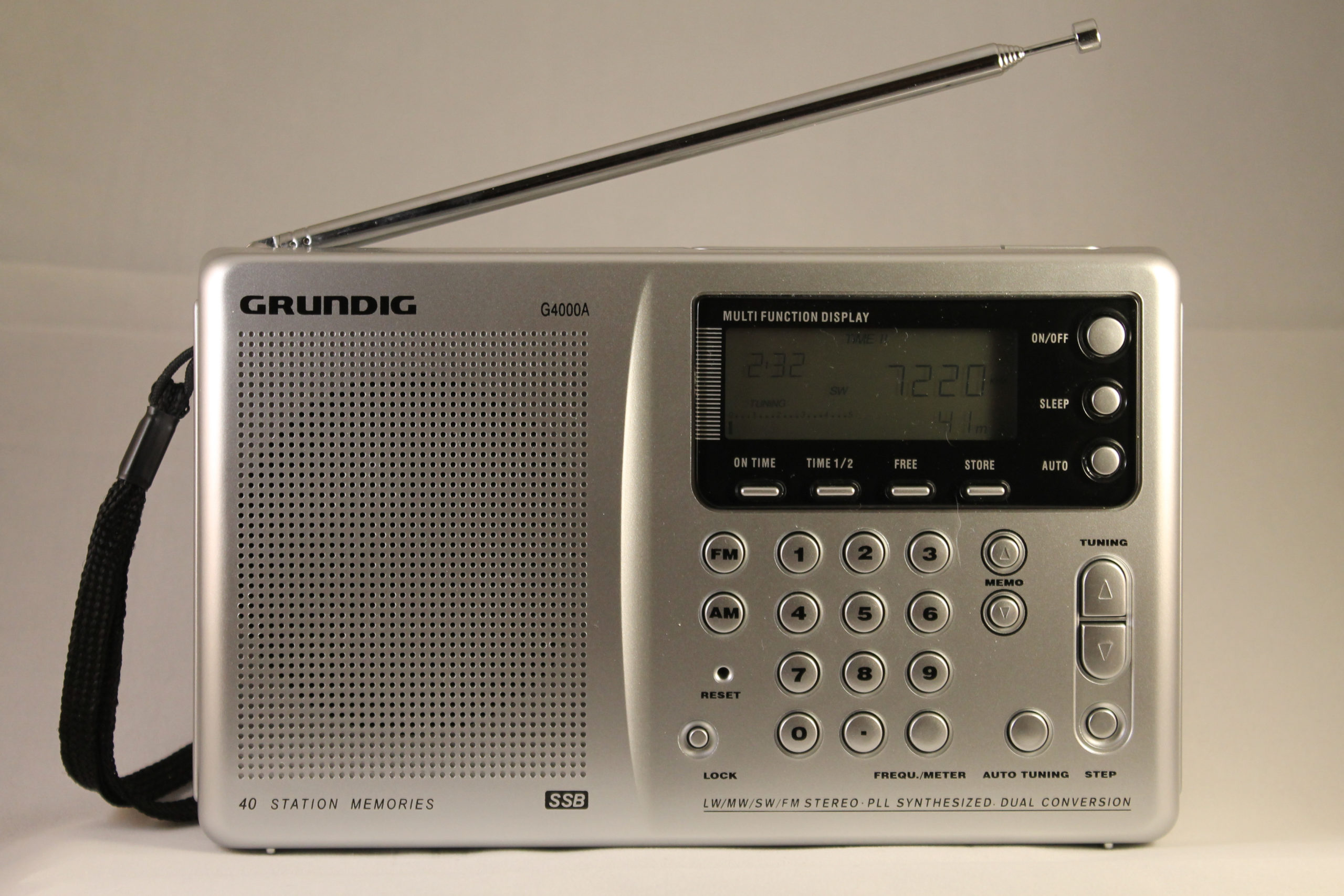
The Grundig Yacht Boy 400 came out circa 1994. The internally identical G4000A made its first appearance at Universal Radio in 2004.
I bought a G4000A about the same time as my PL-660. I sold it in 2022 in my mad radio downsizing phase, probably because I liked the PL-660 better. But as time passed, I forgot the annoyances of the Grundig and picked up a very nice used one on eBay. Someone interested in this radio might refer to these two articles:
Unless the lighting is just right, its display is hard to read. Operation isn’t intuitive. Who would guess that the AUTO button turns the alarm on and off? (“Hey Copilot, how can I turn the alarm off on this Grundig G4000A? It’s driving me bananas!”)
Nevertheless, I have been using it some of late, notably in my reception of HCJB, Ecuador. It gets shortwave stations well, and of course has SSB.
Sangean ATS-909
This radio, initially released in 1996, was one to be reckoned with. It had a huge display, FM RDS plus SSB. It’s the oldest radio in the contest. I think mine was manufactured circa 2004. It was also sold as the Radio Shack Realistic DX-398, and the Siemens RK777 in Europe.
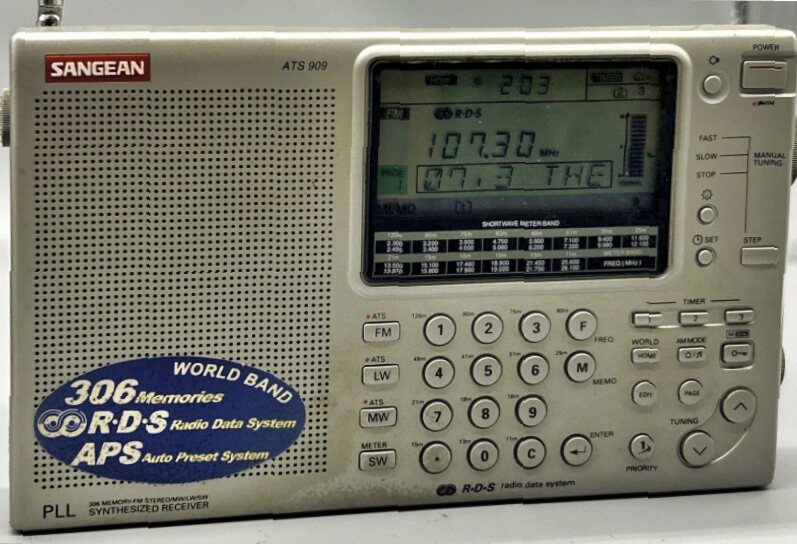
Its successors in the ATS-909 series (ATS-909X and ATS-909X2) are DSP-based radios. The funny thing about the ATS-909 is that it mutes when tuning, acting a lot like a modern DSP unit. Each increment of 1 or 5 kHz makes a very significant mute in the audio output. Also direct frequency entry creates a significant delay during which sound is muted. One reasonable theory is that muting is intentional, there to suppress spurious noises while the phase locked loop locks onto the frequency.
Tecsun PL-660
I’ve owned my PL-660 since December of 2011, and I still use it. It was my first to receive Music 4 Joy broadcasts. Frankly, if it were my only radio, it would satisfy most of my listening needs. It has LW, MW, SW, FM and AIR bands, featuring both SSB and sync detection. It’s very sensitive.

The only maintenance I’ve had to do on it is to replace the readily-available telescopic antenna. For a more detailed review, see Tecsun PL-660 vs PL-880. Its two faults are that it stores noise as stations on ATS scans and the signal strength meter is almost always pegged to the right.
Kaito KA1101 / Degen DE1101
Pretty much everyone has heard of the Degen DE1103 both in its DSP and prior analog incarnations. The 1101 and 1102 models were less notable. My KA1101 is the Kaito branded export version.
The smaller KA1101 is a dual conversion superheterodyne PLL receiver with some nods towards more serious use: Local/DX switch, bandwidth switch and an external antenna jack.
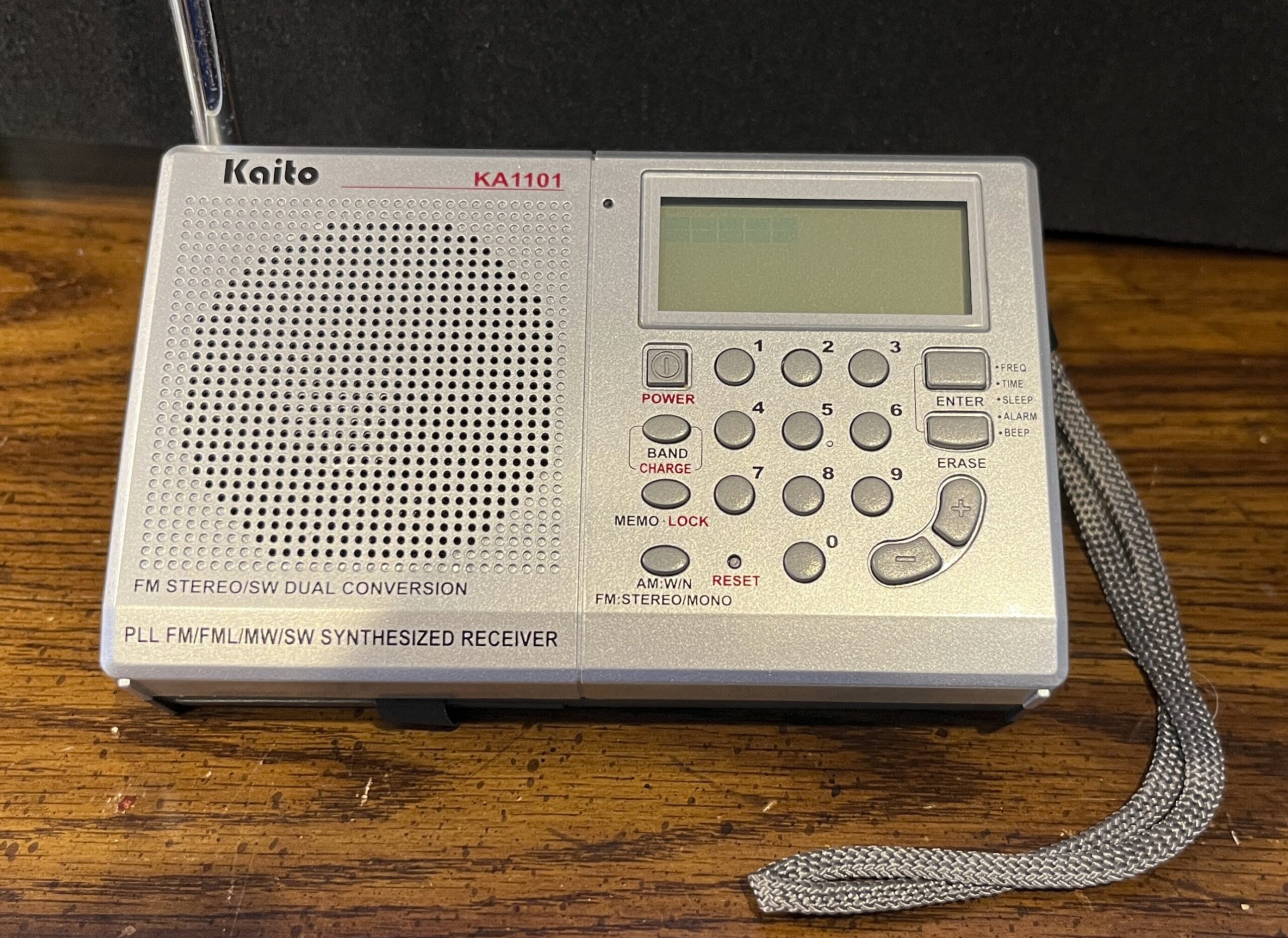
It’s the only contender that does not support SSB. For more, see: First Impressions: Kaito KA1101.
Tecsun PL-990
Of the group, the PL-990 is the only triple conversion radio, and the only one that has a digital decoder in the final IF stage. The result is much more control over bandwidth. The PL-990 was designed for the Chinese market, defaulting to 9 kHz step on MW and with different FM step options, unlike the more commonly referenced PL-990X primarily designed for export with LW stretching all the way down to 50 kHz (compared to 100 on mine). Both have MP3 playback and barely hidden Bluetooth support.
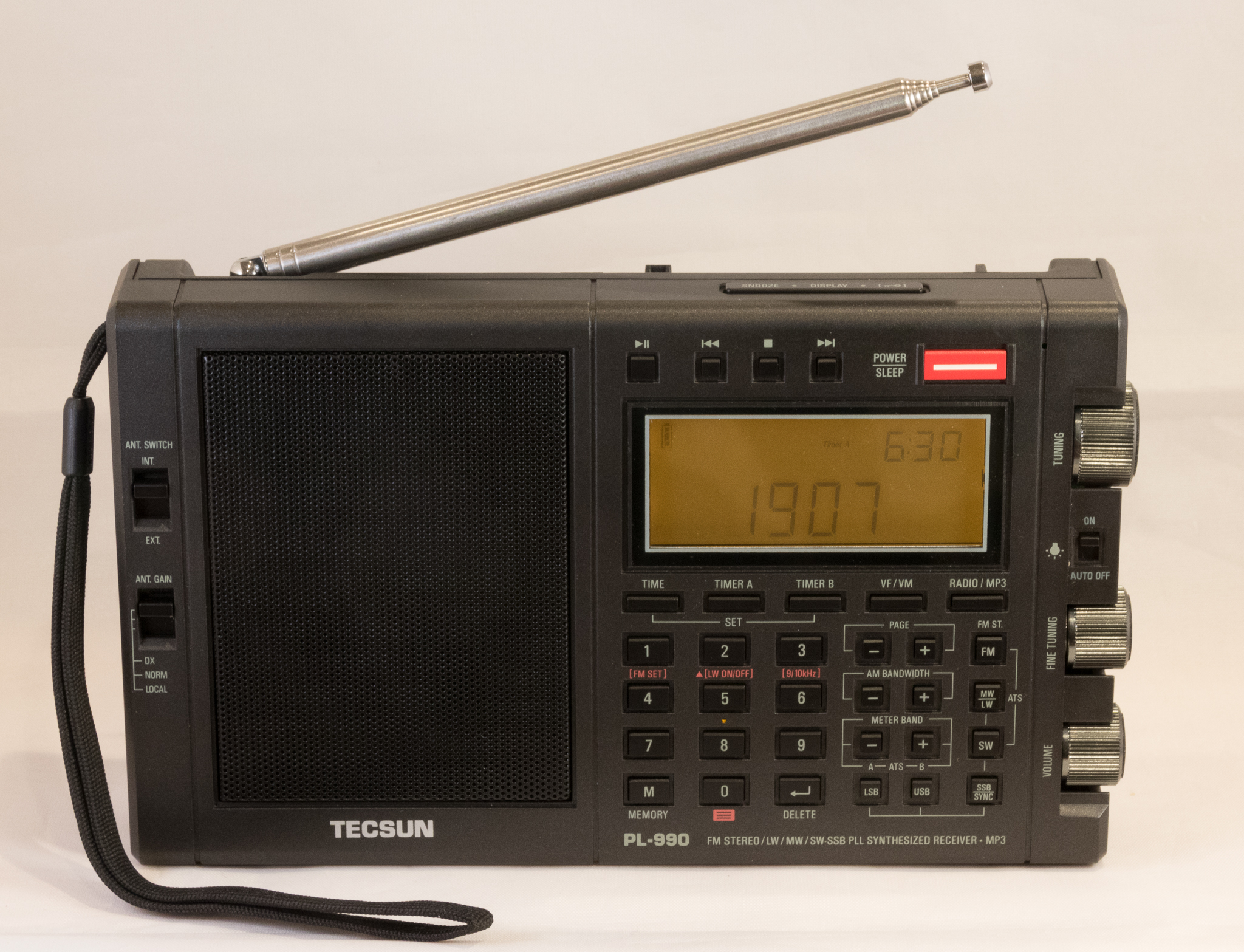
It’s a very satisfying radio to operate with explicit controls for things like switching to the external antenna jack and a separate fine tuning knob. The speaker quality is sublime. If it only had a Mute button.😔
Check out my review here: Review: Tecsun PL-990 Shortwave Receiver.
Comparison
It wouldn’t be Blog or Die! without a big table of some sort, so let’s start with a feature matrix:
| Feature | ATS-909 | G4000A | PL-660 | PL-990 | KA1100 |
|---|---|---|---|---|---|
| LW (kHz) | 153 – 519 | 144-353 | 100 – 519 | 100 – 519 | n/a |
| MW (kHz) | 520 – 1710 | 520 – 1710 | 520 – 1710 | 520 – 1710 | 520 – 1710 |
| SW (MHz) | 1.711 – 29.999 | 1.6 – 30 | 1.711 – 30 | 1.711 – 29.999 | 3 – 26.1 |
| SSB | USB/LSB | SSB | USB/LSB | DSP USB/LSB | N |
| SSB step | 40 Hz | cont. | cont. | 10 Hz | n/a |
| SYNC Detection | N | N | Y | Y | N |
| FML | N | N | 76 – 108 | 64 – 108 | 70 – 95.5 |
| FM | 87.5 – 108 | 87.5 – 108 | 87 – 108 | 87.5 – 108 | 87 – 108 |
| FM RDS | Y | N | N | N | N |
| AIR (MHz) | n/a | n/a | 118 – 137 | n/a | n/a |
| AM Bandwidths | 6.5 / 4 (Wide / Narrow) | Wide / Nar | Wide / Nar | 2.3, 3.5, 5, 6 | Wide/Nar |
| SSB Bandwidths | ? | ? | ? | 0.5, 1.2, 2.3, 3, 4 | n/a |
| Presets | 307 | 40 | 2000 | 3150 | 50 |
| ATS | Y | N | Y | Y | N |
| Paged Memory | Y | N | Y | Y | N |
| Scan | Y | Y | Y | Y | Y |
| Tuning Knob | Y | N | Y | Y | N |
| Fine Tuning Knob | SSB only | SSB only | N | Y | N |
| SW Step (kHz) | 1 / 5 | 1 / 5 | 1 / 5 | 1 / 5 | 1 / 5 |
| DX/Local switch | RF Gain | Y | Y | Y | Y |
| Ext. Antenna jack | SW | SW | Y | SW / MW / LW FM | SW / FM |
| Dual Timezone | Y | N | N | N | N |
| Alarms | 3 | 2 | 2 | 2 | 1 |
| Tone control | Y | Y | Y | Y | Y |
| Mute button | N | N | N | N | N |
| Line Out | Y | N | N | Y | Y |
| Batteries | 4 AA | 6 AA | 4 AA | 18650 | 3 AA |
| Charges Batteries | N | N | Y | Y | Y |
| Antenna (in.) | 44 | 37 | 35 | 34.5 | 29 |
| Size (in.) | 8.25 x 5 x 1.5 | 7.8 x 4.75 x 1.5 | 7.4 x 4.5 x 1.3 | 7.8 x 4.7 x 1.5 | 5.4 x 3.3 x 1.1 |
A note on chuffing from my friendly AI:
🤖Although PLL radios tune in discrete frequency steps rather than continuously, they do so without the muting or “chuffing” artifacts common in DSP-tuned designs. This is because the PLL (Phase-Locked Loop) synthesizer directly controls the local oscillator, allowing the radio to shift frequencies almost instantaneously. The analog signal path remains uninterrupted during tuning, so there’s no need to reinitialize filters or demodulation routines. In contrast, DSP-tuned radios often mute briefly between steps as their internal processing reconfigures, leading to a less fluid experience.
That is, DSP radios chuff or mute because of the time it takes for them to change frequencies, not because they tune in discrete steps. The Tecsun PL-990 only uses DSP for signal decoding, so it doesn’t have to reconfigure when the radio is tuned. It’s always tuned to the IF frequency of 455 kHz. The ATS-909 does mute; its tuning knob has detents and there is a noticeable break in the sound as it goes from frequency to frequency. This muting is likely intentional to block any unpleasant sounds that might occur as the PLL locks on.
Performance
This post focuses on shortwave, but the MW/FM station counts are included here for reference. The Sangean and the Grundig exhibited superior performance on MW. The Kaito and the two Tecsuns excelled on FM.
AM With External Antenna
I did some reception tests in various situations, first an early morning test with the radios receiving CFRX in Toronto. It started at 6:53 AM local time here in central Virginia (1053 UTC). I used my WOW antenna (Wire Out Window – 40 feet). The WOW is fairly noisy.
I went out around 12:00 UTC outdoors with the 20-ft wire up a tree (WUP) antenna and recorded several signals, starting with this nice signal from Radio New Zealand on 7425 kHz.
Here is a not-so-nice signal from China on 6030 kHz:
And a nice one from CFRX, Toronto on 6070 kHz:
And finally some music from Radio Rebelde, Cuba on 5125 kHz.
While the speakers were very different, there was not a great deal of difference in reception.
Selectivity settings
The all-analog radios offer basically a wide/narrow option and only on the ATS-909 to we know what those stand for: 6.5 / 4 kHz. DSP chips simplify bandwidth options, and the PL-990 has 2.3, 3.5, 5, 6 kHz bandwidth for AM and 0.5, 1.2, 2.3, 3, 4 kHz for SSB.
SSB
I wrote about SSB in more detail in my article SSB! The PL-660 is the only radio in the current test group listed in that article. While similar in architecture, the PL-990 is supposedly better on SSB than the PL-880 tested before. The G4000A appears not to have a setting for LSB/USB; there’s no control and nothing in the manual about a setting. In this configuration, one tunes to the center frequency and uses the BFO in different directions until a good signal is received.
SSB and I do not get on very well. I put my inability to tune SSB down to lack of practice, but the radios seem to get in my way and the experience is often frustrating. In the morning I went out early and found strong ham radio traffic on the 75 meter band. I presumed correctly the signal on 3945 kHz would be lower sideband (LSB). I spent half an hour and didn’t get any video worth sharing. It helps to know the frequency before you start and to have a radio with dead-on frequency calibration.
The G4000A manual has a length section on SSB, beginning with this caveat:
Receiving SSB signals is not always easy. Since this is two-way communication, transmissions are often very short and sporadic. Also, most two-way communication uses relatively low power, 50 to1000 watts. The amateur radio operators are easiest to find; the others can be very difficult.
The preceding text was copied almost word for word from the Tecsun PL-600 manual from Tecsun Australia.
I’ve always found SSB on the PL-660 easier to tune than other radios. I think it is because a turn of the BFO knob sweeps more frequencies and it’s easier to zero in on the signal. When a radio like the PL-990 (or the PL-330) tunes with their 10 Hz steps, it takes lots of turns and one can get lost. The ATS-909 compromises with 40 Hz steps, and of course the KA1101 doesn’t support SSB reception.
I took the 4 SSB-capable models outdoors and connected the WUT antenna. I found some hams conversing on the 40m band in 7230 kHz LSB.
Pro tip: If you just can’t get it tuned in no matter how hard you try, switch to the other sideband. 😳
Audio
None of these radios has a Mute button, making side-by-side audio comparisons less convenient. The PL-990 has a play/pause button that would work perfectly for a mute, but it only works with MP3. I’m not going to make additional audio reception videos, but the PL-990 audio will be featured in a future article.
Convenience
I like a radio with minimal button presses to direct-enter a frequency. The Sangean, Grundig and Kaito models require prefixing with a key and possibly suffixing. The Tecsuns let you just enter the frequency — that might seem more convenient, but the Tecsun radios (including the PL-330) seem to fail if the buttons are pressed quickly. I have to enter frequencies really slow to avoid an ERROR. I think one needs to pause after the first digit, but in any case it’s very aggravating.
Difficult to read controls on the side of the ATS-901 are a negative; it could also use more labels to explain what some of the buttons do. One would never know the radio had SSB without the manual.
Conclusion
There doesn’t seem to be any good reason to get a radio with double superheterodyne phase locked loop technology these days. The modern DSP radios do everything, and add capabilities like more bandwidth options. Comparing individual PLL radios and DSP radios, one may find a better display, a better speaker or more convenient controls, but as far as getting stations, modern radios fill the need.
I personally can’t stand the AGC-related audio distortion in SSB mode that all si473x based radios suffer from (some more, some less). This is usually not mentioned in reviews or comparisons so I guess that most people don’t find this very annoying but I do 🙂 It’s actually very tiring over longer periods of time. For a portable small radio with SSB, I prefer the Belka DX because if its clean SSB audio, multiple bandwidths, sharp filters and high frequency accuracy. But if I would not have a Belka DX, I would rather use a Sony ICF-7600GR for SSB than any of the si473x radios.