Music 4 Joy is a broadcast carried by a commercial station in Nauen, Germany, that consists of an hour of what some have called “techno” music with no announcements. It’s like random notes accompanied by a drum machine. The audio appears to be the same repetitive pattern, perhaps with small variations, on each of the 8 weekly appearances.
The broadcasts are Tuesday and Thursday only (times UTC):
- 13:00-14:00 – 17670 kHz to Far East
- 18:00-19:00 – 11790 kHz to East Africa
- 18:30-19:30 – 9755 kHz to the Middle East
- 20:00-21:00 – 9800 Khz to West Africa
My interest comes from the challenge of receiving a station that’s unusual and one that’s not broadcasting in my direction.
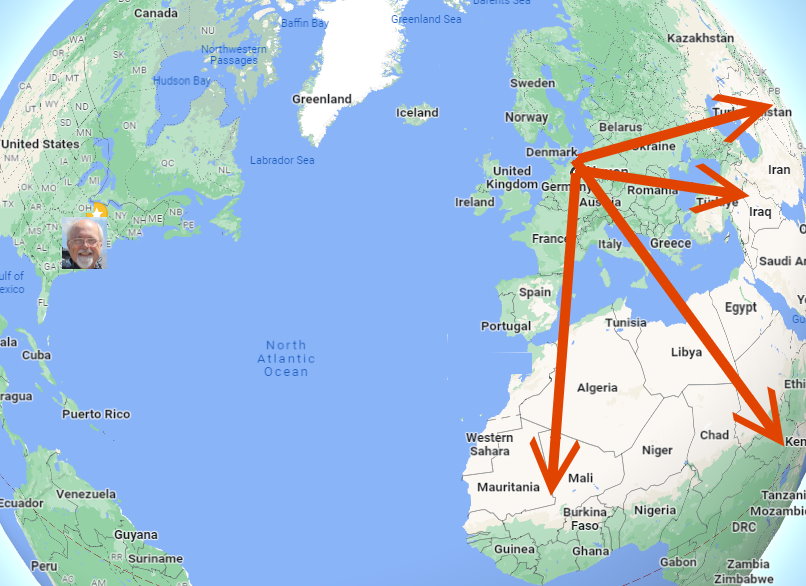
It took 12 tries over 3 days for me to finally hear the broadcast, one to West Africa on 9800 kHz. I found the experience interesting, and the final capture exciting. I shot a video from the broadcast (much of the rest of the time the signal was poorer).
[For a much better recording, skip to the end of this article.]
There were several interesting offshoots from the exercise. First, I got to compare the sensitivity of four of my “good radios,” the Tecsun PL-660, PL-330, XHDATA D-808 and Eton Elite Executive (this was before my PL-880 arrived). The PL-660 was the best, but the others worked OK after the signal strengthened. The radios were outdoors where I could compare my 2o ft. WUT (wire up tree) antenna to an indoor radio connected to an outdoors MLA-30+. The radios connected to the MLA-30+ didn’t receive the station, which makes me want to examine why that happened. I also tried a 2nd tier radio, the XHDATA D-109, that didn’t get the station at all. I also learned that it’s easier to hear a weak station when you know what to listen for, and learned that a station that’s inaudible at one moment, might just appear later.
I went outside this morning to try to receive the 13:00 UTC broadcast on 17670 kHz. It was there, again faintly, but growing in strength over time. I started with the PL-660, knowing exactly what to listen for. I saw this as an opportunity to rate another radio on this cooperating weak signal, my Tecsun R-9700DX, also a dual conversion analog receiver but with an analog tuning dial instead of a digital readout. Careful tuning located the signal — not as strong as the PL-660 — but still clearly there. The comparison is no surprise since the PL-660 is rated the more sensitive receiver. As a result, my respect for for the R-9700DX has improved a bit. I also tried the XHDATA D-109 one more time and this time I had a bit of success. What I found is that the radio mutes a very weak signal, so if it’s not strong enough there’s nothing, but the signal popped up from time to time.
This is the kind of challenge I enjoy.
Before I received the station myself, I heard it on the Upper Bavarian Forest WebSDR in Germany.
[Update] Best ever reception on June 6 of the Far East broadcast on 17,670. Here it is on the PL-660 and PL-880.
I still continue to monitor this station and it still broadcasts exclusively in DRM with a power of 100 kW, here in Romania lately I have not always been able to catch their station with good signal (That’s why I have to receive their station on remote KiwiSDR receivers somewhere in Finland, Spain, Russia, or somewhere else where there’s excellent signal reception), but I blame it on the HF propagation lately due to strong flares and magnetic storms, every week they change the music, but it seems they started airing reruns from the end of 2023, 2024, and from the beginning of this year, music that is also looped for one hour of broadcasting, and also in the background of some music you can hear something similar to MFSK, it seems like there is hidden encryption in the music or something like that, I also noticed that every time at a different time during the broadcast the music cycle ends, there are a few seconds of silence along with the MFSK and the music cycle starts over again. And they still transmit the same 5 jokes in Journaline, which have absolutely no relation to music, and that Journaline is transmitted in two identical audio streams, what is the point of this is unclear. Overall, it’s a very strange transmission that doesn’t make any sense.
Music 4 Joy DRM frequencies schedule currently in the winter broadcasting season B25:
13650 kHz – 13:00 – 14:00 UTC to Far East
13730 kHz – 18:00 – 19:00 UTC to East Africa
7225 kHz – 18:30 – 19:30 UTC to Middle East
9810 kHz – 20:00 – 21:00 UTC to West Africa
Dzisiaj odbierałem tę stację na 13730kHz i trochę się zdziwiłem i rozczarowałem. Jaki jest cel stacji i jaki jest sens nadawania zapętlonego kilkusekundowego nagrania przez godzinę czasu ? Miałem nadzieję, że to będzie coś na wzór The Disco Palace . Niestety takie czasy, że w systemie DRM nie ma czego słuchać dzisiaj.
Nie potwierdzono publicznie żadnego konkretnego celu transmisji „Music 4 Joy”. Mogę się jedynie domyślać, że służą one do testów.
I tried for their broadcast yesterday and heard this station with continuous music from 20:25 to past 2107 hours on the frequency of 9800 kHz.
My question is were does one send a reception report for a verification? And do they verified reports?
Thanks for the catch, I too live too far west to catch their broadcasts with an RTL-SDR dongle, but I’ve managed to catch their digital broadcasts (in the Digital Radio Mondiale standard) via a Kiwi-SDR radio in Spain at 11615 kHz and 13730 kHz. Their digital broadcasts last an hour just like their analog broadcasts but they also include some pictures (sketches as far as I can tell) and five jokes via the Journaline system. I’m not sure what the purpose of the music broadcasts are… they don’t leave any descriptive text.