
Welcome to the conclusion (almost) of a long series of articles about the ZWS-A330, journey from a product that wasn’t available yet, to one received, to one that is as of this writing sold out.
Here’s the history:
- Anticipated Incoming Radio: Zhiwhis ZWS-A330
- Incoming Radio: Zhiwhis ZWS-A330
- First Impressions: Zhiwhis ZWS-A330
- My Amazon review
- Product Review: Zhiwhis ZWS-A330 — Part 1, Features
This post covers actual testing and presents my summary evaluation.
Coming soon will be a test of the ZWS-A330/W3 repeater in comparison with the RD-239S/W2 repeater. That should be interesting.
Reception: The Bands
FM
FM was solid, receiving 80 stations on the midday band scan. That’s on par with a Tecsun PL-990. Comparative Results appear below under MW.
About the only thing I’d wish to be different is an option for a 200 kHz step to match Region 2.
MW
MW is weak here. I don’t expect much from little radios and the A330 brought no surprises. I tested it with the supplied MW ferrite rod antenna, that made a marginal improvement. Making a generous interpretation of results, my daytime band scan returned 9 stations. There was one bad birdie on 550 kHz. Note: the birdie sometimes is not present.
Here are the band scan results for FM and MW:
SW
I ran an ATS scan indoors using the telescopic antenna — fairly noisy environment. The scan took just over 11 minutes, not bad for a radio that scans the entire range between 2.3 and 30 MHz.
My first shortwave outing was to the patio where electrical noise is much lower. The target station was my mainstay, CFRX in Toronto, Canada on 6070 kHz. With me were the A330, Qodosen DX-286, Raddy RF760 and LiJiANi RD-239S (without repeater). I hand held the radios and waved the telescopic antennas around for best reception.
The immediate result was that the RF760 was far below the others, so far that I’m eliminating it from further testing. The following video shows what the radios sounded like.
I picked a group of shortwave radios to compare, and headed outside to test them. The location was a small nearby park and the time was just after 8am local time (1200 UTC). I used a Sangean ANT-60 reel antenna clipped to a tree limb.
The radios selected for the test were:
- Zhiwhis ZWS-A330
- LiJiANi RD-239S
- Qodosen DX-286
- Tecsun PL-330
I picked the DX-286 both because it was an outstanding performer and because it has the fastest and most accurate ATS scan. The PL-330 is of course a widely owned radio among shortwave listeners and a fine performer. The third comparison unit was the LiJiANi RD-239S because it is similar to the ZWS-A330 in wide band coverage and its repeater option. The repeaters were not used in this test.
Following is a video of the radios as I fumbled to keep them upright on the picnic table — the PL-330 and the ZWS-A330 having no kick stands. Note that in the earlier tests, the RD-239S audio equalization was set to something other than the neutral E0 setting, resulting in more high frequency hiss than normal. This was corrected.
What I found was the A330 and the RD-239S were similar in performance and the the PL-330 and DX-286 were a class above, receiving stations simply not present on the others.
SSB
SSB reception is fairly straightforward. It only works on the shortwave band (and not on CB). Operation is simple:
- Tune the Station
- Tap the Demod button to cycle: AM/ LSB / USB
- Tap the BFO button to display the BFO offset value, +/-100
- Rotate the Shuttle (fine tuning wheel) to clarify
Radios that are easy to use are the ones with accurate calibration; ones with poor calibration can take a very long time to clarify.
Ham radio and aviation weather stations provide good signals for testing. In addition, pirate radio stations often use SSB around 6900 kHz. There is one international broadcaster on SSB, WJHR in Milton Florida on 15550 kHz.
I went outdoors with the A330 connected to a Sangean ANT-60 reel antenna tied to a tree branch around 8am local time (1200 UTC) and came across an amateur radio group that called itself the North Carolina Net. One of the members identified himself as being in Mt. Pleasant that’s in the Charlottesville area and technically in South Carolina.
Clarification was easy, suggesting good calibration on 3927 kHz LSB. The sound was good. My only complaint is that the BFO fine tuning automatically closes after a few seconds of unuse and I found myself accidentally tuning off the station when I was trying to clarify. Here’s what it sounded like:
VHF
I cheated testing VHF and just tuned to my local NOAA weather station. That worked.
UHF
UHF was not tested. I live in a rural area, and UHF reception is rare.
AIR
I don’t regularly listen to AIR band. There is a frequency 126.875 MHz that I believe is some sort of hand off frequency. It has traffic most of the day. I selected the band and received some aviation traffic. Because transmissions are intermittent, the squelch feature is welcome. After some testing, I found the L3 squelch setting worked well, muting the radio until there was an actual transmission. There is a small burst of noise when the transmission ends and before the squelch activates, probably the AGC attempting to boost the lost signal.
CB
The CB band on the A330 is actually more than the 11-meter CB band. It covers 25 – 28 MHz. There is actually an 11-meter shortwave broadcast band (with no actual broadcasts anymore) and some fixed mobile mobile services other than CB in that range, but nothing I would expect to receive. The problem with the extended frequency range with basically nothing on it is that it slows down ATS scans. And because the maximum step setting for the band is 5 kHz, it scans twice as many stations as needed to catch CB transmissions. That is, the band is 3 MHz wide, divided by 5 kHz gives 6000 stations to test when there are only 40 CB channels and 6 obsolete radio control channels.
I think the best strategy is to tune to CB Channel 1 (26965 kHz), set the STEP to 5 kHz and long press the up tuning arrow to search for the next station. After reaching Channel 40 (27405), just scan back down. I don’t get much CB during the day, but around sundown, the skip signals start rolling in. This video was made with the repeater connected, but it’s an idea of what there is on the CB band.
WB
As far as receiving is concerned, A330 weather band works fine. I always get my local station, KZZ28 on a weather radio and then possibly other stations that are at or just over the horizon via tropospheric tunneling. My A330 test returned 4 stations which is top tier.
I’ve been limited in my ability to test weather alerts because NOAA only tests here on Wednesdays at 11am and I’m not always available then. I have some cheap signal generators, but none of them can generate a 162 MHz FM signal modulated by a 1050 Hz tone.
So I tried something. I have an XHDATA E-100 walkie talkie, perfectly capable of all manner of wildly illegal things, including transmitting on the NOAA weather band. I have half a dozen dummy loads with F connectors and I found an F to SMA adapter too. All that’s necessary is to play a 1050Hz audio file next to the walkie talkie and key the transmit button. A little leakage should be enough. To make matters even easier, Wikimedia Commons has an official NOAA alert audio file.
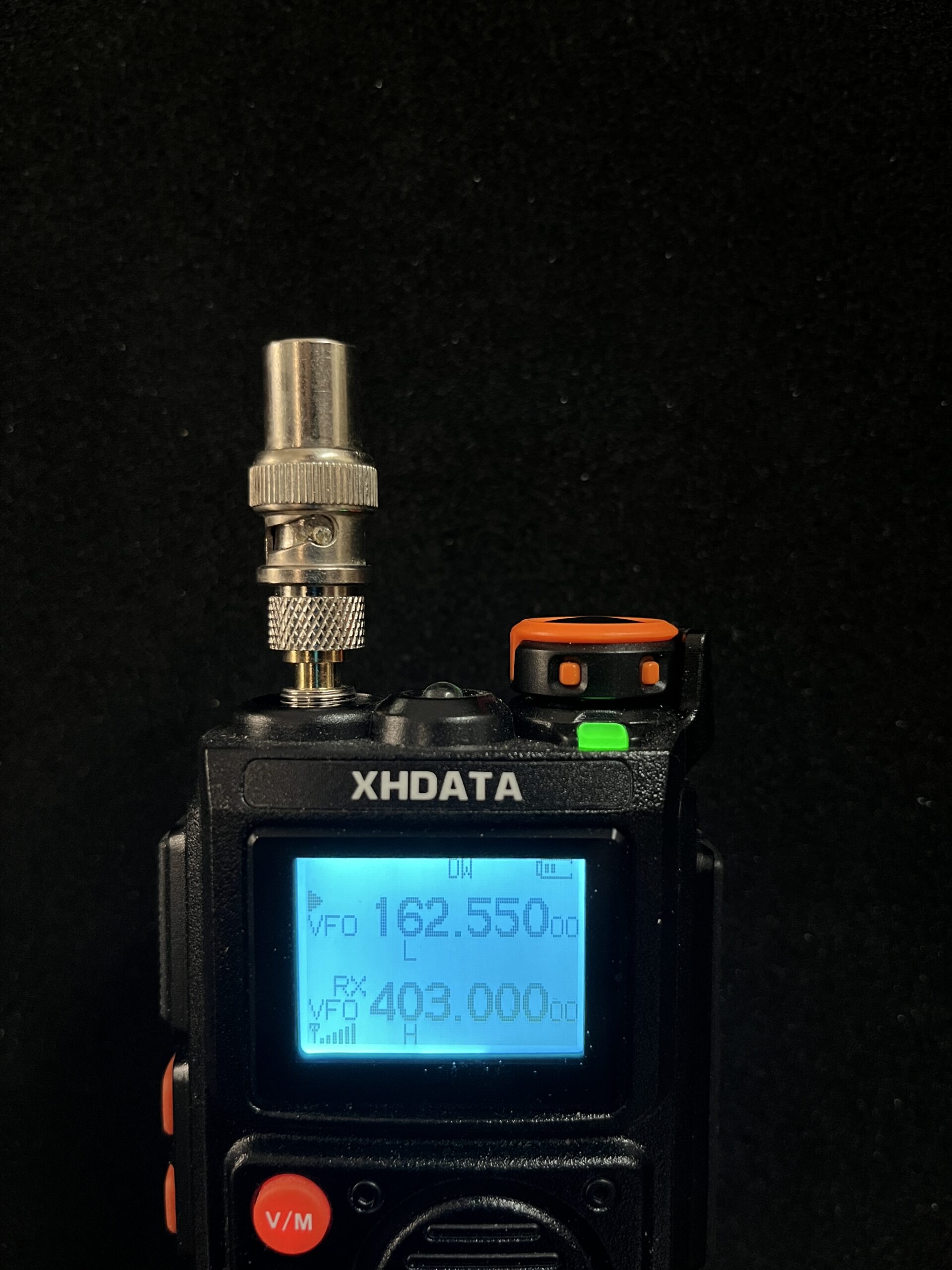
The test worked and now I now know what happens. The radio stops scanning and the weather band station starts playing (this test was done with the W3 repeater in use). It’s basically the same behavior as when an ATS scan ends on one of the another bands.
Receiver Features
Step and tuning
There are at least 7 tuning methods. The obvious one is the numeric keypad, what I use most. Press the “F” key, followed by the frequency, followed by the “F” again — except when the “F” is not required.😲
The Tuning buttons on the side of the radio have 3 functions. Simply pressing an up or down button raises or lowers the frequency one step. Pressing the button and holding for a couple of seconds starts a scan for the next received station. When in Preset mode, these buttons scroll through saved memory locations.
The [Band/ATS] button scans the entire band for stations and stores frequencies in memory — up to 200 per band.
Sub bands are simply frequencies within a band that the radio will point to when the [SUB] key is repeatedly pressed. On shortwave one gets the recognized meter band start frequencies for broadcast frequencies, but not ham. The feature works on SW, AIR, VHF and UHF. The specific frequencies are detailed in Section 12.14 of the user manual.
Then there is a “fine tuning” knob that the manual calls a “Shuttle” that can be rotated to advance/decrease the frequency by a set amount. When the knob is rotated, one digit (probably the rightmost) will start to flash, indicating which digit will change when the knob is rotated. When the [STEP] button is pressed while a digit is flashing, the flashing moves one digit to the left. I found the knob rather stuff to turn, but usable. I’ll call this a variable step control.
Other step values are set by pressing the [STEP] button. See section 12.2 in the manual for the list of values available on each and. On Shortwave, they are 1 and 5 kHz. It’s a shame that there is no 10 kHz step on CB, since that is the normal separation on this band.
Squelch
Squelch mutes the receiver when no station or just a weak station is tuned. There are 9 sensitivity levels. Squelch is particularly useful on the AIR band, since it is AM and has lots of noise between transmissions.
Bandwidth
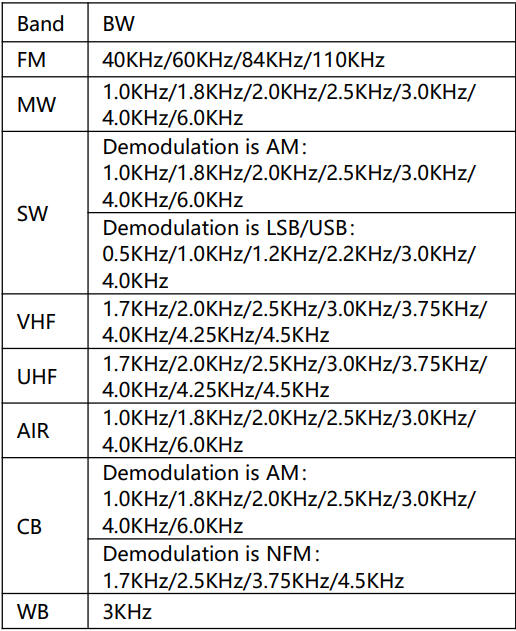
The A330 takes a move into serious receiver territory by providing extensive bandwidth options. Bandwidths are set by repeated presses of the [BW] button. Here is the list excerpted from the manual.
Attenuation
A Local/DX switch is available to mitigate distortion from strong local signals. It’s controlled by the ATT button.
Antennas
The A330 comes with a small external ferrite rod antenna, that I believe is the same thing sold separately by Zhiwhis as the “T10.” [Thanks to commenter for that info.] It provides only a marginable improvement. When the ferrite antenna is used, the radio has to be switched to use it. I would recommend removing the rod antenna when not in use because it seems to pick up interference at some angles and sometimes injects it into MW reception when the internal antenna is selected.
There is of course a 36cm telescopic antenna and a 3.5mm external antenna jack that can support one of the popular reel antennas or something of your own design. Plugging in the antenna automatically selects it on all bands except MW.
Little things
Many options are set with the single press of a button, a button that does double duty with frequency entry. If a mistake is made entering a frequency, it is quite easy to change a string of options unaware, and because the options display is so tiny, an unwanted option might persist without the user being aware.
Music Play Functions
Music play features are in line with other products. The A330 supports a TF/MicroSD card up to 256 GB in capacity and music formats MP3, WMA, WAV, APE and FLAC.
I will just say that the speaker sounds good. There is no booming bass, but it can be turned out very loud. There are also equalization profiles (Normal, Pop, Rock, Jazz, Country, Classical) for various types of music, selectable from the [EQ] button. Listening to the stereo effect requires headphones.
Recording
I have several radios that record and I rarely use the feature, rather relying on my iPhone camera and microphone. I do that because the phone notes the date and time, plus I can read the frequency from the video image. This way I don’t have to take notes. It eats up lots of storage. But that’s changing.
Four recently-obtained radios (Zhiwhis ZWS-802, Zhiwhis ZWS-A330, LiJiANi RD-239S and MAHALIT MLite-880) store time, date, frequency and demodulation mode in the media card’s file directory. It’s visible when the card is plugged into a computer and visible in the app when the radio plays the file.
Computer Stuff
When a USB cable is connected between the radio and a computer, the computer can display files on the TF card and play them. The A330 can act as a USB speaker for the computer. It also acts as a Bluetooth speaker for your computer, TV or phone.
Conclusions
Overall this is a competent radio. A great many things make sense. It receives well and shares the benefit of app support. It has good audio. I has just about everything but a flashlight, with coverage up to 999 MHz. It will fit in a shirt pocket, albeit bulging over the top.
I didn’t think the CB band was well thought out. The display is tiny and hard to read in some lighting conditions.
I got mine for just over $70 with coupon and I think it’s worth that. There are better shortwave radios, but this one earned its niche.
If you just want a great MW, FM, SW radio then get a DX-286. If you need SSB too, look at a PL-330. If you want something that’s fun to carry around that covers just about every frequency, then you might consider the ZZWS-A330.
Coming Soon
I’ve already purchased the Zhiwhis ZWS-A330/W3 repeater and I will be testing this alongside my LiJiANi RD-239S/W2 repeater to see how those compare. The W2 repeater adds LW and SSB to the RD-239S, and the W3 repeater adds LW to the ZWS-A330.
What may not be coming soon is your ZWS-A330. A week after it went on sale, it’s out of stock.