
Introduction
I was excited about this one — my old friend LiJiANi Rd239, now with SSB. While that’s true, there is more going on. In addition to to SSB, there is app control, bandwidth settings and a new UHF band.
Check out First Impressions: LiJiANi RD-239S + W2 Repeater for the shipping box and contents. One might want to look at my review and comparisons of the original Rd239 later:
- LiJiANi Rd239: A different radio
- XHDATA D-109WB vs LiJiANi Rd239 Multiband Receivers
- Qodosen DX-286 vs LiJiANi Rd239
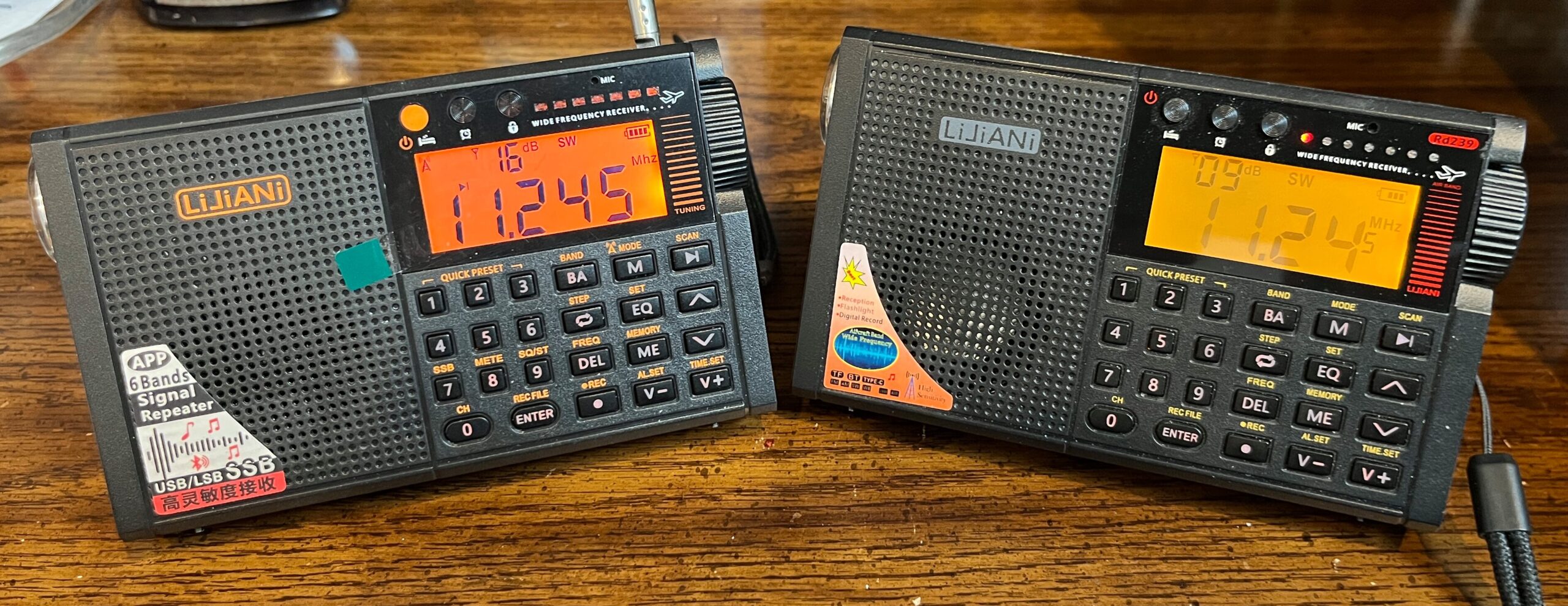
The sharper display on the RD-239S in the photo is observable in person; it’s not a photo artifact. Note the additional frequency display digit. The number of digits is the same on both displays, but the trailing “5” is shown as a small digit on the older model. In both the buttons are illuminated, although not obvious in this well-lit photo. Note: the Rd239 power off is a long-press of the power button, while the RD-239S accepts a short press. The orange power button on the 239S is lighted when the radio is on, even of the display and button illumination is off,
North American users will want to set the FM band to start at “87” so the radio will operate according to Region 2. One early setting I made was to set the display light timer to something longer than 5 seconds. With the radio in “clock state” (that no man’s land between ON and OFF), long press the [SET] button to show “BL” (backlight) plus a number of seconds. Repeatedly press the button until you get a number you like, up to 30 seconds.
Features
A lot can be gathered from the display diagram in the manual.
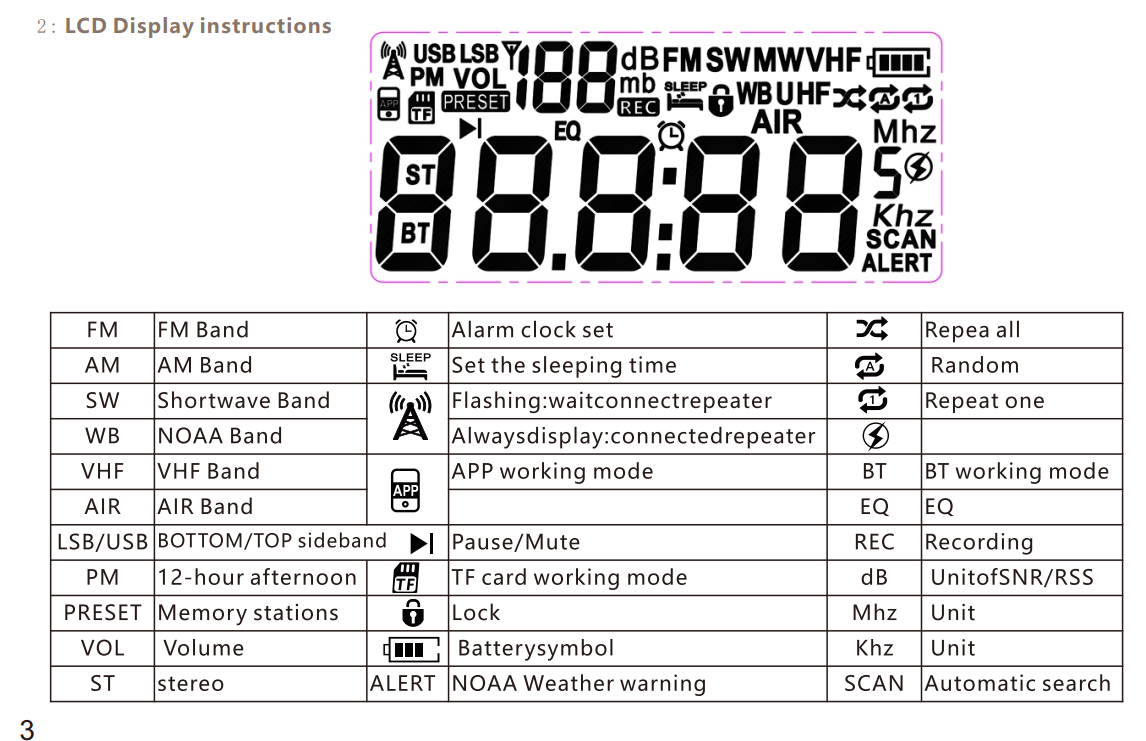
While the USB band is shown in the schematic, it’s omitted from the description underneath.
The chart (Section 2 of the manual) shows digits followed by “dB” as “Unit of SNR/RSS”. What is shown is the Relative Signal Strength Indicator (RSSI). It represents the total RF power at the radio’s front end. It includes the desired signal, interference and noise. When the W2 is active, SNR is viewable in the app.
A review wouldn’t be true Blog or Die! without some big feature chart, so here it is:
| Feature | RD-239S | RD-239 | PL-330 |
|---|---|---|---|
| LW (kHz) | n/a | n/a | 153-513 |
| MW (kHz) | 520 – 1710 | 520 – 1710 | 520 – 1710 |
| SW (MHz) | 3.2 – 30 | 3.2 – 29.99 | 1.711 – 29.99 |
| SSB | USB/LSB | USB / LSB | USB/LSB |
| SSB step | 1 kHz1 | n/a | 40 Hz |
| SYNC Detection | N | N | Y |
| FM | 64 – 108 | 64 – 108 | 64 – 108 |
| FM RDS | N | N | nNa |
| AIR (MHz) | 118 – 138 | 118 – 138 | n/a |
| VHF (MHz) | 30 – 200 | 30 – 200 | n/a |
| UHF (MHz) | 200 – 4701 | n/a | n/a |
| Weather | Y | Y | N |
| AM Bandwidths | 1K, 1.8K, 2K, 2.5K-3K, 4K, 6K1 | N | 2.5, 3.5, and 5.0 kHz |
| SSB Bandwidths | 0.5K, 1K, 1.2K, 2.2K, 3K, 4K1 | n/a | 0.5, 1.2, 2.2, 3.0 and 4.0 kHz |
| Presets | 1230 | 504 | 850+ETM |
| ATS | Y | Y | Y |
| Paged Memory | N | N | Y |
| Scan | Y | Y | Y |
| Tuning Knob | Y | Y | Y |
| Fine Tuning Knob | SSB only | n/a | SSB only |
| SW Step (kHz) | 5 (1 for SSB) | 5 | 1 / 5 |
| Squelch | AIR/VHF W2 only | Air , and off/on only | N |
| DX/Local switch | N | N | N |
| Ext. Antenna jack | Y | Y | Y |
| Dual Timezone | N | N | N |
| Alarms | Y | Y | Y |
| Tone control | Equalization | Eq. | n/a |
| Mute button | Y | Y | N |
| Line Out | N | N | N |
| Batteries | BL-5C 3 AAA | BL-5C 3 AAA | BL-5C |
| Charges Batteries | Y | Y | Y |
| Antenna (mm) | 60 | 37 | 35 |
| Size (mm) | 138 x 85 x 28 mm | 138 x 85 x 28 mm | 139 x 85 x 26 mm |
| Bluetooth | Y | Y | N |
| MicroSD play | Y | Y | N |
| Aux. In | Y | Y | N |
| Computer Speaker | Y | Y | N |
| Computer Access TF Card | Y | Y | N |
| Record | BT, Mic, Radio | BT, Mic, Radio | n/a |
| App control | Radio-C/Radio-CT | Radio-C/Radio-CT | n/a |
| Flashlight | Y | Y | N |
| Reading light | Y | Y | N |
| Control back backlight | Y | Y | N |
| Kickstand | Y | Y | N |
1 Requires W2 Repeater
Without the W2 Repeater
Without the W2 Repeater, the RD-239S isn’t much different from the former Rd239, but with the significant addition of app control from the Radio-C/Radio-CT apps. The app provides for remote operation, viewing the firmware revision, direct frequency entry, display of the playing music file name and duplication of many features on the physical radio. What the app cannot do is let you listen to the radio on your phone.
The display of shortwave is different. A frequency of 11.215 MHz would appear 11.215 on the Rd239 and 11.215 on the RD-239S.
With the W2 Repeater
The W2 Repeater is essentially a separate radio, remote controlled by the RD-239S. It has its own antenna and DSP chip (an Si4735), communicating back to the RD-239S via Bluetooth. In this mode of operation, the RD-239S is a remote control and also a Bluetooth speaker for the repeater.
The Bluetooth antenna is lower-left.
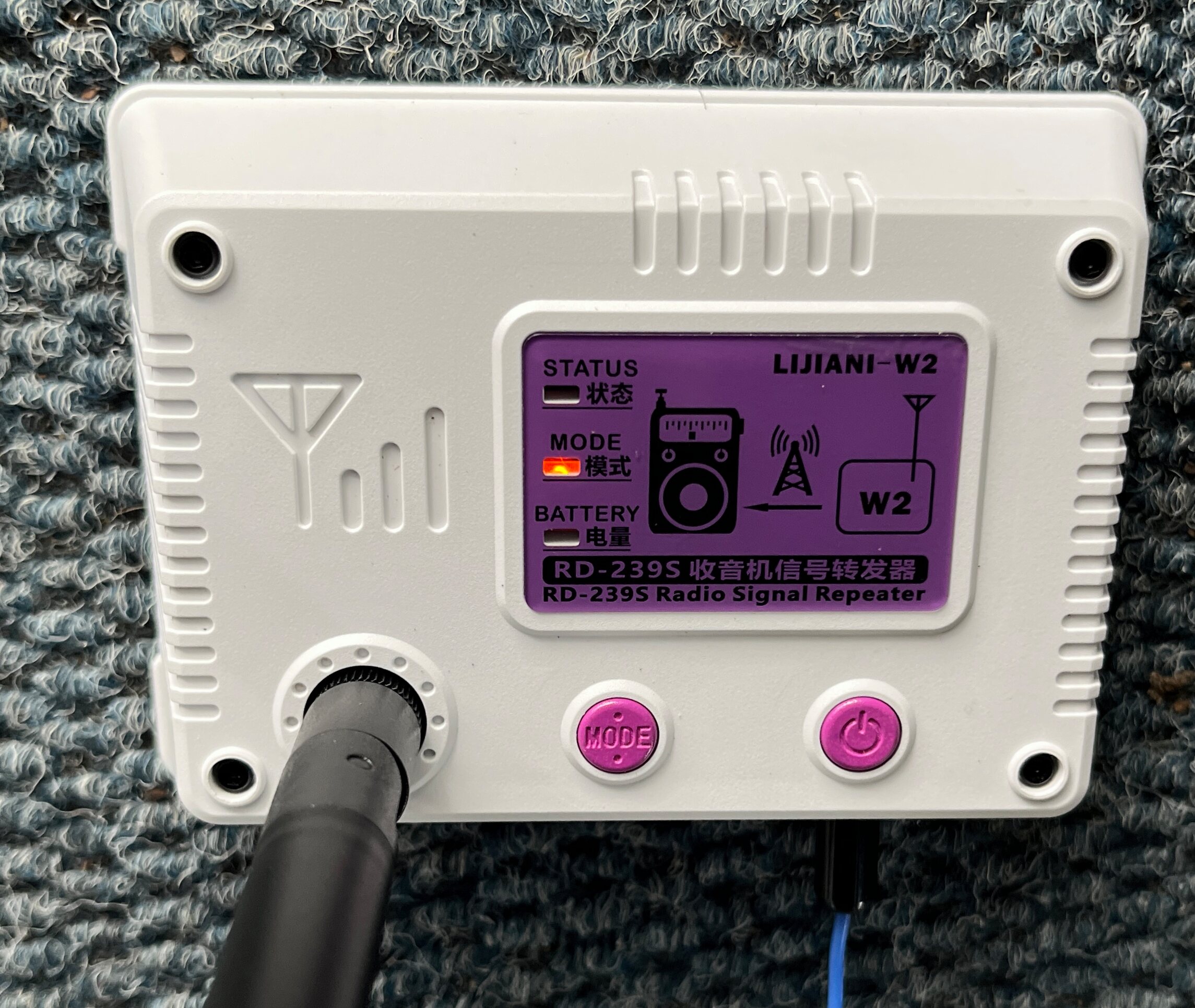
It’s powered by two 18650 batteries (the supplied ones are labeled with a 3500 mAh capacity). It can alternately be powered by 3 AA batteries if necessary, but they do not last as long.
The W2 has two modes, an off/on mode and a “Status” mode. It appears that the former mode turns the repeater off 1 minute after the radio disconnects, and the Status mode wakes up periodically for one minute to see if there is a connection request. As time passes the delay between wake-ups increases from 1 minute eventually (in a little over 6 hours) to 20 minutes. In practice, no one is going to wait 20 minutes for their radio to come on. Even waiting one minute is not what one is used to when turning on a device. In practice, I just go outside and press the power button. However, if one does choose to wait for a connection, there is a helpful trick; after turning on the radio, press the >| mute button; when the radio connects to the repeater, it will unmute and you’ll hear the signal to let you know.
The repeater enables additional features in the RD-239S:
- SSB
- 1 kHz tuning step (for SSB mode only)
- UHF band
- Bandwidth settings
- Squelch (AIR/VHF bands only)
These are the bandwidth settings from the manual:
FM bandwidth: 40K-60K-84K-110K; AM/SW (AM demodulation) / AIR bandwidth support: 1K-1.8K-2K-2.5K-3K-4K-6K; VHF bandwidth support: 1.7K-2K-2.5K-3K-3.75K-4K-4.5K;USB/LSB bandwidth support: 0.5K-1K-1.2K-2.2K-3K-4K.
The supplied W2 repeater manual is English on one side and Chinese on the other. Much of it is very similar to the Zhiwhis W3 manual, including the repeated misspelling of “seconds” in the wake-up time delay table. The manual needs work:
Short press the [MODE] button,turn on the signal repeater,afer turn on the signal repeater,long press [MODE] button,enter to Mode status, it is Automatic Wake-Up Mode. …
If the 239S radio is connected, the signal repeater will enter a low-power mode.
More likely, it’s a disconnect that triggers low-power mode.
It’s a Radio
I can rave about how bright the flashlight is and the unit’s ability to record from Bluetooth, but we’re really talking about a radio here. And frankly, I’m a shortwave listener. That biases what I look for.
At the outset let me state that I had a poor outcome with another repeater radio, the Zhiwhis ZWS-802 + W3 repeater. The W3 repeater just didn’t do anything useful on MW or FM — MW was non-existent and FM only got half the stations it should have gotten and it overloaded badly. (Other bands seemed OK.) I had some trepidation starting this round of testing of a another radio with a repeater, but I was pleasantly surprised.
So what do I value and how does the RD-239S measure up?
- Sensitivity: Reasonable
- Minimal internal noise: Good
- Convenient frequency entry: This radio has direct frequency, but it does require a prefix key, so it half meets the criterion. Better examples are the Tecsun PL-330 and Qodosen DX-286.
- Readable display both in light and dark conditions: I give this one a high grade, especially because of lighted buttons: It’s even better than the older Rd239.
- Buttons that always work: I’ve had zero issues with the buttons.
- Accurate and sensitive ATS: I stores frequencies that are just noise.
- Station search: It has the feature.
- Mute button: It has the feature.
- Rarely needs advanced settings: It meets the criteria. About the only advanced feature that might be used is bandwidth.
- Sufficient volume. There is plenty of volume for personal listening.
- Antenna jack: It has the feature. The jack is on the back.
Operation
ATS scans appear to be destructive, erasing whatever was in the band previously. Even if the manually-entered preset is outside the range of slots stored by the ATS scan, it gets erased. That is, the user can use the ATS feature or the Preset feature, but not both. That’s terrible design and something that might be addressed by a firmware update.
Another radio, the Eton Elite Executive says this in its manual, addressing the intersection of ATS and Presets:
Suggest manual storing frequency into memory from page 00. In FM mode, ATS will store memory from page 99, if the memories locations are available on page 99, ATS will replace already stored memories with new entries.
The strategy is to use one area of presets for user-defined ones and the other area for ATS. The automatic erasure of all presets by ATS defeats this strategy.
6 bands have 199 preset memory locations each, in addition to 6 “quick preset” memories that let the user go to a station on a band with a single button push. I’ll put CFRX in Toronto one for the SW band and a local hand-off frequency on Air band. One thing I do not like about ATS on the SW band is that it covers all the frequencies. This is a problem because it wastes time; outside of the broadcast bands, pirates and time signals, transmissions are brief and chances are the station is not transmitting during that fraction of a second when the radio is listening.
I must say that operation feels odd because it doesn’t matter how or if one holds the radio. The real radio is in the W2 repeater and that’s where the antenna is. It’s a novel experience to just pick up the radio anywhere and use it without thinking. And of course the telescopic antenna is never extended. And there is one more benefit: charging. Many radios recommend not charging while listening because of interference, but here the actual radio is far away.
I found the telescopic antenna thin and difficult to pull out. Silicone spray lubricant didn’t help. I suggest pulling out the antenna for 3 segments and then grasping the lowest exposed part to pull out the rest.
There is one feature that’s not yet in the manual for the RD-239S. In the clock state, a brief press of the STEP button displays the firmware version. In my case 2.05. The app also provides this information under the gear icon, along with the firmware of the W2 Repeater (2.04 for mine).
MW
I don’t get much in the daytime on MW, 2 stations on the cheapest radios and 25 on the best (my vintage Sangean ATS-909). A Tecsun PL-330 gets 12.
The W2 was on my back porch, oriented NE / SW at about 3:45 pm local time. The first station heard, reasonably well, was WSVA in Harrisonburg, VA, about 47.5 miles from me. Then I got 910, WRNL in Richmond, also about 47 miles. Then on for a total of 8. Not bad. Then I did an ATS scan and it picked 10, including some I missed on my manual scan.
I’ll call this decent reception, although not world class like my Sangean.
FM
The first time I turned on FM, I tried an ATS scan. It found 74 stations. That’s not directly comparable with my other radios with a telescopic antenna, while the W2 has a 4m wire. Still it’s impressive. I gave it another go today and the ATS count was 50.
SW
I was watching the OfficialSWLChannel live show this past Saturday when my new RD-230S was delivered. A pirate station on SSB was reported, so I hastily strung out the 4m antenna on the W2 repeater and tuned the station. It wasn’t all that loud, but it it was fairly clear, and perfectly tuned.
Next try was CFRX, a reportedly 1 kW station, in Toronto, Canada. It’s audible during most of the 24-hour day except when the sun is high. A couple of morning attempts received the station, not strong, but there.
Next experiment was an ATS scan around 9AM. The scan stored 62 stations! Were they real? The first one was real — CFRX.
Here’s what I got from my ATS scan around 13:40 UTC (9:40 local)
| Frequency (kHz) | Station | Language | Signal (1-5) |
|---|---|---|---|
| 6070 | CFRZ, Toronto | English | 2-4 |
| 7335 | Radio Marti (USA) | Spanish | 3 |
| 7365 | Radio Marti (USA) | Spanish | 3 |
| 7490 | WBCQ | Ennglish | 3 |
| 9395 | WRMI | English | 3 |
| 9955 | WRMI? | 2 | |
| 10000 | WWV | 3 | |
| 11900 | Reach Beyond Australia | Hindi? | 2 |
| 14920 | China? | Chinese? | 1 |
So out of 62 ATS hits, there were only 9 stations to listen to. That’s why I want ATS to stay in its international broadcast band lane.
I ran another band scan a little after sunset local time, and got 106 stations stored. Here is an audio recording of all the results, including most hiss, some CW and a couple of hams in the 40m band. I couldn’t use the built-in record feature because radio cannot be tuned while a recording is in progress — bummer — so this was recorded with a microphone. An ATS scan on SW takes 13 minutes.
Next morning about an hour after sunrise, 11:00 UTC:
SW SSB
Here’s a ham on 7251 kHz LSB:
The frequency is first tuned to 5 kHz by the tuning knob. Then the up and down arrows tune it to 1 kHz (available on SSB only). Then a brief press of the SSB key brings up the fine tuning display and the tuning knob then sets the digital BFO offset. I think the fine step is 10 Hz.
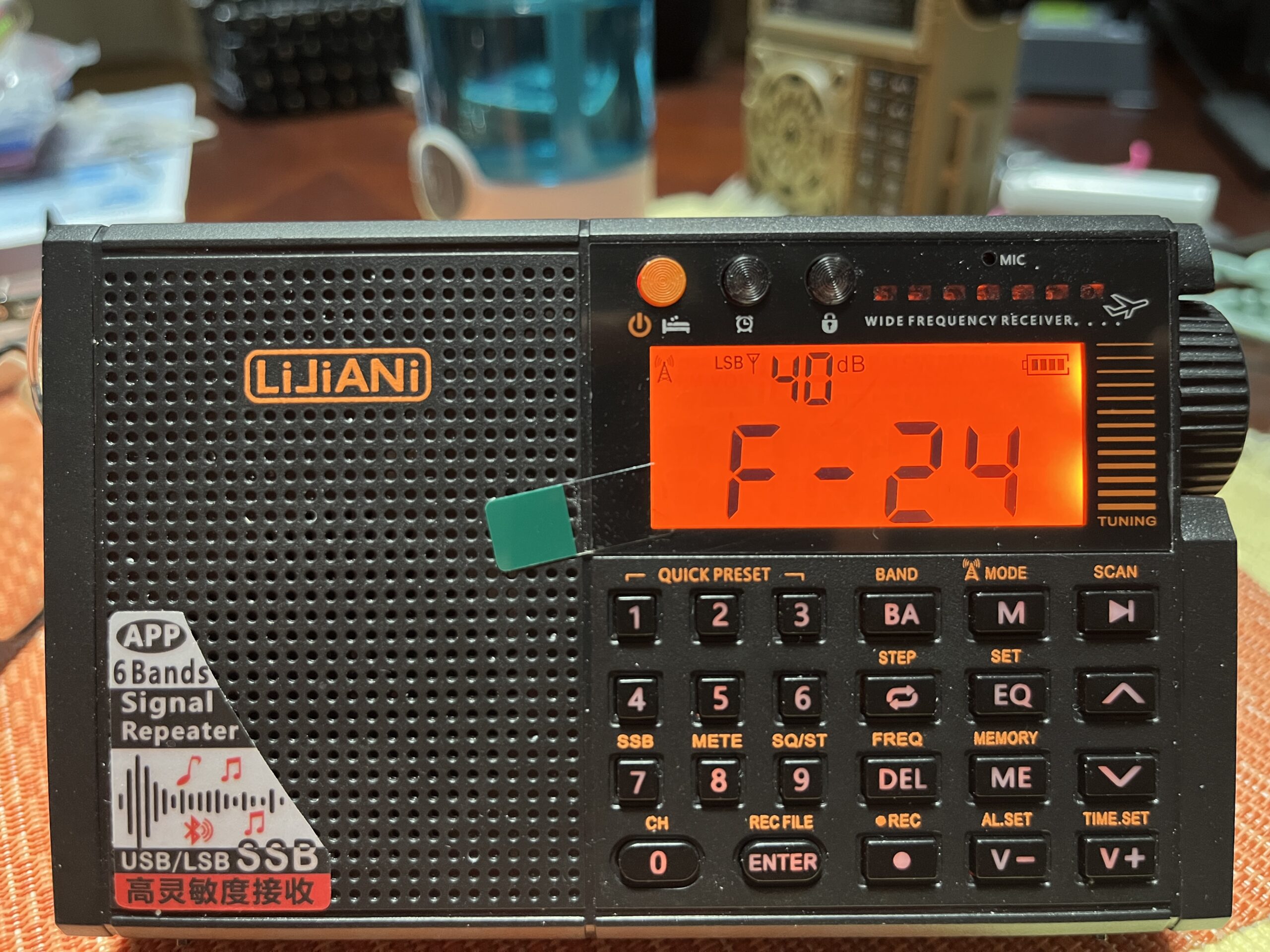
I tuned WHJR in Milton, Florida on 15.555 USB and received it, although the volume was not loud. I had to set the “BFO” to “-38” to clarify it. I’ll add that I’ve found low volume for SSB a common problem in portable radios.
VHF
I ran a band scan and got quite a lot, but it was just the FM broadcast band and weather band.
UHF
I ran a band scan and found only 2 frequencies with tones on them. There are two problems here: first scans are slow and easily miss brief transmissions; second, the wire antenna the repeater uses is really not suited for VHF and UHF frequencies.
Weather
I got my local weather station, KZZ28, well, but no other stations. On a good day (tropospheric tunneling?), but that require moving the radio around for a good location, which I’m not doing with the repeater. Again, the supplied antenna isn’t designed for VHF.
Air
Air band worked, clearly receiving the local route transition frequency I hear on all my air band radios.
Sound
While radio specifications tell you the wattage of the speaker, that’s not a measure of the power that the radio’s electronics can deliver. The speaker number is 5W for the RD-239S (and curiously 3W for the Rd239). It’s not that loud — not weak — just not 3W.
I often tune an FM radio to 89.7, my local public radio music station, and there I found symphonic music and noticed some rather pronounced high frequency reproduction. I didn’t hear deep bass, but holding the case, I definitely felt the low tones. Speech was good. This isn’t a room filling radio, but for little radios, it’s good.
There are equalization settings:
| Mode | Radio | Media / Bluetooth |
|---|---|---|
| E0 | Normal | n/a |
| E1 | Pass 4K | Normal |
| E2 | Pop | Pop |
| E3 | Rock | Rock |
| E4 | Jazz | Jazz |
| E5 | Classical | Classical |
| E6 | Country | Country |
One might try the Pass 4K setting to remove hiss on a shortwave station.
I have my music collection on my PC, so I thought I’d try connecting via Bluetooth from the computer, forewarned that when I do that, the repeater will disconnect. Windows quickly recognized a new RD-239S device and the radio said “connecting.”
I’ll sum up and say that while speech is excellent to listen to on this radio, music lacks presence and depth. I’d never pick this radio to listen to music.
The radio can also be used as a computer speaker when connected with a USB cable, as well as allowing the computer to access files on the media card.
Recording
I don’t typically record on my radios that have the feature, and the main reason is that later on there’s no way to identify the sound segment without keeping written notes. Recently there has been a breakthrough with a couple of models that store frequency and time information in the file directory. One of them is the MLite-880 and the other is the Zhiwhis ZWS-802 + w3 (aka HanRongDa HRD-802). Has HanRongDa put their stamp in this product? Yes, they did:

It looks just like the results from the 802. There’s the date, time, and frequency. The “Date Modified” is garbage, but all the real info is there in the filename. One might wonder about the date, since there is no date setting on this radio; however, I set the time using the app, not the radio setting, and apparently it sends the date too, and the radio saves it.
The App
I have several radios now that use the Radio-CT app. While they have different brand names, all but the RD-239S come from HanRongDa.
- HanRongDa HRD-757
- HanRongDa HRD-908
- LiJiANi RD-239S
- Raddy RF75A (HRD-787)
- Zhiwhis ZWS-C919 (HRD-C919)
- Zhiwhis ZWS-802 (HRD-802)
There are additional supported models that I don’t have, including the HRD-A320 and HRD-802S (an AM/FM radio only).
It’s nice that one can learn the app and then control the radio to a some extent without actually learning the quirks of the radio. It provides a consistent way to find out a radio’s firmware version. It can enable recording in some models with no button for it. It can show the name of a song being played from media, and it can automatically set the date and time on the radio from the Internet. It supports setting the alarm and sleep timer, when those can be complicated on the radio itself. It can even set some advanced features like squelch and bandwidth.
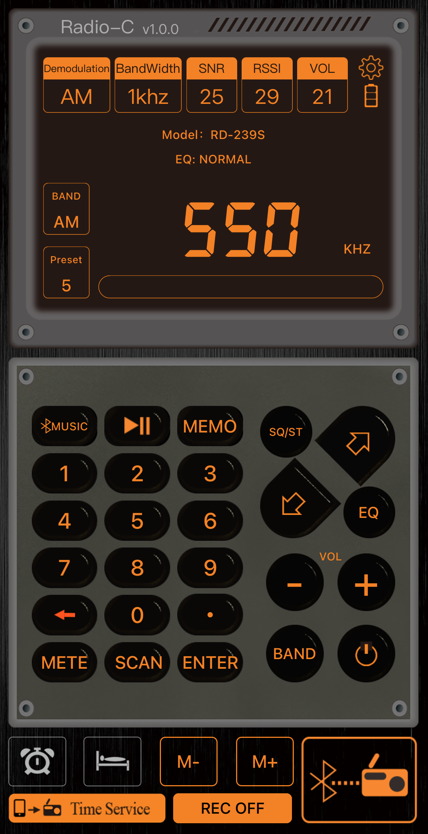
Radio-CT works very well with the RD-239S and I am quite pleased with it.
Support
In the brief time since I’ve owed the radio, I’ve had the opportunity to discuss the manual and some of the features with the LiJiANi company (email address on the product box) and they have been extremely responsive, collegial and effective in their support and in correcting mistakes in my initial review. They offered one suggestion that I think worth passing on:
I suggest you make a 15-meter-long antenna yourself. When listening to SW, replace the 3-meter red antenna. Theoretically, the effect is better. I wrapped W2 in a waterproof bag and put it outside the window because I was afraid of rain. This is how I use it myself.
That makes a lot of sense.
Conclusions
I really wanted this one to succeed and I’m not disappointed. Battling indoor noise is the modern foe to radio listening the repeater concept addresses that problem. Not only can the repeater be positioned away from noise, it doesn’t have internal display electronics to add to the noise.
To Do
So far I’ve spent all my time with the W2 Repeater connected. I want to spend at least a little time using the radio without the Repeater just to see if it’s different from the older Rd239. I also want to do some experiments with other antennas since the supplied 4m isn’t much.
I really want to do a video for YouTube on something related to the radio. It’s new and it’s worth the attention.
Updates
The RD-329S + W2 is now available on Amazon US for $89, considerably less than I paid for it. I’ve posted what may turn out to be the first Amazon product review.
On Amazon US, this combo is priced higher than the well-regarded XHDATA D-808. Accessories (e.g. remote antenna), differences in band coverage, and and app control aside, the direct competitor _as a radio_ in this price range is the D-808. @li zhao – I see some of your side-by side comparisons on YT but it would be great if you could also do this one.
Where did you order it from?
The Clooblut store at AliEx;ress.
Unfortunately I can’t find it on Aliexpress, I’ve searched and searched but no results. But I’ve found it on amazon.us for 89 dollars + tax and other fees to Sweden. But what I’m wondering is based on your experiences after such a short time, if it’s something you could consider recommending as a purchase. I’m a bit confused about what to do, so I would need some advice on the way to a decision.
For some reason, searches on AliExpress no longer find it. This is the URL (https://www.aliexpress.us/item/3256811836700946.html) and I note that the price has gone up. Amazon is much lower in price. https://www.amazon.com/RD-239S-W2-Listening-demodulation-Operation/dp/B0GZ3C8XZG/ref=sr_1_1
The RD-239S is a credible radio that solves a problem, indoor electrical noise. And if you want one radio that covers not only shortwave, but AIR, VHF and UHF, one that adds a recording function, it makes sense. It lacks longwave, which might be something of value in Sweden.
If I wanted something just for LW, MW, SW, FM and I needed SSB but not the other bands, then I’d get a Tecsun PL-330 or PL-520. If I didn’t need SSB, I’d get a Qodosen DX-286. If I wanted great SW plus very pleasing music then I’d get a Tecsun PL-990.
It all depends on your interests.
The price difference is due to many reasons, including varying tariffs and shipping costs between countries. As far as I know, many products with European addresses are blocked; you can find them by changing your address. This is because preferential tariffs for small parcels have been cancelled, and many European products haven’t submitted certifications. This product is sold normally on AliExpress, but the price varies in different countries, and it’s not visible for some addresses. For example, Turkey has a 100% tariff, which is terrifying.
Yes, this site is blocked for me in Sweden. When it comes to longwave, there’s not much left anymore, the BBC recently shut down its longwave broadcasts, and there’s not much left on mediumwave in Europe either, most (authorities) seem to believe that the internet and mobile networks will work without problems in a crisis situation…
Thanks to Kevin and you for the answers, I’ll have to think about it for a while, because after all, I already have some other radios to play with, but the W2 thing seems interesting.
Listening to the radio in your bedroom, office, or concrete house can be a poor experience. The W2 signal repeater solves this problem. The W2 receives a clear signal outdoors and then wirelessly transmits it to the radio indoors, similar to the principle of Wi-Fi. This is an innovation.
SSB can be fine tuned by BFO funtion through button number 7 [SSB] button.
From manual 7.13.2:
Single sideband BFO (beat frequency oscillator) tuning: After entering SSB mode, lightly press the [SSB] button and then rotate the tuning knob to fine-tune the tone. Tune until the vocals are clear, natural,and not harsh. The BFO is the “tone knob” for adjusting SSB voice.
Thank you very much for your correction. I have updated my review with this important information.
Interesting device and review, Kevin.