
I took my new HRD-908 outside at around sunset local time (00:39 UTC) to see what it could do. It hits the ball out of the park on FM. The speaker is great, MW sucks and so does the manual. But there’s more:
Shortwave
The first thing I did was an ATS scan on shortwave. This radio scans all frequencies within its range (4.75 – 21.86 MHz) and it took a long time, a characteristic of radios that don’t limit their scans to the broadcast frequencies. It found 68 stations, the large majority of which were real stations of some sort, many broadcast plus few ham and utility. It boomed with signals from Romania and Brazil. I was impressed by the 5W speaker. I get the impression that the bandwidth is a bit wide. The radio only tunes SW in 5kHz steps.
VHF
Just for grins, I tried ATS on VHF and it got 75 stations after a painfully long trek from 30 to 200 MHz. It picked up some sort of image of some broadcast station just above 30 MHz. It picked up a few FM stations and 3 NOAA weather stations. The VHF band is set for narrow FM (NFM), so FM broadcast stations don’t work particularly well. The tuning step for VHF is also 5 kHz.
I typically don’t pay much attention to VHF; outside of the separately supported weather band, there isn’t much traffic that is easy to find. There is the 6m amateur band (50 – 54 MHz). FM broadcast radio is in that area, but this radio only supports narrow FM decoding on VHF. Aircraft operate in the band (118 – 137 MHz) but they use AM modulation, and so won’t be intelligible on this radio. And there is the the 2m ham band. Add to that some baby monitors and public service traffic. There is a reason that VHF listeners choose scanner radios for the brief transmissions found there.
Midday Band Scan for MW and FM
The scan, as always, is carried out in the middle of the day, outdoors, on the same plastic topped table with the radios oriented in a NW/SE direction, the direction of most stations for MW, and hand held and waved around for FM. I live in a weak signal area, so MW performance is generally not good.
Also for this scan I am re-evaluating the Sihuadon R-108 on MW. The scores it got the first time just seem unreasonably high and I want to test it again. I have an improved methodology for recording results now, a form where every possible frequency is listed and I check off what is received rather than a simple tally.
My experience with MW reception on emergency radios has been poor and so I went in with low expectations. The teardown photos of the HRD-908 show a ferrite antenna of roughly 43 mm, on the low side. MW reception was worse than expected because in the absence of a signal, it appears that the radio sets the AGC to a level so high that it picks up the radio’s internal electronics. The result is a loud raucous buzz that no one is going to put up with, at least not me. On the one strong station we have, reception was normal. I didn’t rate MW on the table.
FM, by contrast got more stations than any other radio I have ever tested, 82.
I retested the Sihuadon R-108 and got fewer stations. I tested another radio and got fewer stations too. I decided not to update their results, at least for now.
Weather
I’m still learning about weather propagation. What I do know is that I can receive 3 NOAA weather stations clearly on a good day on a good radio, and only one on other days. Since VHF signals like this are transmitted line of sight, they shouldn’t be affected by the propagation factors involved in lower frequency signals. The nearest station is on a mountain top only 21 miles from me. The elevation where I live is 371 feet (113 m).
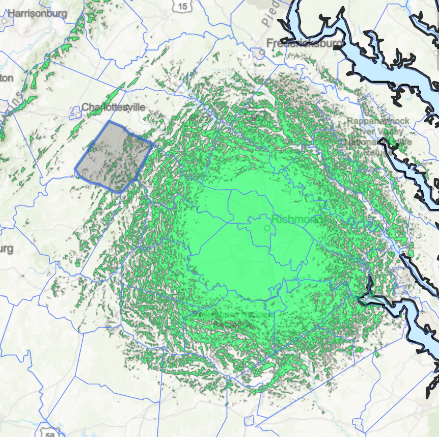
The station in Richmond, VA, is farther. This map shows its coverage area, and my county highlighted. I live in the northwest corner of the county.
And here is the coverage from WXL92 in Lynchburg. I live in the northwest corner of the gray area.
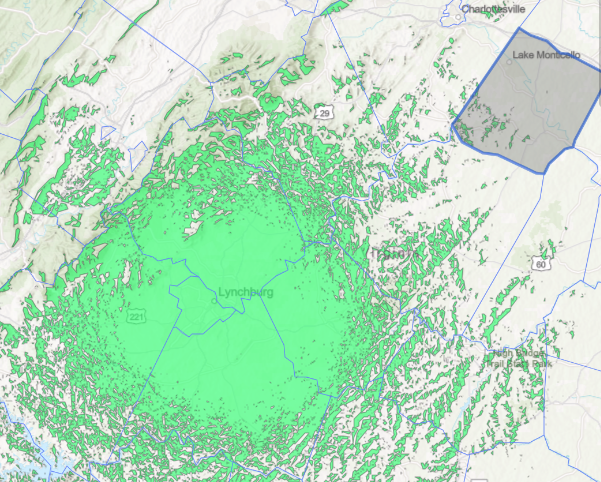
NOAA Weather Station WXL92 in Lynchburg, VA with Fluvanna County highlighted
What I can say is that I got very clear reception of the three stations on this radio on a good day, and that it is good as any other weather radio I have. A process called tropospheric ducting can give surprises on VHF. I have more to learn and explore.
Sound
I liked the sound. The music equalization profiles can boost the bass some, although I tend not to use equalization on my radios. The profiles work on radio as well as Bluetooth and MP3 play. Here’s a short symphonic track with the neutral profile from FM:
When an equalization profile is selected, the light bar across the top is activated. The rightmost light bar element also turns on when the radio is charging.
Similarity
As I was tuning around, I got a sudden feeling of familiarity, and the radio that came to mind surprised me, the Raddy RF75A, not the LiJiANi Rd908 in red below. First, I note that the RF75A is alternately branded the HanRongDa HRD-787. Next, both radios use the Radio-C/Radio-CT app. Both lack numeric keys, both have weather alerts, both have flashlights and both have the same 5 bands.
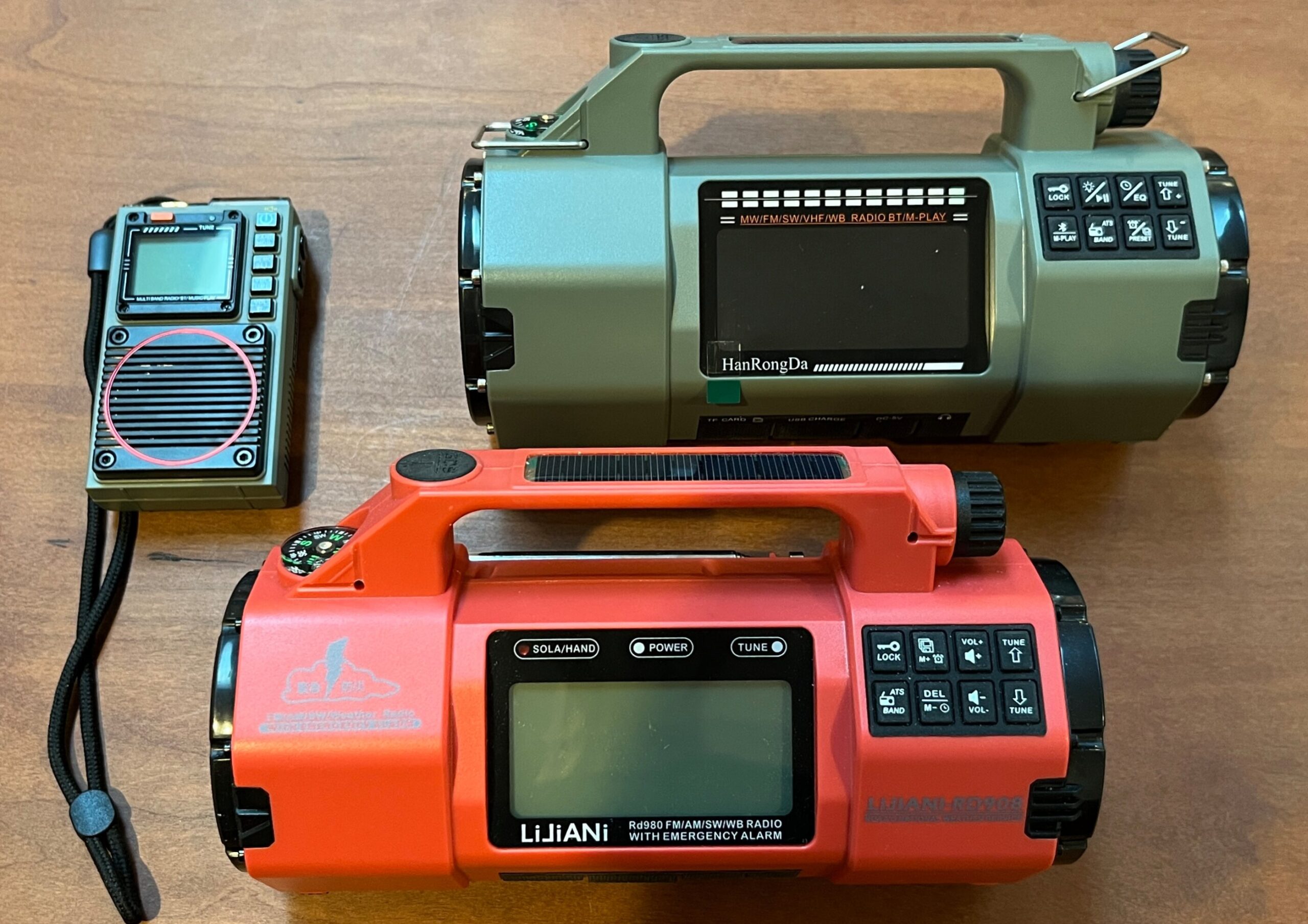
The SW band is 4.75 – 21.86 MHz, the same as the RF75A. VHF is virtually same, starting at 30 MHz and topping off at 200 MHz (199.976 on the RF75A). The RF75A as 396 ATS memory slots, 99 per band (except weather); the HRD-908 has 100 per band. Both radios host MicroSD cards, music profiles and Bluetooth. Both have a mute function. Both have clock (that can be automatically set from the app), alarm and sleep timers. Both have 6 audio equalizer settings and both can act as a PC speaker, and allow a PC to access files on the MicroSD card. Both have ATS scans that cover all frequencies supported.
For both the HRD-908 and the RF75A, the MW channel spacing is tied to the FM band limits and is set by a long press of the BAND button in clock mode. Both effect the change using the up and down arrows once in setting mode.
About the only difference was a key to switch between meter bands, which appears on the RF75A, but not that I can find on the HRD-908.
Of course, the HRD-908 adds a knob with multiple functions, including power on/off, tuning and volume control.
This similarity is in stark contrast to the dissimilarity in the Rd908 and HRD-908 that, although having the same external appearance, are radically different in features.
On/off
The knob can be pressed inward, providing a multi-function control with different functions in different contexts:
- Radio off: Short press puts the radio in Clock Mode (Time is displayed)
- Clock mode: Short press turns the radio on
- Radio on: Short press changes the knob function from tuning to volume control; long press returns the radio to clock mode.
In clock mode, the radio turns itself off after 10 seconds of inactivity.
Room to Improve
I’ve already criticized MW performance, which is the biggest negative of all. That buzz is downright ugly.
It’s very difficult to tune shortwave without the app. Manual tuning and even ATS is painfully slow and the scan does not reliably land on the next station.
There is no “meter band” capability to repeatedly press a button and cycle through the international broadcast bands, something that would mitigate the slow tuning.
An easily accessible electronic copy of the manual would be a great asset, since the supplied manual has tiny print and some symbols are missing. The one I found in the FCC certificate process was an early version. I rate the manual as “C” for basic English, grammar, composition and completeness. And yes, the tuning knob is called a “shuttle.” Sigh!
One annoyance about the radio is that it automatically blanks the screen after 10 seconds, and when the screen is blanked, there is no way to tell by looking at it whether the radio is off or on. Usually LCD screens can be read in normal lighting when the backlight is off. The manual describes a setting to have the screen always on, always off, or delayed for 20 seconds (the default).
The manual explains:
Time display status, long press the [💡] button to enter the backlight time adjustment, short press the [💡] button can be selected: “bL AUtO “/” bL ON”
bL AUtO: indicating working mode, the light will automatically turn off after being on for
20S. press any key to turn on the LCD light.
bL ON: Indicating working mode, the LCD backlight is always on.
Despite the poor wording and formatting, the reader can get the gist of what it’s saying, but maybe not. The tricky bit is the opening words “Time display status.” Does this refer to the function being set — the length of time the display is on — or does it refer to the radio being in clock mode (displaying the time) in order for the setting to be made? In other places the manual refers to time display “state” rather than “status.” And yes, the setting is made in clock mode.