
E-gad, this shipping box is heavy: 4 lbs. 6 oz. It may have something to do with the 5 x 18650 batteries, 3 for the radio and 2 for the repeater. And unlike almost every radio in my experience, it’s bigger than I anticipated.
I compared a couple of color screen models in a photo:
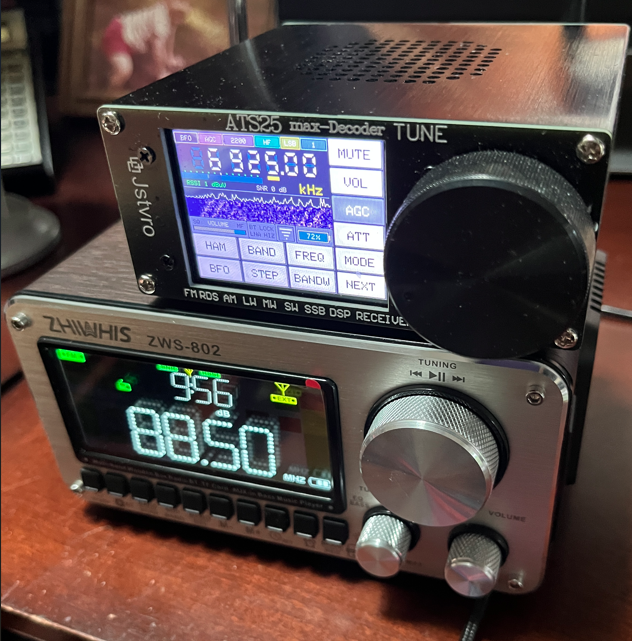
Both have a big tuning knob that also acts as a switch and of course the ATS25 max-decoder has a touch screen compared to buttons on the ZWS-802. In fact, all three knobs are also push buttons.
A brief comparison between the HanRongDa manual I found online and the Zhiwhis variant didn’t immediately indicate any difference. My Zhiwhis included a separate manual for the W3 Repeater unit.
While there is no keypad frequency entry on the ZWS-802 via buttons, keep in mind that it’s app controlled also, providing direct key entry through the app. The app paired with the radio quickly. The Radio-CT app has one particularly cool feature — the ability to set the radio clock with a single button, albeit only to the local time zone rather than UTC.
The ZWS-802 came with 3 x 2500 mAh 18650 cells and the W3 Repeater has two, but the repeater alternately runs on 3 AA batteries.
Using the app, I tried to select the bands. The only options were FM, AM and SW. There were no U.VHF, Weather or AIR bands. It turns out that Weather band only appears when the radio region is set for the Americas and the W3 isn’t required. The other bands require the repeater. I note SW coverage is limited to 3.2 – 21.86 MHz.
ATS
At around 0300 hours local time, I performed a SW ATS scan with the 27″ whip antenna. It found 139 stations. ATS scan on this radio scan all frequencies in range, not just broadcast frequencies, resulting in a fairly long scan process. My first impression, subject to further testing, is that most ATS results were bogus.
Settings
The manual states that the radio comes preset for the Europe/Asia market with optional settings for Russia, Japan and the Americas. The ZWS-802 has 3 states: Off, Time and On. The region setting is accomplished in the Time state. Briefly press the Power button to switch states. In Time state, long press the SUB BAND button, causing the low FM band frequency to show. For the America, rotate the main tuning knob until 87 is shown. Then press the power button to exit the time state. This setting not only determines the FM range, but also the MW step, 10 kHz for the America and 9 for the others.
As I mentioned, time can be set automatically from the cellular network with the app. Changing the hour and selecting 24 hr. mode is easy. Again from the time state, just press and hold the clock button, release and turn the main big tuning knob to set the time, press clock again to set minutes, and press a third time to select 12/24 display. Just wait a few seconds for it to automatically exit the setting mode. There is also an alarm and a sleep timer.
Look and Feel
It looks moderately premium with its wood case, metal knobs and sharp color screen display. Did I mention that it’s heavy? The radio alone with batteries weighs 2 lbs., 9.9 oz. or 1186 gm. The weight is a definite factor for handheld use. I note some nice rubber feet and the radio has some very useful lifters in the front to tilt the unit for better visibility. The viewing angle is critical because the display fades sharply when viewed straight on or from below.
The Repeater
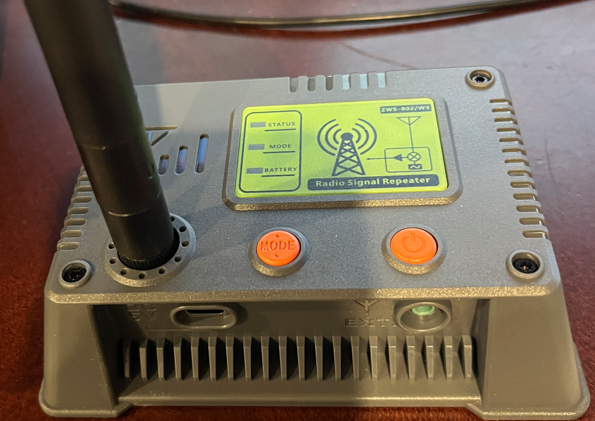
The W3 Repeater can be turned on and off manually, and it has an automatic wake mode with supposedly low battery drain. The manual suggests that it can operate with just one of the two 18650 batteries installed.
Once the W3 is communicating, the band selection on the app increases to AM, FM, SW, AIR, WX and V.UHF (also called VHF). The V.UHF band covers from 25 to 999 MHz.
It should be possible to achieve noise reduction in two ways, first by removing the actual receiver to a physically less noisy location, and second by removing the display electronics from the receiver. I noticed during the initial setup that I could receive a MW station with the W3 connected that I could not receive on the base radio alone. This encourages me to spend early testing using the repeater.
Both the radio and the repeater have 3.5mm antenna jacks.
Audio
Clearly this can be turned up loud. It has 2 x 4W speakers and I suspect some of that device weight represents their contribution. Audio is good. All reports are that it is real stereo (I’ll check it). I haven’t spent time yet with serious audio testing yet.
Likes
- Pressing the large knob mutes the radio
- App control
- 3.5mm antenna jack (on both units)
- Good sound
- Quality controls and good overall appearance
- Extensive frequency coverage up to 999 MHz.
- Plenty of battery power (3500 mAh 18650 x 3)
- Nice feet
- USB-C charging
Dislikes
- Badly translated manual, missing/wrong information
- Does not receive 21.86 – 30 MHz
- No SSB or CW
- Display precision on SW only 5 kHz
- Heavy
- No LW
- Screwdriver required to replace radio batteries
- No direct frequency entry without the app
- Putting the radio briefly in clock mode to check the time disconnects the repeater.
- Wide bandwidth on SW.
Testing
Subject to revision, I’m thinking of comparing the ZWS-802 to the ZWS-C919, HRD/ZWS-757, Qodosen DX-286 and Tecsun PL-990. I also envision an article, “The Battle of the Big Radio Speakers” one day.