
I’ve hurried through this review because I really don’t think much of the product. I refer the reader back to my prior articles for some details:
It’s a cheap (under $23 with shipping) radio and music player. It’s not defective. Some observations and usage note follow.
Radio
It’s a plain MW/FM/SW radio and not a weather radio, despite the misleading “W” on the model number, “ALERT RADIO” printed on the front panel and WB specifications in the manual. Further, I have not been able to locate the purported “WB version” for sale. I’ve marked up the manual’s specifications table to emphasize this.
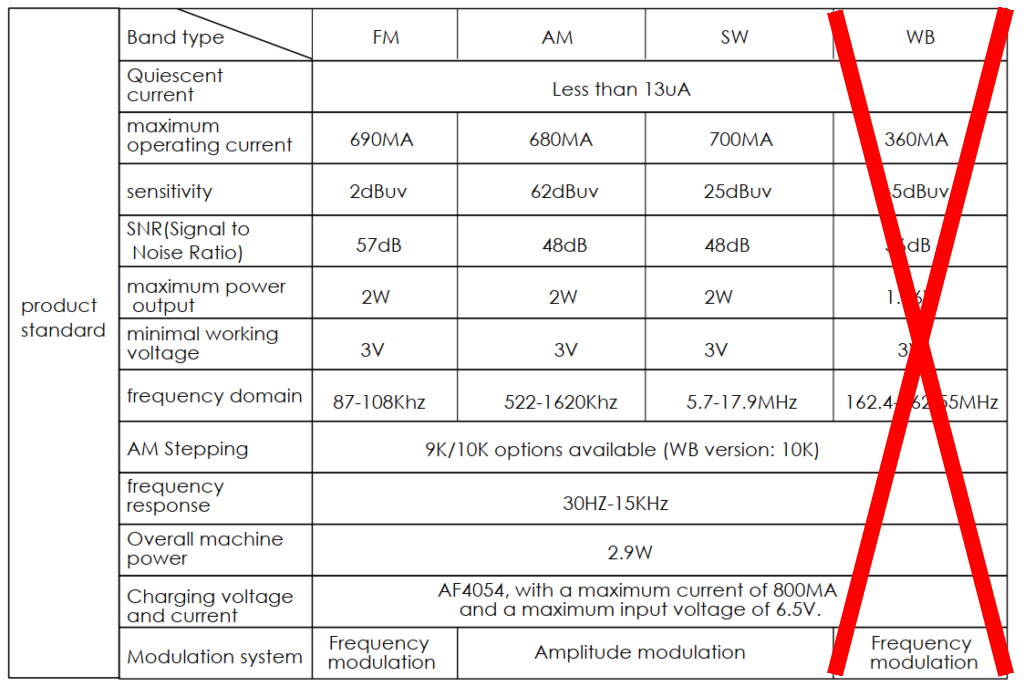
The other problem with my radio is that it appears to have a 9 kHz frequency step on MW that cannot be changed; MW also caps the frequency range at 1620 and so doesn’t cover the top of the US MW band. These MW specifications, however, are of little concern because the radio is so insensitive on MW as to make them moot.
Reception
MW reception was as bad as I have ever encountered, with a total of 2 stations heard on the daytime band scan. Of course, MW stations propagate better at night and more stations could be heard, but the performance vis-a-vis other radios is abysmal.
FM reception is definitely better. I received 42 stations on the daytime band scan. It’s far from outstanding, but decent. I’ll give this a check mark as an FM radio.
I didn’t put this radio on my Daytime Band Scan chart because it’s impossible to count stations reliably on a DSP radio with analog tuning and significant backlash on the tuning knob. I count stations for my digital radios by actually tuning every frequency in the band and listening for something. This radio can only be tuned to a very rough approximation. For FM there are 10 – 15 channels between two adjacent dial numbers.
Shortwave presents a different problem. It does receive stations, even with its short 33cm telescopic antenna, but along with the stations is a machine gun popping sound on many frequencies. I pulled out another radio just to check that it wasn’t some extraordinary local interference — it wasn’t. My speculation is that the noise comes from the LED indicator lights.
Shortwave coverage is from 5.7 to 17.9 MHz, but not continuously.
| Band | Frequency Range |
|---|---|
| 49 | 5.7 – 6.2 |
| 41 | 7.2 – 7.6 |
| 31 | 9.4 – 9.9 |
| 25 | 11.6 – 12.2 |
| 22 | 13.57 – 13.87 |
| 19 | 15.1 – 15.8 |
| 16 | 17.48 – 17.9 |
Tuning
Backlash in the tuning knob is a problem. I presume it’s connected to a potentiometer that signals frequency change to the DSP chip. While the potentiometer is effectively continuous, the radio’s tuning is not. So when the knob is turned enough, the chip jumps to the next channel with the chuffing noise one would expect. By the way, clockwise turning of the tuning knob reduces the frequency.
I tried tuning the SW band and counting chuffs in an effort to determine the tuning step, but the results gave no usable information.
ATS
Automatic tune storage (ATS) is at first blush an odd concept on a radio with an analog tuning display; however, ATS on the radio is independent of the display. This is what the manual says:
[PRESET] 3.Radio mode: In FM/AM/SW mode, long press to activate the ATS function to search for and store stations. The LED will show an upward flowing light as a prompt.
I did that on the FM band and the LED display did indeed flash repeatedly from bottom to top for something less than a minute. It’s unspecified how many stations can be stored per band. Later on in the description of the >>| and |<< keys (also labeled up and down), the manual says:
- Radio mode: Short press: To select and play the saved radio station (if there is no saved station, the corresponding indicator light on the corresponding frequency band will flash. You need to use the PRESET key to store the radio station first). Long press: To search for radio stations, the playback will stop when there is a signal, and the LED will have an upward/downward flowing indication.
And indeed, it found some number of stations.
The ATS search is for the full shortwave range, not the meter band selected. The entire scan took just under 4 minutes, in line with some other radios I’ve tested over the years. It found 4 stations, 2 of which could be heard.
Music Play
Sound
So how’s the bass?
I didn’t find the sound to be anything special. There was no booming bass on recordings that had it. I couldn’t really turn the radio up uncomfortably loud. Equalization worked, but none of the settings made the bass boom.
Media
The manual doesn’t specify the supported music formats. I tested MP3 and that worked. Maximum media capacity wasn’t specified either. I tested with a 128G USB flash drive. I didn’t bother testing with a MicroSD card, but I assume the same results.
Bluetooth connected fine with my Windows desktop, identifying as a J-101 (not W).
SOS
A long press of the SOS button (whether the radio is on or not) starts a warbling siren, similar to the sound from many emergency radios. It’s loud, but I wouldn’t depend on it for rescue outdoors. The manual says it’s turned off with a long press of the SOS button, but a short press works just as well.
Concluding
It reminds me of the HanRongDa HRD-700 that can be purchased for about $10 more on Amazon. It really has weather band.
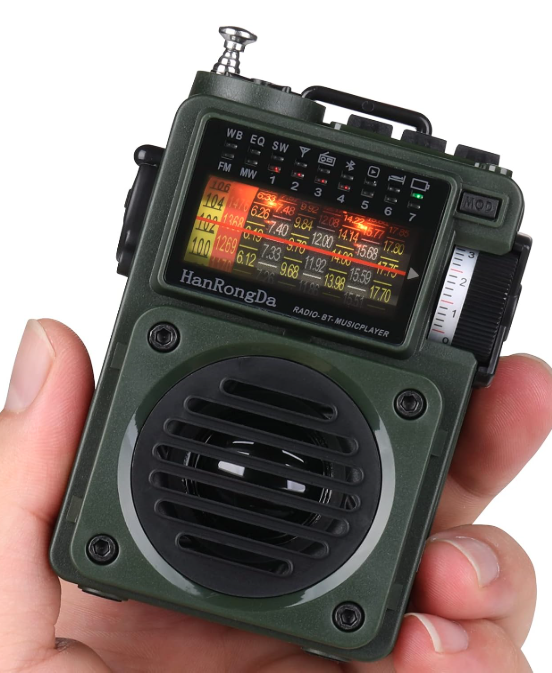
I never owned the HRD-700, but I had the similar HRD-701 and still have it. It has very good sound. They also had Bluetooth and media play.
The JOC J-101W doesn’t fill any need I have, except something to review on the blog. I would never listen to MW or SW on it. I have radios with far better speakers. If I want retro, there’s my ZWS-C919.