
My first attempt at DRM on the MLite-880 was Radio Romania, and there I got a wonderful sound experience. Today at 9:45am local time in central Virginia (13:45 UTC), I tried my old favorite from 2023, Music 4 Joy from Nauen, Germany.
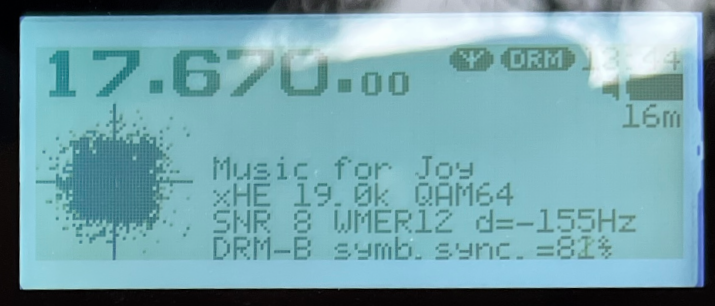
Today on 17670 kHz with the 20′ WUT antenna out on the patio with the MLite-880 and its newly-installed V1.6.1 firmware I received Music for Joy’s DRM broadcast, but there was no sound. Here’s what showed on the radio’s display:
At the end of the article, I chronicle the testing.
I showed Microsoft Copilot the display and asked it what was going on. Here’s the reply:
🤖Kevin, your screenshot actually tells us exactly why you got no audio from Music 4 Joy on 17670 kHz — and the MLite‑880 is behaving correctly. The signal was present, partially synchronized, but not decodable enough to produce audio.
Here’s what your display reveals and what each line means for DRM decoding:
1. SNR 8 dB → Too low for audio
Your screenshot shows:
SNR 8
For DRM, usable audio typically requires:
- Minimum: ~10–12 dB
- Reliable audio: 14–18 dB
- Strong, stable audio: 20+ dB
At 8 dB, the decoder can lock the OFDM carriers (hence the constellation and “DRM‑B”), but cannot decode the MSC (Main Service Channel) where the audio lives.
This alone explains the silence.
2. WMER 12 → Very high error rate
Your display shows:
WMER 12
WMER (Weighted MER) is a measure of how well the constellation points match the ideal QAM64 pattern. For audio:
- Good: WMER 20–30
- Minimum for audio: ~18
- 12 means: the decoder cannot extract audio frames
So again, the radio is locking the signal but cannot decode the content.
3. Symbol sync 81% → Not enough for audio
You have:
symb. sync = 81%
For DRM audio:
- Needs: 90–100%
- Below 85%: metadata may appear, but audio fails
- Below 80%: even metadata may fail
Your 81% is borderline — enough to show the constellation, but not enough to decode xHE‑AAC audio.
4. Frequency offset d = –155 Hz
This is fine — the MLite can easily correct ±200 Hz. Not the cause of the silence.
5. QAM64 + xHE‑AAC 19 kbps → Requires a stronger signal
Music 4 Joy uses:
- QAM64 (high‑order modulation, less robust)
- xHE‑AAC at 19 kbps (needs clean MSC)
This is a more fragile configuration than Radio Romania’s typical 16–20 kbps QAM16/QAM64 mixes.
So the weaker Nauen signal is simply not strong enough at your location.
…
What you can try next
Here are practical ways to push the signal over the threshold:
1. Slight antenna repositioning
DRM is extremely sensitive to multipath. Even a 1–2 foot reposition can change SNR by 3–5 dB.
2. Use the MLite’s IF bandwidth setting
Try:
- 10 kHz
- 12 kHz
- 14 kHz
Sometimes one bandwidth gives a cleaner constellation.
3. Try at a different time of day
17670 kHz from Nauen is strongest:
- Late morning–early afternoon on the U.S. East Coast
- Weak in early morning or late afternoon
4. External antenna
Even a simple 20–30 ft wire clipped to the whip can raise SNR by 4–10 dB.🤖
Copilot didn’t know I already had an external antenna (with a north/south orientation). I also tried my 40′ WUP (wire under porch) antenna without success.
I gave Copilot the schedule of M4J broadcasts, and asked it what the best reception times should be here in Virginia. It replied with this nicely formatted table:
| Slot | Time (UTC) | Frequency | Target area | Likely strength in Virginia | Overall promise |
|---|---|---|---|---|---|
| 1 | 1300–1400 | 17670 kHz | Far East | Very weak | ★ |
| 2 | 1800–1900 | 13730 kHz | East Africa | Weak–moderate | ★★ |
| 3 | 1830–1930 | 11710 kHz | Middle East | Moderate | ★★★ |
| 4 | 2000–2100 | 11615 kHz | West Africa | Moderate–strong | ★★★★ |
Tuesdays and Thursdays are usually busy days on my schedule with today an exception, so I’ll see what I can get this afternoon, the only catch being the rain forecast.
Copilot also gave me a table of what values displayed give best reception results:
| Metric | Minimum for audio | Ideal |
|---|---|---|
| WMER (weighted modulation error radio) | ≥ 18 | ≥ 22 |
| SNR (signal to noise radio) | ≥ 10–12 dB | ≥ 14–18 dB |
| Symbol sync | ≥ 85% | ≥ 95–100% |
My experience says good audio is possible below 18 WMER. Here are the results from my test:
| Time | Station | Frequency (kHz) | SNR | WMER | Sync | Sound |
|---|---|---|---|---|---|---|
| 16:32 | R. Romania | 13590 | 12 | 12 | 86% | Y1 |
| 17:13 | R. Romania | 13750 | 17 | 17 | 94% | Y |
| 17:10 | R. New Zealand | 7425 | – | – | N | |
| 17:59 | R. New Zealand | 9780 | – | – | ||
| 18:00 | R. Romania | 5910 | – | – | ||
| 18:00 | Music 4 Joy | 13730 | 13 | 16 | 80% | Y1 |
| 18:00 | R. Romania | 9570 | ||||
| 18:56 | Music 4 Joy | 11710 | 7 | 11 | 79% | N |
| 18:40 | R. New Zealand | 9780 | ||||
| 18:52 | R. New Zealand | 9780 | ||||
| 18:59 | R. New Zealand | 11690 | ||||
| 19:40 | R. New Zealand | 11690 | ||||
| 19:50 | KCBS Korea | 6140 | ||||
| 19:50 | KCBS Korea | 3205 | ||||
| 19:59 | R. New Zealand | 13840 | ||||
| 20:00 | Music 4 Joy | 11615 | ||||
| 20:25 | China CNR1 | 6030 | ||||
| 21:00 | China CNR1 | 15760 | ||||
| 22:00 | Radio France | 9565 | – | – | ||
| 22:07 | TDF France2 | 13740 | 21 | 21 | 96% | Y |
| 22:00 | China CNR1 | 9655 | ||||
| 22:00 | China CNR1 | 9720 | ||||
| 23:00 | TDF France | 9720 |
Notes
- Intermittent or no sound as I changed antenna orientation, confirming that signal strength is a critical factor.
- Rain interrupted the full testing list. This TDF reception was on Friday
Here’s TDF France on 13740,