
The Zhiwhis ZWS-777 (aka HanRongDa HRD-777 / Raddy RF750 Plus) is a little product, a mere 2.8″L x 1.7″W x 2.3″H plus a 10.6″ telescopic antenna. It’s also hefty at 7.7 oz. with BL-5C battery and accessory ferrite loop antenna, compared with 4.7 oz. for the larger HRD-701. I suspect some of the weight is due to the metal case and perhaps the 3W speaker (both use the same battery).
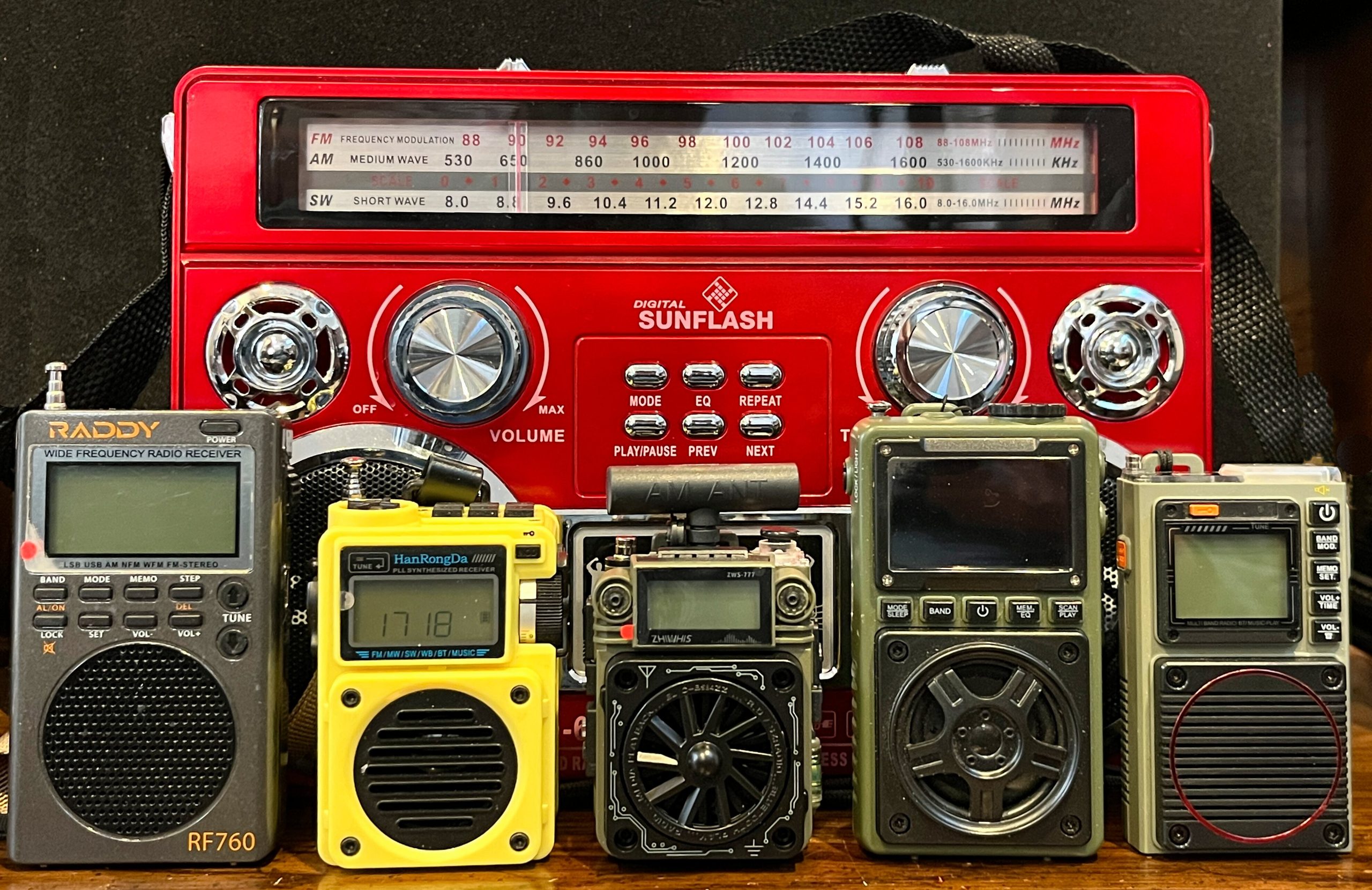
Sunflash RD-666 in the background

This a member of the military-styled radio class from Shenzhen Hanrongda Electronic Corp: the HRD-700, ZWS-702, ZWS-702X, HRD-A320, and HRD-C919. It has sort of a geeky retro military feel to it, from the olive drab color, the five-pointed stars stamped in various places and the schematic circuit symbols around the speaker.

Features
A couple of its features may be unique among radios. The first is the spirit level on the right side, and if you’re curious, it really is level and doubles as a battery status indicator. The other is the fidget spinner in front of the speaker. Give it a flip and it spins fast; enable the feature, and it tunes the radio, and at a nice speed. And yes, the manual calls it a “shuttle.”
One critical feature is app control through the Radio-C app. The app not only puts labels on controls, but it lets you do things that are impossible otherwise, like recording to the TF card and viewing things like RSSI:SNR values, the music filename being played, and the firmware release version (mine is V1.59).
Here is my feature list:
- Setting of ITU Region (sets start frequency of FM band and MW channel spacing)
- Plays sound files from TF card with 4 repeat modes, next/previous, fast forward/backward
- Recording of received radio to TF card.
- Can act as Bluetooth speaker
- Receives MW, SW (4.75 – 21.85 MHz), FM and NOAA weather band
- Weather alerts
- SOS siren
- Sound equalization profiles
- ATS with 297 memories
- Station search
- LED light bar
- Rotating MW antenna
- Backlight options
- Clock / Alarm / Sleep timer
- Spirit level
Here are the “key technical parameters” according to the manufacturer:
- Receiving range: FM: 87.0-108 MHz (it can be set to 64-108), AM: 520-1710 kHz, SW: 4.75-21.85 MHz, WB: 162.40-162.55 MHz
- Receiving sensitivity: FM≦18dB, AM≦86dB, SW≦30dB, WB≦18dB
- Speaker: 4Ω3W
- Signal to noise ratio: ≧40dB
- Number of channels stored in receiving mode: 297
- Bluetooth version: VER 5.2
- Bluetooth receiving distance: ≤10m
- Lithium battery: 3.7V
- Play format of TF card: MP3/WMA/WAV /APE/FLAC
- Max capacity of TF card: 256G
- Dimension: 56x75x44mm, 2.2×2.95×1.7in
- Weight: 226g, 0.5lb (including batteries)
Operation
Operation is a memory challenge. With a range of features and only 4 controls (Power button, Lock button, Joystick and spinner), the controls have to perform multiple functions, including ones invoked by pressing, long pressing, double pressing and even triple pressing. Only the power and lock buttons have labels, and those hard to read due to low contrast between writing and case.
You really can’t operate the radio without a manual. One highly-experienced YouTube reviewer over two videos, never could figure out how to switch bands. Isn’t double-pressing the Power button obvious? 😲 I somehow put the radio in a locked state and couldn’t figure out how to turn the radio off for a while. I pressed the lock button, I long-pressed the lock button, but I failed to double-press the lock button.
I will say that if you know what you’re doing, the radio makes sense. The spinner on the front is great for getting to the start of the MW band really fast and I suppose starting and aborting an ATS scan would accomplish the same thing. Here in Region 2, stepping between FM stations is physically convenient — two side presses of the joystick, and one press for MW channels. Shortwave always steps 5 kHz.
If you don’t know what you’re doing, then the Radio-C app helps enormously.
Radio Performance
One shouldn’t expect much from a 10.6″ (27cm) antenna, which is probably why the manufacturer provided a clip-on wire antenna as part of the package.
FM
Just a reminder of how this test works. I go down to my patio between 11am and 2pm. I hold the radio and wave the antenna around as I step through each frequency of the FM band. If I hear a station, I count it. My best radios top 80 stations.
The standard midday band scans are standardized to the telescopic antenna and so FM performance was expected to be poor on this radio with a mere 10.6″ inches”. I was wrong. In fact it was very good: 77 stations.
I keep an FM dipole handy when I want to get serious about FM DXing. It’s terminated with an SMA plug. I’m not sure the best way to hook this to a radio with no antenna jack.
Todd Erbert, in his YouTube review of the Raddy branded version, stated that 3 FM frequencies were bad: 91.1, 90.9, and 103.9 had “no noise.” His video is over a year old and firmware may have changed, so I tested this myself and didn’t observe his issue. I received a station on 91.1 and hiss on 90.9 and 103.9; However, there were some other blank frequencies for me: 90.3, 95.9 and 101.5 MHz.
MW
I have one strong local MW station, WINA 1070, and there’s not much else. The midday band scan places the radio facing in a NW/SE orientation, which is the best reception. I slowly tune the band and count the number of stations. In this case I aligned the ferrite bar antenna parallel to the radio, both pointed in the optimum direction.
I got 5 stations, all but one of which were fairly weak. No surprise. On MW, size matters and we don’t have much size, and I don’t have much signal to choose from.
SW
Because reception varies from minute to minute on shortwave, I can’t do a band scan comparison. What I typically do is take my Qodosen DX-286 outdoors and do an ATS scan, then try to tune those stations on the test radio on the same antenna. SW ATS scans on radios where the scan is not limited to broadcast bands (like the 777) take a long time (over 7 minutes) and much of what is returned is unusable (CW, SSB and other commercial traffic).
But before I hooked up the long antennas, I compared the two receiving IBRA in Arabic via Woofferton, England on 17670 kHz at 18:48 UTC:
Then I used a pair of 9′ long wire antennas for a test at 19:02 UTC, this time with the Voice of Turkey on 9750 kHz, somewhat weaker.
One caveat about this test is that it was done near the house with more RFI than my usual patio location because of rain.
I did try one ATS scan indoors with the telescopic antenna. It stored 31 stations eventually, most listenable, including CFRX, WWV strong on 10 MHz, WWCR Nashville on 3 frequencies, possibly Vatican Radio on 7305, WMRI on 7780/9395 and what I think was a Chinese station. I couldn’t check them all because handling the tiny radio I bumped the joystick and it started the ATS scan over, erasing what it had found before. Sigh. Still I was bit surprised by the reception on the tiny antenna and again reminded me of the importance of the app.
I cannot emphasize how easy it is to accidentally press down the protruding joystick handling this tiny radio, switching it to PRESET mode and losing whatever station you had tuned. This is a big deal.
Weather
The ZWS-777 has weather alert capability, but it might not be practical. A new, healthy BL-5C cell has a capacity of 1000 mAh. I measured the drain from the radio in Alert mode powered externally with no battery installed. It draws about .065A, giving an optimal alert window of 15 hours, significantly less than one day.
The radio received my local NOAA weather station easily, and barely got one of the three fringe stations some good radios get. It certainly works as a weather band receiver.
Audio
The Amazon product has two things related to audio, one a named feature named “Super Bass” and the other this text:
Superb Sound: The audio is crisp and the bass is quite good; when the volume is turned up, it is quite loud and full with little to no distortion; it also has 6 equalization options.
The speaker is advertised at 3W. If you’re sitting right next to the radio, it can be turned up uncomfortably (for me) loud.
As I mentioned in my First Impressions post, my ZWS-777 was purchased used from Amazon and was missing the USB headphone adapter. I found an inexpensive replacement that the Amazon AI claims will work with PCs. I’ll update when I can test that. Update: it works with PCs, but not with the ZWS-777. Update 2: AI tells me that there are two types of adapters, analog and digital, and found an analog one for me at Walmart. Arrives October 20-21.
Update
I did some additional testing and ended up comparing the ZWS-777 with the ZWS-A330, both fairly small radios. The music was classical and loud (Ralph Vaughan Williams Sea Songs). Even with a smaller speaker hole, the ZWS-A330 was the clear winner for bass, volume and clarity.
Construction
The case is made of metal. My worries are that the spinner knob might break if the radio fell on it, that the thin antenna might bend or pull apart, and that the little covers over the USB port, the MW antenna port and the TF card slot might get damaged and not stay closed. These are my own impressions; nothing has broken so far. The cover over the USB port was particularly hard to open.
What’s it for?
At the top of the article I included a photo of the ZWS-777 next to a chopsticks holder and a model car. Those two objects reside on my desk, keepsakes. I don’t actually use the chopsticks holder and I don’t fit in the car. The ZWS-777 might well fall into a collectible category or desktop ornament rather than a radio someone would actually use. I wouldn’t use it as a weather radio because of the short run time in alert mode. The small size can make it clumsy and the overloaded controls are easy to make mistakes with.
But I wouldn’t write it off. As I said, FM performance is outstanding and shortwave is no slouch either. You might find some small niche where it works.
Every time I come back to this radio, I’m surprised all over again at how small it is.
Updates
I now have an up-to-date Zhiwhis product manual.