
At least 3 new shortwave-capable radios have come on the market supporting bundled or separately-sold “repeaters.” As best I can determine, these are Bluetooth-linked radio receivers with no controls, display or speaker. What the receiver picks up is relayed back to a controlling device via Bluetooth. The controlling device in this series is itself a radio that provides controls, display and sound. The three radios of this type I know of are:
- Zhiwhis ZWS-A330 (aka HanRongDa HRD-A330)
- Zhiwhis ZWS-802 (aka HRD-802)
- LiJiANi RD-239S
Each has a different, incompatible across models, repeater.
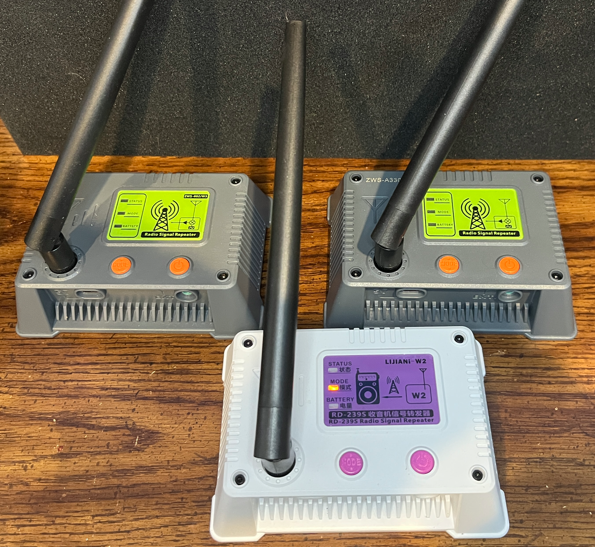
Front: RD-239S/W2
Since the repeater itself is a radio, it can be designed to do things the base radio cannot; for example, the RD-239S repeater demodulates SSB, and the ZWS-A330 repeater adds longwave. But the raison d’être for the repeater is simply to mitigate the electrical interference and barriers that surround modern life. The repeater can be placed in a more ideal location next to a window or outdoors, and then the listening radio can be placed anywhere within Bluetooth range. The range depends on what’s between the repeater and the receiver. I’ve found range to be a non-trivial issue.
All of these repeaters have similar packaging, a USB-C charging cable, a wire antenna, a manual, a window hanger, a Bluetooth antenna and batteries. Supplied are two 18650 flat top rechargeable batteries, but the repeater can be alternately powered by 3 AA batteries.
When one looks at what’s there, it isn’t much. There is no display, no display electronics, no audio power electronics, no speaker, no knobs or switches. It has two buttons, three LEDs, an SMA connector for Bluetooth, a battery compartment and a phone jack for a radio antenna.
I have all 3 radios and repeaters, but I’m just picking the two that support SSB for this comparison.
An Important Lesson
I’ve been using and testing radios for many years and it’s been difficult sometimes. When comparing two radios, there’s pressure to say which one is best and sometimes that’s not clear. Readers here have seen me say that shortwave reception varies from minute to minute and that’s my excuse for not coming down on one side or the other. Radios have different speakers that make a big difference and while the overall sound matters, people using headphones don’t encounter the difference in speakers. This is why I’ve tried A/B switches with an external speaker. I’ve found pairs radios sounding identical with headphones.
I announced that I was writing this comparison a while back and in response I received an email from the company that sells one of the radios in the test, asking me if I found much difference between the W2 and the W3. This is what I told them:
Both radios with repeaters perform about the same.
What I wasn’t expecting was their reply:
Hello, to let you know, there is no difference between W3 and W2. If you disassemble them and observe the circuit boards, they are identical, without any distinction. … The only difference between W3 and W2 is the software, as they are paired with different radios.
As I think back over my reviewing career, I think that I focus a lot on usability, and struggle with testing. The daytime band scans for MW and FM are reasonably objective, but even those tests aren’t carried out side by side; otherwise I must concede to some subjectivity. OK, back to the review.
Setup and Operation
The repeater batteries come installed, so just top them off with the charging cable. Mount the repeater with the supplied window hangers, screw it onto something or just sit it on a desk.
Each repeater has three buttons. One is a simple on/off button. One is labeled “Mode.” When Mode is operating, the repeater goes to sleep when not in use and wakes up on a lengthening delay schedule maxing out at 20 minutes. When the radio is on and the repeater is awake, the two will automatically connect and the repeater will take over reception. The third LED warns that the battery is nearly discharged. Check the manual for details.
The radios have a display icon to indicate whether the repeater is connected or not. The repeater has an LED that’s solid on when connected. When operating in the Mode, the repeater can sit idle for weeks without depleting the battery. One nice feature of both radios is that the play pause / button [>||] unmutes when the repeater first connects. You can force disconnect the repeater by pressing the MODE button on the RD-239S and the M-Play button on the ZWS-A330. The repeater can be re-enabled by pressing the BAND button on both radios.
The ZWS-A330 has a separate one-time procedure necessary to enable repeater recognition. Turn the radio off; with the display blank, short press the power button; wait two seconds for the time display “:” to start flashing; quickly press [Demod], [Demod], Power. The radio will display the current repeater enabled state (“EXRADIO” ON or OFF); long press the power button to toggle OFF or ON.
Each repeater has a 3.5mm phone jack for a supplied external antenna. The W3 antenna is 3m and the W2 is a little over 4m. A separate UHF antenna supports the Bluetooth connection.
Firmware
Both the radios and their repeaters have firmware whose version surfaces in the Radio-C/Radio-CT app (click the gear icon).
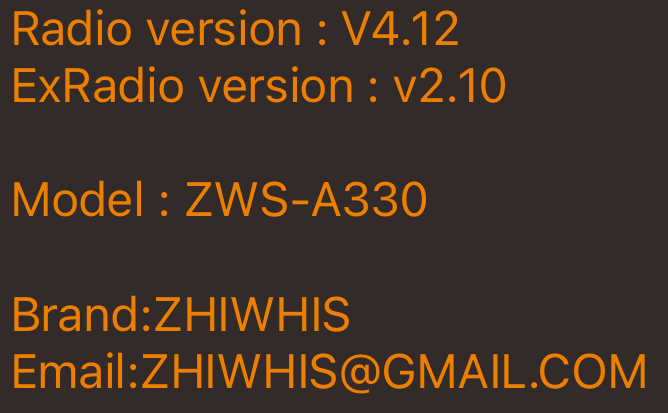
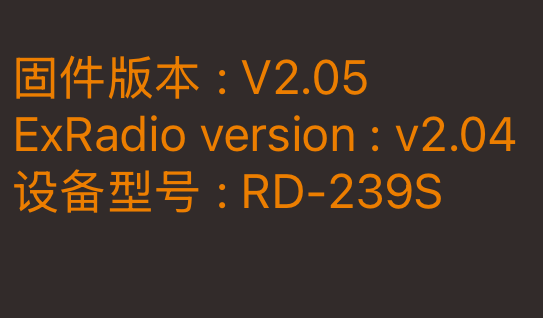
Device Model
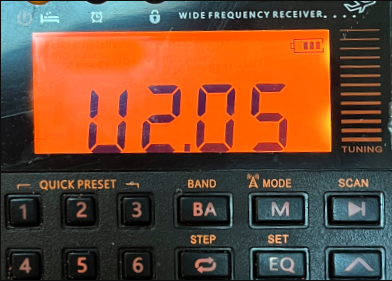
The A330 radio firmware version is also displayed with a short press of the [Preset] button in clock mode. Press STEP in clock mode to display the firmware on the RD-239S (undocumented feature).
I’ve been corresponding with both the LiJiANi and Zhiwhis folks with questions, documentation updates and bug reports and receiving replies from both. LiJiANi indicated that they are currently working on a software update that can be applied through a file on the TF card. I don’t know about updates from Zhiwhis; I hope then put out an update too. The A330 manual says that a radio bricked by a user firmware upgrade is not covered by warranty suggesting that an upgrade is possible.
Bluetooth Range
The elephant in the room is Bluetooth coverage. It’s not going to work if the repeater and the radio can’t talk to each other. I set up a test for the radios, and thought I was well in range. Only the radio sat on my desk, and in order to reach the repeater, signals had to pass through the thick wooden desktop, a keyboard tray, the back of the desk, two walls (a total of 2 inches of sheetrock) and the lattice back of a wrought iron chair. Reception was intermittent. This is why I suggest prospective purchasers use some Bluetooth device they already have to walk around and test the waters. I did not find any difference in the Bluetooth range for the two radios. [I wrote that before I knew that the W2 and W3 are electronically identical.]
When Bluetooth coverage is marginable, the signal just cuts out and comes back on. A radio signal dropping below the squelch threshold acts the same way, so rule out the squelch before concluding it’s Bluetooth.
What the repeater adds
The RD-239S gets three major benefits when the repeater connects: SSB support, 1 kHz SW tuning step in SSB mode and a UHF band.
The ZWS-A330 gets a LW band. The RD-239S has longwave blocked because there is no “LW” icon on the display.
Testing
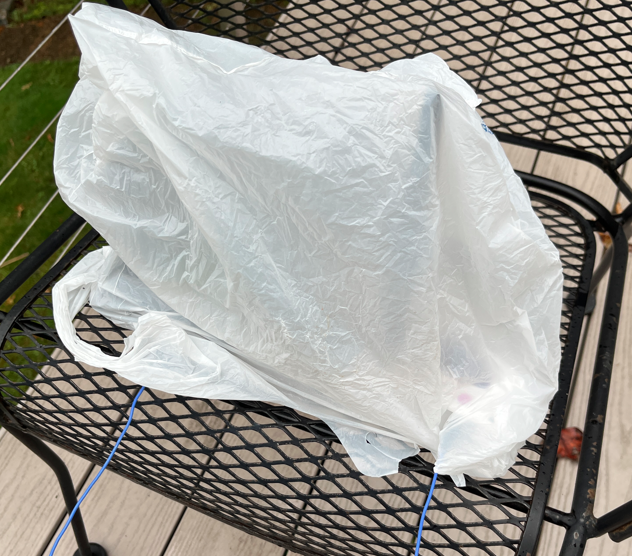
To test as fairly as I could, I used the two antennas that came with my W3 repeaters that are the same length (the supplied W2 repeater is a meter longer), and connected the radios to an external speaker using an A/B switch. When I started setting this up, it was after a rain and the chair outside where I usually sit was wet. Then it hit me. I can sit comfortably at my dining room table and put the repeaters outside. Duh. And then it started raining again.
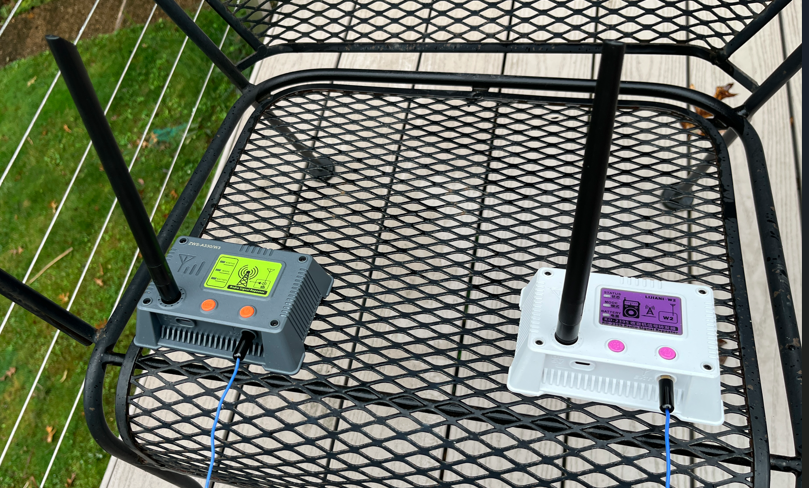
Weather protection ->>>>>>
Only the A330 supports LW, and that only when connected to the repeater. When the repeater is present, a LW band appears among the bands toggled by the [BAND] button. A good LW radio will receive around 3 daytime nondirectional beacons (NDB) when equipped with an external antenna. It appears in this case that the external antenna is not used on LW. I got nothing.
MW
Each of the repeaters has its own internal ferrite rod antenna. The rod antenna runs parallel to the front of the repeater. The A330 allows an external antenna to be used on MW, selected by a button; however, that button appears to have no effect on the repeater.
For the test, I selected 2 local MW stations, the first somewhat weak and the second stronger. I set the volume control of each radio to “24”, a value that gave what sounded like the same level to me on the strong station. The earphone jacks were connected to an A/B switch (the ZWS-A330 was “A” and the RD-239S was “B”. The output went to a Sony SRS-XB20 external speaker.
The video below shows the results. The weaker station sounded better on the RD-239S and the stronger station sounded about the same on both radios. Keep in mind the you’re not listening to the radio speakers themselves. Listening to the videos later, I’m not sure of the difference.
FM
It seems to me that FM is the sweet spot of modern radios. I’ve certainly been getting good results testing recent models, even relatively low-priced ones.
For my usual radio testing to count FM stations, I hold the radios in my hand with their telescopic antennas extended, tilting them in different directions to try to pick up stations. It surprises me how a station that’s just not there, suddenly sounds clear as the radio moves. No one in practice is going to wave a repeater around.
For the opening experiment I had the repeaters set up as they were for the MW test. Then I ran an ATS scan on the respective radios. The RD-239S/W2 counted 56 stations and the ZWS-A330/W3 caught 62. I don’t consider that significantly different. Both are very good.
While it’s not related to the repeater, I did want to give some idea of what the radios sounded like on FM. Ironically, the FM station I chose is itself a repeater. 😲
SW
For shortwave testing I used the A330 ATS to find the stations. The scan recorded stations that the radio barely received, what I consider a good result. Stations vary minute to minute and you want marginal stations that might be better later. The test was conducted mid morning, so there wasn’t much on the air. As with the MW test, both repeaters were side by side outdoors, and an A/B switch routed the audio output to an external speaker. The volume control was set to “24” on both radios, a setting that seems to produce the same level on a strong station. It does not produce the same level on a weak station. I thought the W3 was better at lower frequencies and the W2 at the higher frequencies. Watch the video and decide for yourself. Views of my videos often disagree with me.
SW – SSB
RD-239S tuning bug
I found an error in RD-239S firmware version 2.05 (W2 version 2.04). It’s not possible to directly enter some frequencies in single SSB mode. Example, in SSB mode press FREQ and try to enter “4172”. When the “7” is pressed the radio switches to fine tuning mode and it is not possible to complete entry of the frequency. When the radio is in the middle of entering a frequency, the [SSB] button should be treated as a digit, but it isn’t. The workaround is either to set the frequency to a 5 kHz step before entering SSB and then switch to SSB and use the arrow keys for the final 1kHz step, or use the app to direct enter the frequency in SSB mode. (The tuning knob has a minimal step of 5 kHz, so use the arrow keys.)
Calibration
If I know the frequency, like with VOLMET weather transmissions, I can key it in, switch to USB and listen to the station — provided the radio is calibrated. If it isn’t, I have to use a BFO/fine tuning control to make the signal listenable. The farther off the calibration is the longer longer it takes, and the more frustrating it becomes. Some radios come out of the box perfectly calibrated. Others have a user calibration feature. The ZWS-A330 and RD-239S don’t have documented calibration procedures.
I tuned a pirate station that was mostly music. Music is the hardest to tune for some reason — speech is easier. I tried music on a pirate station, 6160 USB. I found the ZWS-A330 required an offset of -017. The RD-239S required an offset of -12 (note that the display is 3 digits on on one and 2 digits on the other). In any case, those are numbers to write down and start with when tuning SSB. Both radios remember the offset value between listening sessions, simplifying the process.
Testing
Since learning that the W2 and W3 repeaters are electrically identical, side by side testing seems less important; more important is the experience of tuning SSB on the two radios, noting that the RD-239S only has SSB capability through the W2 repeater where the AWS-A330 has native SSB.
Both radios have operational problems with SSB (ones that I hope will be amenable to a firmware fix).
The issue with the 239S is that direct frequency entry fails with the numeric keys in SSB mode. You can’t enter a “7.” Let’s say you want to listen to 7284 LSB. Basically one has to take the radio out of SSB mode, enter 7285 (only 5 kHz steps in AM), put the radio back in SSB and then use the down tuning arrow to get to 7284. Also, I would prefer a 1 kHz step using the tuning knob, but the up and down tuning buttons are required.
The issue with the A330 is that the fine tuning control (BFO) using the central “shuttle” knob times out fairly quickly so that if the user pauses in the find tuning process, the control reverts to coarse tuning. It’s hugely annoying. Let’s say the signal is a ham radio operator. Those are often short transmissions so the BFO setting can’t be completed in one segment. When the transmission resumes, the BFO has closed and you have to open it again. Also the shuttle knob is somewhat stiff, and arguably the worst physical issue on the radio.
My first scan at 6pm local time around 6MHz returned none of the VOLMET stations, but AM station CFRX, Toronto, on 6070 sounded intelligible. I tuned the same station on the two test radios and got these rough fine tuning values, producing good speech:
- ZWS-A330: -020
- RD-239S: -12
Next morning …
As further evidence of the clumsy operation of these two radios, I decided to make life easier and get out my totally excellent Tecsun PL-990 with big numbers and a separate fine tuning control as smooth as silk, then tuned around the 40m ham band to get some traffic, finding some sort of net operation on 7284 LSB. Having found the stations, I used the frequency for the test radios. So here is ham radio traffic in SSB on the two radios.
If SSB is your thing, these radios, because of poor firmware design, aren’t something I would recommend. Get a Tecsun PL-330 instead or a Tecsun PL-990 if you can afford it. With the right firmware updates, these repeaters could be much less frustrating and more usable.
Summary
What we have is two electrically identical repeaters front ending two very different radios. The full feature comparison is in my review of the A330. With the repeaters in place, the radios perform about the same. The real difference is in appearance, operation and convenience.
For either radio, I caution the prospective buyer to consider the Bluetooth range. Use some other Bluetooth device to check the exact signal path you intend. Desktops, keyboard drawers, flooring, walls and furniture all have an impact.
Appearance
I think the ZWS-A330 looks sharp. It looks “technical” with that high-end walkie talkie aesthetic. Things look tack sharp, with the exception of the central power button on mine that leans towards the lower left (tsk, tsk). The RD-239S is a little less sharp with orange lettering on black, but that is offset by a major feature of the radio, backlighted buttons. Look at the two images from the video previews preceding. On a computer monitor, the A330 image is considerably bigger than the radio actually is, while the RD-239S appears smaller than in real life. In real life the A330 display is tiny; it’s hard to read in some lighting conditions. It has lots more information on the display. The 239S display is easy to read in all conditions.
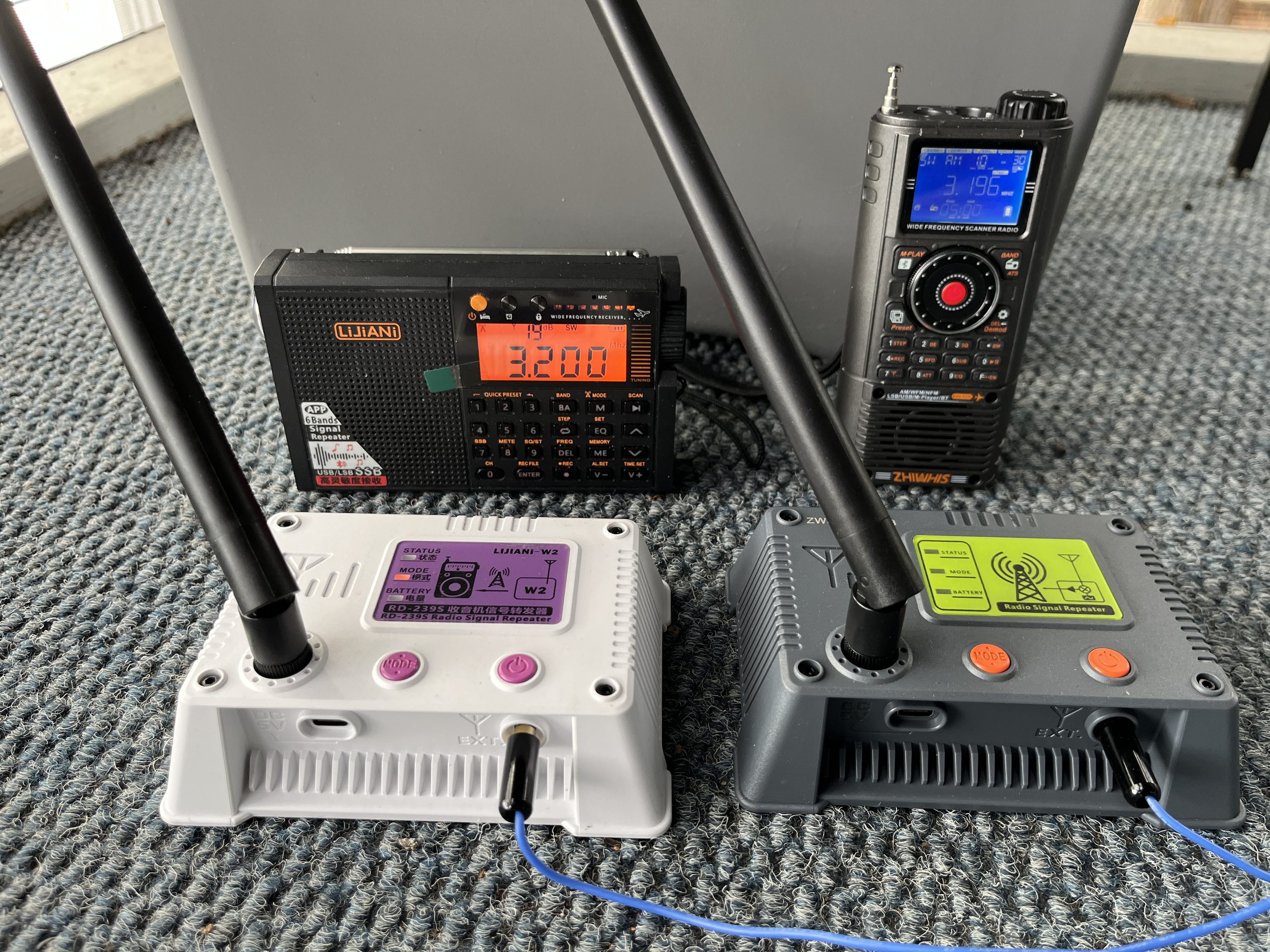
Display differences are offset by the fact that both radios can be remotely operated with an phone app
Operation
The 239S has one operational advantage — a separate button to start and to conclude direct frequency entry. This helps because both radios may automatically end frequency entry if enough digits are entered (the rules are somewhat mysterious) and if the one-button solution is pressed to end, you may find yourself starting a new frequency entry.
Both radios have significant problems (discussed previously) with SSB operation that could be fixed with firmware updates. We’ll have to wait and see.
The A330 has a rather stiff tuning wheel, what the manual calls the “shuttle”. The tuning knob on the 239S won’t step at 1 kHz on shortwave SSB, an unnecessary limitation.
Both radios can record to a MicroSSD/TF card. The 239S can record from an internal microphone or AUX input in addition to radio.
Both have equalization controls that help customize the sound.
Convenience
The A330 doesn’t have a kickstand, and it hardly could because of its vertical format. It’s still fairly stable. The 239S has a kickstand, but that’s less useful because the external antenna jack is on the back too. You’d want an angled plug for the antenna.
I finally decided to install the provided hand strap and to remove the factory-installed belt clip — it got in the way and didn’t hold firmly.
The A330 ships with an external antenna for MW (not the repeater), but it is wired non-standard, connected to the ring and shield. The antenna connections for the repeaters are standard, but it appears that the repeater does not support an external antenna for MW.
The A330 can reasonably be operated with one hand while holding it. The 239S reasonably takes 2 hands.
The 239S has a flashlight and a reading light.
Conclusion
I’m not going to recommend one radio/repeater combination over another. They are decent mid-tier performers at what I think is a fair price given all the features and bands received. Reception is about the same; the differences are in operation and that depends on what a potential purchaser values. I predict that both of mine will end up on the shelf.
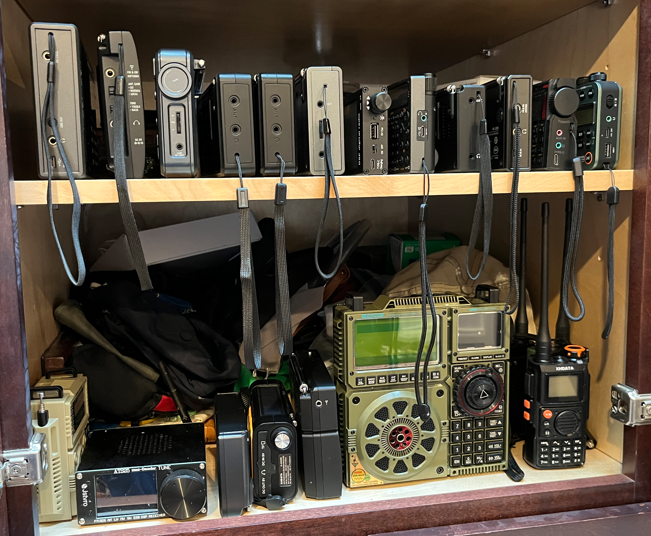
My Qodosen DX-286 will remain on my desk and the Tecsun PL-990 will be hauled out when I need to listen to SSB.
The radios in the photo starting with the top row are: Tecsun PL-330, Tecsun PL-660, Eton Elite Executive, XDATA D-109, XDATA D-109WB, XHDATA D-808, clone DSP Digital Radio SDR V6, HanRongDa HRD-757, Sihuadon R-108, Tecsun PL-330, LiJiANi Rd239, Sansui F50. Bottom row: JOC J-101W, ATS25 max Decoder, XHDATA D-219 (US version), XHDATA D-608WB, MALAHITEAM MLite-880, Zhiwhis ZWS-C919, XHDATA E-101 transceiver. Then there is box of radios, and drawer with some more, and a shelving unit downstairs.