
The Raddy ATS200 was first released in May of 2024. I ordered one from Raddy today because it was on sale for $69.99 (plus about $10 shipping). That’s $50 off.
It’s an attractive package at that price, with LW, MW, FM, SW, AIR, featuring both RDS, CW and SSB. It has touch screen operation plus lots of settings for AGC, bandwidth, attenuator and LNA. The chip is an Si4732 DSP plus an EPS32 microprocessor. Plus it sports a flashlight. Operation is almost all touch screen.
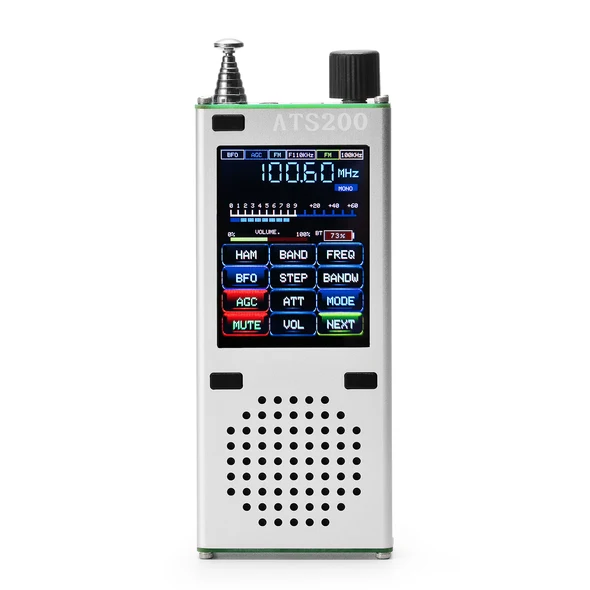
The case is CNC Aluminum, although the top and bottom seem like circuit board material.
RDS and AIR band are uncommon together. In this instance, there is an internal downconverter to support AIR bad. It also appears (the manual is fairly sparse) that the radio is a Bluetooth transmitter that can pair with external Bluetooth speakers, similar to the MLite-880.
It’s fairly small at 137 x 50 x 20mm / 5.4 x 2 x 0.8in (including knob and antenna). The antenna is an impressive 82cm (32″).
It’s supposed to arrive Oct. 27.
Questions
Does the radio have WiFi? ESP32-based hardware has Wi-Fi on the board, whether it does anything or not. My ATS25 max Decoder has a similar lineage, although it has an explicit external UHF antenna. The ATS25 can install firmware updates over the network.
There is one odd thing. I’ve always thought that iraddy.com and radioddity.com represented the same company, only with a different focus. Radioddity.com sells what they call the “Raddy Malahit ATS200”. It’s regular price is $119.99 and it’s on sale now for $107.99. iraddy.com sells it as the “Raddy ATS200” with the same regular price, but on sale for $69.99. Is there a difference?
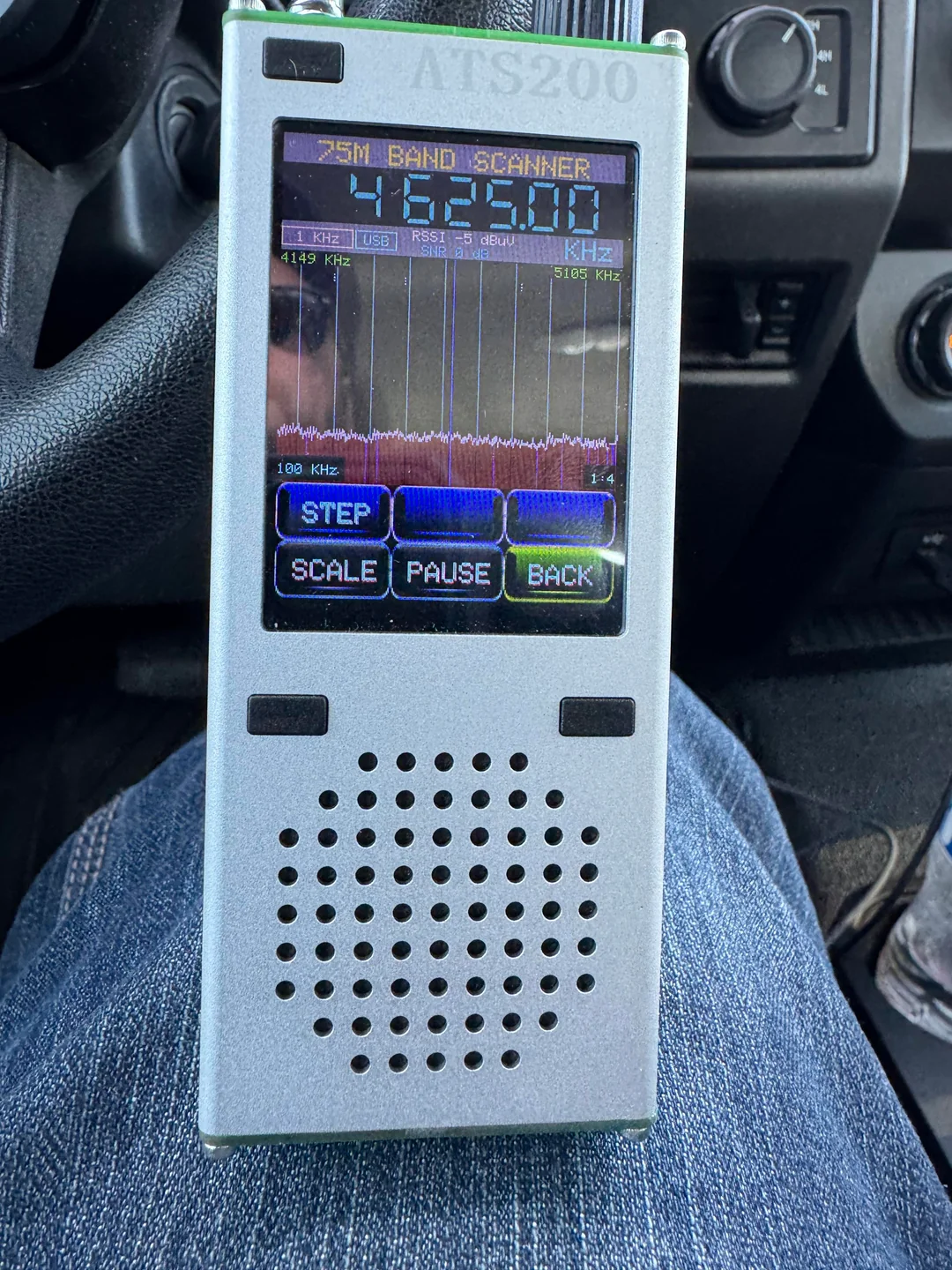
Why is there no spectrum display among Raddy product photos? I found this on Reddit. It appears to be a snapshot of the scan function. One runs the scan and then an image of the result is shown. The user can use the tuning knob to select a spot on the display and tune to it.
Is the firmware licensed? That is, can I download and install firmware without buying an activation code? Raddy marketing materials talk about firmware updates, but there are none listed on their download site.
There are YouTube videos available, including this detailed and informative one:
I noticed from the teardown in the video that there is no internal ferrite rod antenna for MW. This corresponds to a jack on the bottom panel of the radio, showing connection for a ferrite rod or a longwire antenna. I’ve collected a few ferrite rod antennas lately, including ones for the ZWS-C919, ZWS-777 and ZWS-A320.
Manual
More on this later but here is the English translation of some marketing material from the HamGeek seller on AliExpress:
The ATS200 radio is an upgraded version of the ATS120. It has a built-in frequency converter (mixer) that allows reception of AM signals up to 200 MHz, including coverage of the 118-137 MHz aviation band.
The radio uses an SI4732 + ESP32 + Bluetooth + 2.4-inch touchscreen display design. It features a custom high-grade aluminum alloy metal enclosure and a built-in 40 mm large speaker.
It supports FM, AM, LSB, and USB reception modes. FM includes RDS functionality. A Bluetooth stereo (FM) audio transmission feature has been added, allowing audio reception and playback through stereo Bluetooth headphones for a true Hi-Fi listening experience.
A switchable LNA preamplifier has been added to accommodate different signal conditions. Despite its slim and compact body, it incorporates an 820 mm telescopic antenna. It is convenient for travel and easy to carry. It is currently one of the world’s most cost-effective handheld pocket radios with SSB, full-band coverage, and a color touchscreen display.
Main Features
- 2.4-inch TFT color touchscreen
- Frequency spectrum scanning
- Backlight brightness adjustment
- Backlight off function
- Battery voltage display
- Battery percentage display
- High-precision, long-life rotary encoder tuning knob
- FM RDS information display
- Switchable LNA amplifier for different reception environments
- Automatic AM/FM band switching; AM and FM do not interfere with each other
- Bluetooth 5.3 high-fidelity stereo audio transmission. Enjoy listening privately with Bluetooth headphones or share via Bluetooth speakers.
- Top-mounted 3.5 mm stereo headphone output. In FM mode, the headphone cable can serve as an antenna.
- Touchscreen and encoder lock function to prevent accidental operation in a pocket
- Bottom-mounted 3.5 mm external antenna connector for various outdoor antennas
- Dedicated top-mounted LED mini flashlight that can be used even when the radio is turned off
- Built-in 820 mm extra-long telescopic antenna
- Built-in 3.7 V / 1200 mAh high-capacity lithium battery
- Built-in 40 mm large speaker
- Standard USB Type-C charging and firmware upgrade interface
- High-precision CNC-machined aluminum alloy rugged enclosure
- Compact size: 120 × 20 × 50 mm
A few technical comments
- The Chinese text says it can receive AM signals up to 200 MHz, which is almost certainly referring to RF coverage extending to 200 MHz through an upconverter/mixer arrangement, not ordinary medium-wave AM.
- The claim that AM and FM do not interfere with each other is marketing language and doesn’t have a clear technical meaning.
- The Bluetooth feature is unusual. It appears to mean the radio can transmit received audio to Bluetooth headphones or speakers, not merely receive Bluetooth audio.
- The mention of 118-137 MHz aviation reception is noteworthy because the stock SI4732 does not directly tune the air band, implying additional hardware or frequency conversion is being used.
Frequency Coverage
Frequency Ranges:
- FM: 64-108 MHz (with RDS function)
- LW: 153-500 kHz
- MW: 520-1710 kHz
- SW: 1730-30000 kHz
- SSB: 1730-30000 kHz
- Extended Frequency Coverage (AM mode):
- 50-200 MHz
- Includes the AIR band: 118-137 MHz
Basic Operation Guide
1. Button Functions
(Refer to the labeled diagram in the manual.)
A. Upper-left button: Power button
- Press and hold for more than 3 seconds: Power ON/OFF
- Short press: Turn the flashlight ON or OFF
B. Middle-left button: Multi-function button
Short press
- Locks the touchscreen.
- The letters “TL” appear on the display.
- Short press again to unlock the touchscreen.
- The “TL” indicator disappears.
Long press
- Press and hold for 3 seconds to lock the rotary encoder tuning knob.
- The letters “RL” appear on the display.
- Press and hold again for 3 seconds to unlock the encoder.
- The “RL” indicator disappears.
Double press
- Turns the built-in LNA amplifier ON or OFF.
- The “LNA” indicator appears on the display when enabled.
C. Middle-right button
- Clears Bluetooth pairing information.
2. Top Panel Components
From the top of the radio:
- Telescopic antenna
- USB Type-C charging port
- 3.5 mm stereo headphone output
- Rotary encoder/tuning knob
- Flashlight
- Hidden printed Bluetooth antenna
3. Bottom Panel
- 3.5 mm mono external antenna jack
4. Screen Menu Functions
The various touchscreen menu items correspond to their respective touch controls and are not described in detail in this section.
Main Menu Description
- HAM – Amateur radio bands commonly used by hams, including SSB operation.
- BAND – Common broadcast radio bands.
- FREQ – Direct frequency entry.
- BFO – Fine frequency adjustment for SSB reception.
- STEP – Tuning step setting.
- BANDW – Bandwidth selection.
- AGC – Automatic Gain Control.
- ATT – Attenuator selection.
- MODE – Mode selection.
- MUTE – Mute.
- VOL – Volume adjustment.
- NEXT – Next page.
Warning
Warning: The ATS200 uses an entirely new firmware platform. It is not compatible with the Russian firmware. Do not flash firmware arbitrarily, otherwise the radio may be damaged.
This passage answers a couple of questions you’ve raised in earlier ATS200 discussions:
- BFO is explicitly intended for SSB fine tuning, not just CW.
- STEP is a menu item rather than a dedicated button function.
- ATT confirms there is a selectable attenuator in addition to the switchable LNA.
- The manufacturer explicitly warns that the ATS200 firmware is different from the firmware ecosystem used by many of the Russian-developed ATS receivers (ATS20, ATS25, ATS120 variants, etc.), suggesting the ATS200 is not merely another ATS120 running modified software.