
Note on Antennas
In what follows I may refer to various antennas:
- WOW (Wire Out Window): the WOW antenna is 40 feet long stretching E/W terminating in a 1:9 earth-grounded balun. With the balun, the radio performs just about equally whether I set it for 50Ω or HiZ
- WUT (Wire Up Tree); the WUT antenna is 20 feet long, stretching N/S diagonally up a tree. The lower elevation where the radio sits is about 6 feet above the ground. It has an earth ground also connected to the radio using it when possible. I set the radio for HiZ or this antenna. I have found on other radios that the ground connection on LW and MW make a world of difference.
- MLA-30+: This is a commercial amplified loop antenna.
- Telescopic: whatever comes with the radio. The MLite-880 antenna is 72cm.
- Reel: Sangean ANT-60 wire antenna about 23 feet long. I set the radio for HiZ or this antenna.
- Donut: This is a loop antenna about 4 inches in diameter, often bundled with some of the ATS4732 mini radios. I have a red one labeled for 10kHz – 180 MHz. Mine isn’t tunable.

Frequency coverage

The graphic above from the Elecevolve website is supposed to indicate the frequency coverage of the radio; however, the frequencies between 108 and 118MHz can also be tuned but I haven’t received anything there. The range between 30 and 64MHz cannot be accessed.
Longwave
There’s not much to hear on the longwave band in North America. The MLite-880 covers 130 – 30000 kHz continuously. Noise is a huge limiting factor on LW. To avoid the noise I went outdoors and hooked up my 20-foot WUT (wire up tree) antenna and an earth ground to see how it went.
The 25W nondirectional beacon at the Culpeper Airport is about 43 miles from me. While the station broadcasts Morse code (“MSQ”), the tone is AM modulated, not CW. The MLite-880 picked it up nicely.
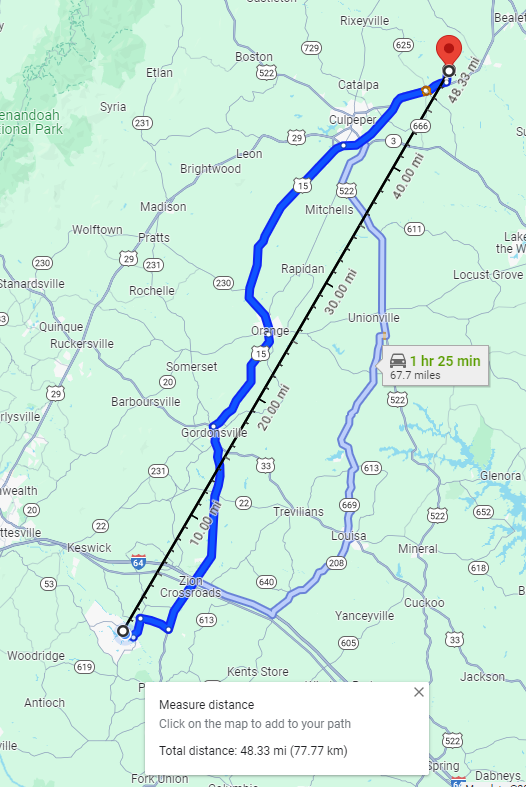
I’ve picked this up before with the same antenna on my, Qodosen DX-286, Tecsun PL-330 and Raddy RF-760 radios (Flying the Shuttle: Raddy RF760 Tips and Tricks).
And now the story gets interesting. I tried another NDB, further away in Fredericksburg, VA, and there was noting, nada, zip. My DX-286 got it fine. Then the realization hit, there is an antenna setting on the MLite-880: 50Ω or HiZ. Switched to HiZ (high impedance), the radio received the station loudly. Lesson learned: when trying a new antenna on a new band on this radio, check the impedance setting.
However, with the WOW antenna, the 50Ω setting isn’t much different, presumably because of the impedance matching balun on the antenna. One nice operational feature of the MLite-880 is that it’s easy to change the antenna settings, performed with one button without leaving the menu, allowing simple audible A/B comparison.
Conclusion: the MLite-880 is a strong performer on LW, at least above 237 kHz.
MW
Usually I’d be talking about my midday band scan on MW, but that’s doesn’t apply here because there is no internal MW antenna on the MLite-880, and choice of antenna makes a huge difference, far more than the receiver.
I don’t get much on MW in my rural location in general. I thought I’d try a donut antenna and quickly found the 50Ω setting more appropriate. It easily picked up the one strong local station, WINA 1070 kHz, but almost nothing else. Following is a video of reception. What’s interesting is what happens when I turn noise reduction on (turn up video volume for maximum impact):
The donut antenna didn’t get much compared to a conventional radio with a loopstick inside.
Just for grins I plugged in a loopstick antenna that was bundled with my Zhiwhis ZWS-C919. It didn’t do any better than the donut.

When I plugged in the WUT antenna at midday what happened was exactly what I expected — stations flooded in; I stopped counting at 60.
While in lower frequency territory with the WUT, I scanned through 2000 – 3000 kHz and didn’t hear any artifacts (often a problem with DSP radios).
FM
I found the FM sensitivity with the supplied telescopic antenna outstanding, on par with the best radios I have like the Tecsun PL-990. The midday band scan results are in this article: First Impressions: MLite-880 Resumed!
RDS/RBDS
Broadcast FM radio stations optionally include data with their signal, data identifying the transmitting station, program type, time of day and program details. What actually gets included varies widely by station. For more general information on this topic, see my article: RDS / RBDS: FM on Display.
In order for a radio to properly display Radio Data System information, it has to know the region. A few radios, like the ATS25 series, have explicit ITU region settings. Most just figure it out, typically based on the MW step size. The MLite-880 has neither an MW step setting, nor an ITU region, so one wonders how the radio will figure it out, or if it will figure it out. Some radios can set their clocks with RDS data, although RDS time information can be unreliable depending on the station. Nothing I’ve found suggests that the MLite-880 can set its internal clock from RDS. I never use RDS for clock setting anyway because stations are unreliable.
So my testing interest has two parts, finding out what information gets displayed, and whether the PS segment is decoded correctly for Region 2. I’m using WVTW for the experiment. The comparison is with my Eton Elite Executive, the best I have, except that it doesn’t show PI. In general, there is significant variability between stations as to what they include in the segments, and around here. Also note that it takes time to send the data on the 57 kHz subcarrier, so wait a little while for all the results.
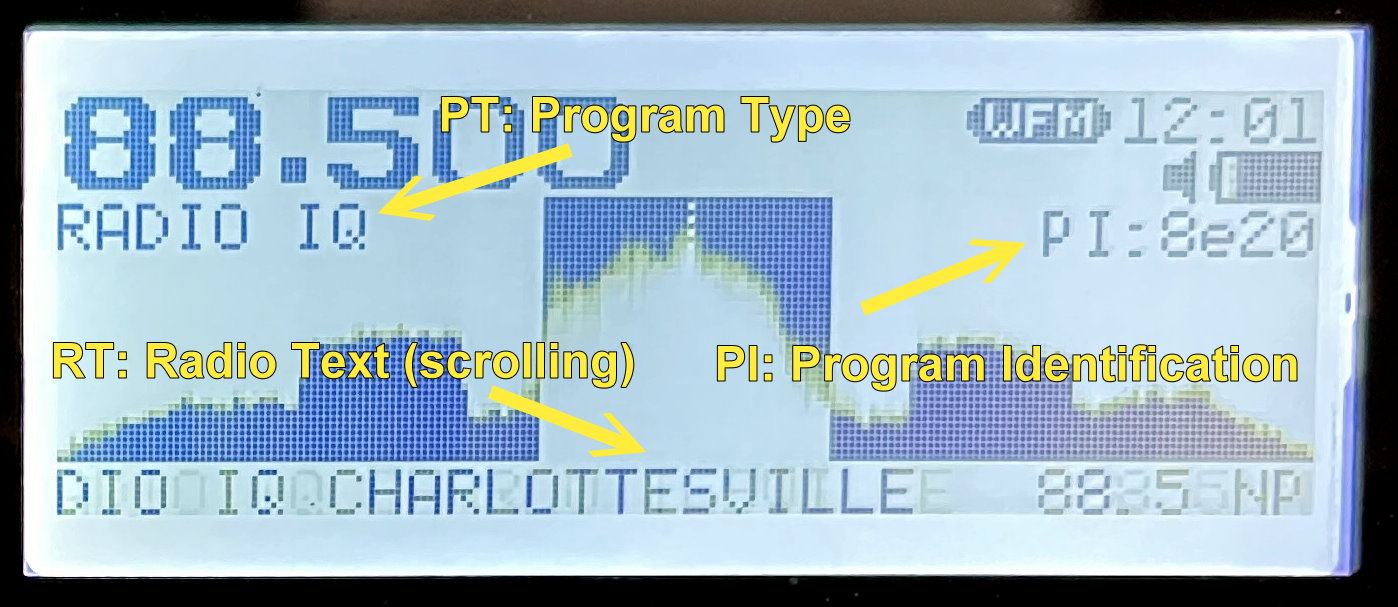
All regions have a 4-digit hexadecimal number called the PI, and in the United States most stations include a unique value that can be looked up or converted to a call sign algorithmically.
| Segment | Eton Elite Executive | MLite-880 |
|---|---|---|
| Program Service (PS) | TALK | n/a |
| Program Type (PT) | Radio IQ | Radio IQ |
| Radio Text (RT) | Radio IQ Charlottesville 88.5 NPR NEWS TALK | Radio IQ Charlottesville 88.5 NPR NEWS TALK |
| DATA / CT | “NO DATA” | n/a |
| Program identification (PI) | n/a | 8e20 (correct) |
So it appears that the MLite-880 bypasses the regional differences in the PS Segment by omitting the segment. No big deal — the listener can tell the difference between NEWS and ROCK without a display.
SW
Shortwave Broadcast Listening
I’m mostly an international broadcast listener, and with fewer stations on the air, selectivity is less significant. It appears that HF selectivity is implemented as an audio filter in this radio (?) rather than earlier in signal processing (or else they hid it better than I could find). There is, however, a bandwidth setting for CW mode and others besides AM.
Sensitivity and low noise are more important for my listening. The MLite-880 is very reactive to hands near the display, and it issues a burst of noise when the display is touched, so don’t do that. In addition, pressing the “9” key to blank the display entirely can reduce noise a tiny bit. A signal would really have to be at the margin before I’d bother blanking the display. The display backlight itself doesn’t generate any noise I can detect.
Test results with the Telescopic Antenna
I found the telescopic antenna sensitive compared to other comparable radios. Just one warning, set the antenna input to HiZ; it’s not automatic.
Test results WUT Antenna
Overall, my WUT antenna, because it’s away from noise, gives me the best results. Here’s that same strong Radio Exterior de España signal on the WUT:
Next I ran a comparison with my Qodosen DX-286 on Canadian station CFRX, which is fairly weak this time of day.
Test results with WOW Antenna
I got up early for this one, hoping that I could receive HCJB from Quito, Ecuador on 6050 kHz. The once mighty broadcast powerhouse today is represented by Reach Beyond Australia, but still broadcasts on low power religious programming and music in Spanish, and indigenous languages of Ecuador. It’s not a particularly difficult catch here in Virginia at the right time of day with the right antenna. I used my WOW antenna with the radio set for 50Ω and Noise Reduction on. 1006 UTC, 06:06 local time. (I had clicked the encoder to get the display light to come on so it’s 1 kHz off frequency at the start.)
Listening with the MLA-30+
One neat feature of the MLite-880 is its ability to power an externally amplified antenna without a separate Biasing T. Magnetic loop antennas are particularly useful to reduce local noise. Because then are amplified, one might consider turning internal low noise amplifier in the radio.
I gave it a try. The “power switch” is on the Radio Settings Menu, Page 1. A blue light confirms. I set the Antenna input to 50Ω. It appeared to work. The voltage I measured was 3.78V, which is outside the nominal 5-12V operating range for the MLA-30+. One might get 4.2V out of a fully charged battery.
Here’s Radio Exterior de España, at 2020 UTC on 17715. It was a strong signal. Noise Reduction was on.
SSB
SSB is a big deal to some people and the lack of it a deal breaker. Ham, military and utility traffic may use this technique to transmit over longer distances with greater power. Only one shortwave broadcaster I know of uses it, WJHR in Milton, Florida. It’s on during daytime at 15555 kHz USB, but I haven’t been able to catch it recently.
About 8:35 AM local time I visited the 40m amateur radio band where I expected abundant SSB traffic; I was not disappointed. Ham traffic on 40m is almost certainly on the lower sideband, LSB.
Here is a detail from the MLite-880 display of a LSB signal showing a vertical dotted line marking the tuned frequency and signal display to the left, the lower sideband. The display can be a rough tuning aid.

I don’t know the exact location of the transmission site but from the conversation, I think it was in Ohio. Frequency was 7193. My MLite-880 calibration was about 50 kHz off, so I will need to do a little calibration. Noise reduction was tried, but it doesn’t make much difference with SSB. I thought the SSB transmission sounded quite good. The antenna was my WOW. Here’s the video:
Frankly, I have found SSB reception frustrating on other radios. I keep tuning around in the dark hoping to get close enough to the frequency that the fine tuning or BFO control can clarify the signal. I found the spectrum display to be quite helpful for coarse tuning.
For more on this signal transmission mode, check out my article: SSB!
CW
Firmware release 1.5 improved CW so now the listener need only tune the base frequency and the radio will offset to generate the audible tone.
VHF
My first VHF attempt was for my local NOAA weather station, and what I found was a significant difference between the displayed frequency and the actual frequency. It was necessary to calibrate the radio. I won’t go through the procedure, but it’s basically under the Radio Settings menu and is called Freq. correct. The units vary by band and firmware version. I set mine to -85 x 0.5 ppm.
Air band
I don’t listen to air band much. When I get a new radio with Air band, I tune to 126.875 MHz. It’s some sort of traffic control handoff frequency and it’s fairly active. Channel spacing for Air band in the US is 25 kHz. In some parts of the world where the band is more crowded, the spacing is 8.33 kHz. Both steps are supported by the MLite-880.
To reduce noise (since AIR band uses AM), one typically uses a squelch control to mute the radio between transmissions. Depending on implementation, there may be a huge burst noise at the end of each transmission when the AGC tries to compensate for lost signal and before the squelch kicks in. The MLite-880 noise reduction, however, cuts down on the noise significantly, so much so that one might not even decide to use the squelch.
In any case, I was not at all surprised to pick up air band signals well. A serious air band listener will be using a scanner radio rather than a general-purpose radio like this.
Weather Band
With the V1.4 firmware release, the MLite-880 receives NOAA weather stations (162.400 – 162.550 MHz) and frequencies up to 165 MHz (formerly the top was 148MHz). It lacks nearly all of the features one usually associates with “weather radios,” like weather alerts, solar panels, device charging, sirens and flashlights.
I went out to my front porch, the optimum weather station reception point, and received my local station plus 3 others. That puts it with the top of my tested weather band receiving radios (see: Thunderous Clash of the Weather Radios). Set the radio STEP to 25 kHz for weather band. The MODE is NFM.
I have a very new (late April 2026) MLite-880 and it arrived with the 1.4 firmware and weather band. Owners with older hardware aren’t faring as well. When they installed v1.4 and v1.5 firmware, they were able to tune WB, but the radio was deaf above 148 MHz. Elecevolve has promised to resolve this for all units with v1.6 firmware that’s supposed to be available the week of May 18.
Here’s a brief video of weather band reception. It appears that the radio bandwidth is set narrower than the actual signal, and I could find no bandwidth setting for narrow band FM (NFM). The existing bandwidth is adequate.
Noise reduction
Noise reduction seems fantastic. There is a noisy signal on Air band or something on shortwave. Press the NR button on a noisy signal and the signal sometimes sounds almost local (different signals respond differently), but before showing a before and after video and doing the happy dance, I have to note that the MLite-880 itself seems to me a noisy radio to start with. So in the video that follows, I compare the MLite-80 with noise reduction on and off to a Qodosen DX-286 at the same time with the same antenna. (The NR display indicator doesn’t appear when the encoder knob is set for volume control, as it was in the video, so I’ll add that as a title.)

Audio
My first test for audio is tuning WWV with its low frequency digital time code subcarrier. The MLite-880 reproduces the signal and one can feel a strong vibration when holding it.
Speaker
The video compares stereo FM classical music between the MLite-880 and the Tecsun PL-990. As expected the Tecsun sounded better.
Headphones
With a pair of Audio-Technica headphones, the PL-990 seemed more alive and had better bass. They didn’t seem to help the MLite-880 much.
Recording
I took a small sample of that FM broadcast, recorded by the MLite-880 itself for comparison. The gain cannot be set unless recording, so take samples in advance. If the radio displays “OVF” then be assured it’s badly overloaded. I had mine set for 19 db, and that was probably too high. Recordings are only in .WAV format. Recordings end up in a folder named “SoundRecords” on the MicroSD card media. Here’s some Mozart courtesy of WVTF and the MLite-880:
Bluetooth
Bluetooth wasn’t immediately apparent, and my best guess, that it might be under Audio, was wrong. It’s under Radio Settings, Page 2.
I had no problem pairing with three Bluetooth speaker devices, the Tecsun PL-990, Sony SRS XB-20 and a Sunflash RD-666, but in each case the MLite kept playing through its own speakers, and nothing was heard from the Bluetooth speakers. The MLite-880 blue indicator light was on.
When in doubt, refer to the manual (shudder). No help there. Finally I wrote an email to Elecevolve asking what was going on, but before sending it I though of just one more thing to try. It turns out that Bluetooth only works when the Audio Output is set to headphones.
Below is what Bluetooth sounds like connected to the DP-666 (which, by the way, is not stereo). The sound was so very much better than straight from the DP-666.
Thing that could be better
First, I simply do not like having tuning and volume on the same knob. I repeatedly turn the knob expecting one and getting the other. I ended up not clicking the decoder knob to make the switch, rather relying on the “#” keyboard shortcut. I don’t what firmware versions support this shortcut key, but at least V1.5.
Calibration isn’t something one does often, but the firmware could certainly updated to make it easier. What is needed is access to the spectrum display at the same time the calibration is adjusted with the tuning knob. As it is, one has to keep switching back and forth.
Capriciously replacing direct frequency entry when it’s not a multiple of the STEP setting is inexcusable. There’s simply no reason for the radio not to tune to the frequency keyed in.
It’s a shame that there are no frequency markings on the spectrum display — just a vertical rule like with the DSP2 with no numbers would help. Also every other radio I know of turns on the display backlight when the the user interacts with the radio, except this one. Very few things turn it on. This is a big annoyance
Auto tuning mode just doesn’t work. Sometimes it skips most stations, and sometimes it stops on almost every frequency, station or none.
Bluetooth should work, no matter what the output setting (speaker, headphones or both). It only works with the headphone setting.
Conclusions
This the part I hate about reviews. I’m a Gemini and I have two minds about almost everything. The MLite-880 checks a lot of boxes:
- Coverage of LW, MW, SW, FM and VHF (Weather, ham, AIR)
- It is sensitive on all bands
- No overloading problem
- Noise reduction is surprisingly good
- Recording feature with stored frequency and date/time
- Actively supported with firmware updates
- Spectrum Display
- Hosting Bluetooth speakers
I’m going to agree with Gilles Letourneau of the OfficialSWLChannel on YouTube, that without the Noise Reduction feature, people probably wouldn’t consider this radio (check his extensive coverage). But it has the Noise Reduction feature and that makes listening far better.
I’m going to assume that this radio would only be considered by someone who intends to listen to SSB and CW (lots of money could be saved using radios without them). Adding the VHF or recording features to the criteria excludes SSB-supporting radios like the Tecsun PL-330/PL-520. Adding an arbitrary $200 price cap excludes the Raddy RF919/HanRongDa HRD-C919/… that I’m not enthusiastic about anyway. An alternative doesn’t jump out.
If you want a grab and go radio where you don’t have to think about settings, the manual is complete, and there is a button for almost everything labeled right on the front, then the MLite-880 isn’t your baby. On the other hand, of you’re an enthusiast that likes a device with a community behind it, can live with menus, gets excited about an actively growing capability through firmware updates, and one who loves to experiment; if you want a full function radio and don’t mind only one knob, the learning curve, the awful manual and no ATS, you might well want to consider the MLite-880.
Knowing what I know now after weeks of testing, I doubt the MLite-880 will become my daily driver. It will live mostly on the shelf and I’ll be waiting for the far more expensive Malahit DSP4 when it comes out. And in the meantime there is always an SDR dongle and a computer.
Interesting discussion here:
https://swling.com/blog/2026/05/revisiting-the-mlite-880
Doesn’t this radio have synchronous demodulation (SAM)? You should test that too!
Yes it has synchronous detection, and yes I should test it.