
Terminology one sees online isn’t always precise, and many people conflate muting, soft muting and chuffing. I tend to get sloppy too. For the purpose of this article, here are the terms as I’m using them:
- Muting: When the radio shuts off the sound. This can be a Mute or Play/Pause button on the radio, or an automatic function to quiet the radio when scanning.
- Soft Muting: This is a radio feature that reduces the volume when there is a very low signal to noise ratio. It makes the radio quieter when tuning through empty bands, but it can also hide weak signals.
- Chuffing: Chuffing is an annoying “chuff” sound when tuning from one frequency to another.
Whenever someone asks a question or makes a comment about these, it’s best to know what they mean.
Continuous Tuning
Shortwave radio receivers can be divided into two categories, those that tune continuously, and those that tune in steps.
My Nanaola 10NT-504 from 1966 is an example of continuous tuning.
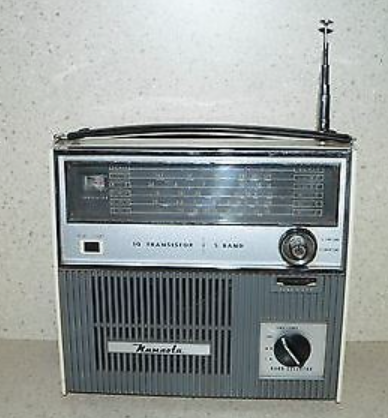
It had concentric coarse and fine tuning knobs in a 5-1 ratio connected to a continuously adjustable variable capacitor that controlled the frequency of the local oscillator. The local oscillator generated a signal that when mixed with the incoming radio frequency produced a fixed intermediate frequency signal filtered for 455 kHz, the intermediate frequency that was amplified, detected, amplified and eventually output by a speaker.

Users of these radios developed an expectation of continuous tuning where the slightest jog of the tuning dial made an equally slight change of frequency, gradually changing the sound as smoothly as the eye can pan the horizon.
It was all analog processing and the tuning was almost continuous. Why did I say “almost”? Because this radio didn’t tune continuously; it had 5 bands: LW, MW, SW1, SW2 and SW3. While those three shortwave bands left no frequency gaps between, the user still had to manually turn a switch and invoke different circuitry in the radio to switch bands — and when the operator did that, there was interruption and a sudden change in the background noise and the radio made a sound that one might even call a chuffing sound. For many decades, most radios worked this way.
Digital Displays

As technology advanced, radios started showing the frequency on a display screen. These radios received signals in exactly the same way as before, but there was a frequency counter that measured the frequency of that local oscillator and computed the signal frequency for display. My sentimental favorite Tecsun DR-920 is one such radio.
One issue with all the radios discussed so far is drift: the tendency over time for a radio to go off frequency and require retuning.
Digital Tuning
Radios like my DR-920 lacked features we take for granted today: frequency stability, the ability to scan for stations, and memory presets. To address these shortcomings, a new technology called the phase locked loop (PLL) was developed. Instead of a variable capacitor, a voltage controlled oscillator generated the local oscillator signal, and the PLL kept it on frequency.

The Tecsun PL-660 tuning resolution is fine, but not continuous. Here is a chart from the Tecsun PL-660 User Manual from Tecsun Australia:

So why does the tuning feel continuous despite discrete steps?
- PLL technology changes frequencies very quickly.
- The radio doesn’t mute between steps and doesn’t need to.
- The human brain is good at filling in gaps when changes are small and smooth.
- The bandwidth isn’t particularly sharp, meaning signals from one step appear partially on both sides of the transition.
- The PL-660 is particularly well engineered.
In a digitally tuned radio the analog motion of turning a tuning knob has to be digitized. That can be accomplished in a couple of ways, either by connecting the knob to a potentiometer (a variable resister) or a switch that sends a signal each time the knob rotates a certain amount. The PL-660 does a very good job at tuning smoothly. On the other hand another expensive early and well respected radio, the Sangean ATS-909, is also a PLL superhet radio, but it does not tune smoothly at all:
The tuning knob has very deep detents and the chuffing sound is extreme.
Digital Signal Processing (DSP)
Multi-band radios are complex and expensive to manufacture. Improving selectivity and suppressing images requires additional circuitry, as many as three conversion steps. Things like IF transformers are more expensive than chips, and they have to be mechanically aligned during manufacture.
Going all digital makes circuits simpler and lowers costs. Companies like XHDATA sell MW/FM/multi-band SW radios for $12 these days. Other digital radios explode the number of bands supported to VHF, UHF, AIR, Weather, GMRS, CB, LW, SW, MW and FM. They pile on features like massive ATS memories, switchable low-noise amplifiers, many bandwidth options, SSB, NFM, MP3 play/record, flashlights, weather alerts, and Bluetooth, priced at a fraction of the $512 price tag (2025 dollars) of the Sangean ATS-909 when it was new.
Not withstanding all those features, tuning isn’t so smooth. Changing frequency in a DSP radio takes time and most DSP radios mute the sound during that gap.
The Hybrid Model
Some high end radios like the Tecsun PL-880, PL-990, S2200X and the Sangean ATS-909X2 are PLL superheterodyne radios that use a DSP chip for decoding the signal, but not for tuning it. The result is that only a single intermediate frequency reaches the DSP chip. The advantage is that the DSP chip can provide SSB decoding, synchronous tuning as well as a wide range of options for bandwidth. Those radios appear to the operator as if their tuning is continuous even if a 5 kHz step is employed. They don’t chuff.
With sufficient CPU power and memory, a DSP radio could be created that would emulate continuous tuning (like we see in an SDR), but it might be too expensive and consume too much power to compete with the hybrid model.
Soft Mute
Soft Muting is intentional reduction in background noise in response to weak or no signal. It makes the radio quieter, but that also means that some weak stations may not be heard. Squelch is akin to soft muting, but it cuts the sound off completely rather than softening it.
Soft muting is not limited to DSP radios. It’s a switchable feature on the hybrid tuning Sangean ATS-909X2, standard on the Tecsun PL-660 and a “hidden feature” on the hybrid Tecsun PL-880.
The following video shows the difference made by soft muting in three radios, one that soft mutes, one that apparently doesn’t, and one that gives the operator an option.
The first example is the XHDATA D-808 that soft mutes. Here we see WWV being received on 5 MHz. It’s a strong signal, but not a loud one. When tuning upward, the sound level drops noticeably. [Note: there is some disagreement as to whether what follows is actually soft muting.]
In the second video I feature the Qodosen DX-286 that does not appear to soft mute. When tuning above the WWV signal, the radio volume from the noise floor is quite noticeable. The DX-286 also picks up weak stations in an ATS scan.
In the third, I demonstrate the Sangean ATS-405 that has a menu setting to turn the soft mute off and on. The Sangean manual explains:
Soft Mute is to reduce background noise during weak signal, however it will also reduce radio reception. The initial setting for Soft Mute is OFF.
Below are two examples, first with Soft Mute off (the default) and second with it on.
The Tecsun PL-330 has a hidden feature to turn soft mute on and off (long press the “9” button with the radio off to set it).
The Question
A fellow asked on Facebook if there were any reasonably-priced modern shortwave radios that didn’t mute.
It depends on what he meant by mute and it depends on what one considers “reasonably-priced” and “modern.” If he meant radios under $100 that don’t chuff, then I think not. A software-defined radio (SDR) on the other hand, does provide continuous tuning with the benefits of a DSP, but those require a host computer and consume quite a bit more power. The Tecsun R-9700DX is a dual-conversion superhet, a non-digital and non-chuffing radio for well under $100, but I wouldn’t call it modern.