According to their website, World Music Radio is a 24-hour music station using just a couple hundred Watts output power. It’s a rarity to be heard in North America, but thanks to a hint from Gilles Letourneau on the YouTube Official Shortwave Channel, I gave it a shot and was bowled over by the great signal around 22:30 UTC on 25,800 kHz using just a 2o-f00t wire up a tree (WUT) antenna.
Here’s my reception on three radios: Tecsun PL-990, Qodosen DX-286 and Tecsun PL-660.
Like many stations today, it can also be streamed from the WMR website.
The simple strategy is to try to find a low frequency when it’s dark and a high frequency when the sun is up. Solar radiation changes the reflectivity of atmospheric layers that direct radio signals back downward towards the Earth.
Success in the Afternoon
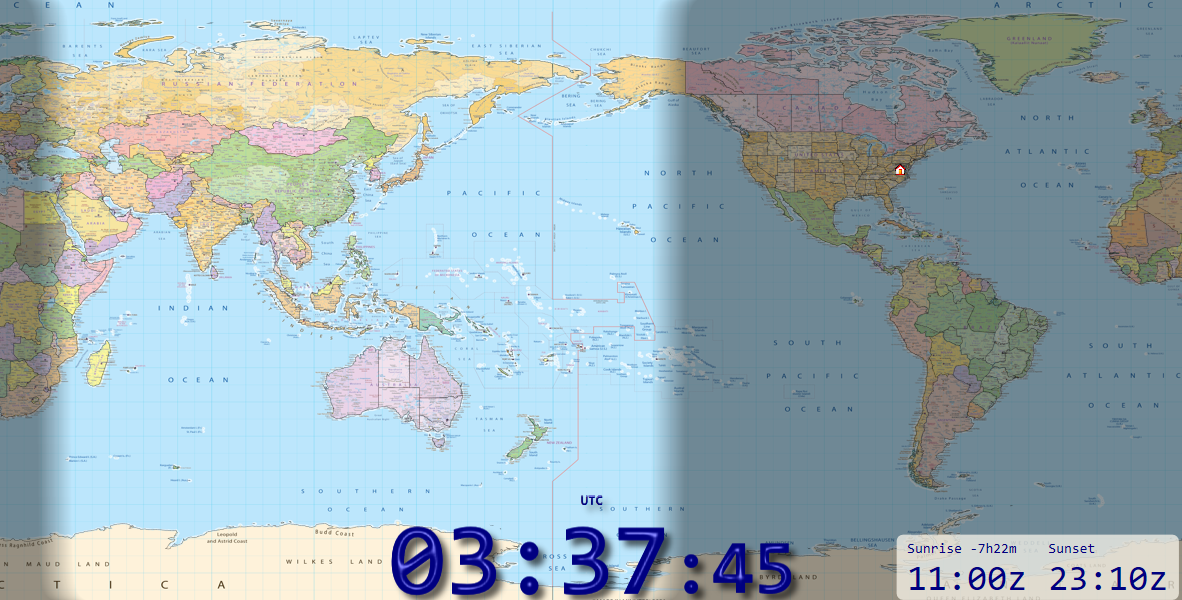
The first time out, around 23:20 UTC on a Friday, just after sunset local time, I tried 17675 kHz on a couple of radios, my Tecsun PL-990 and the always portable Qodosen DX-286. This was outdoors with my 20-foot Wire Up a Tree (WUT) antenna. At this time of day there is a daylight path between me and New Zealand. Both radios picked up the station weakly. About all I could tell was that there was a male and female announcer speaking in English.
Success in the Morning
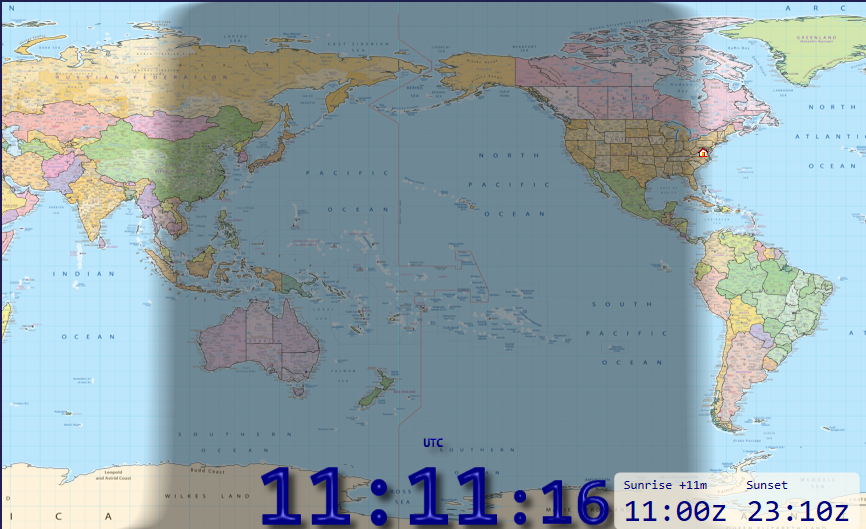
I went out the next morning half an hour before sunrise when there was a dark path between me and New Zealand. I was met with much greater success on 9700 kHz, with a strong signal on the DX-286 with just the telescopic antenna. The issue was rapid fading that made the sound, particularly the music less enjoyable. Fading was a bit less of an issue when I hooked up the WUT antenna. News at 11:00 UTC opened with a story of a nuclear reactor at Three Mile Island in the US being reopened to provide power for a Microsoft AI project. Here’s what the light path looked like about 10 minutes later:
I’m located under that tiny house icon on the east coast of the US and New Zealand is that green thing just west of the International Date Line. The distance is 8,530 miles as the very tired crow files (13,728 km for the New Zealander).
Midnight Madness
I took the PL-990 out half an hour before midnight. WUT Antenna, 17675 kHz. I wasn’t expecting much on such a high frequency so late at night. Wow was I wrong. Strong signal. Male voice reading some literature.
Conclusion
I was able to visit New Zealand via shortwave radio and I didn’t even need a tourist visa.
Many users feedback that DX-286 doesn’t come with batteries, which caused some trouble for users, this time we added new links to the included batteries on both Amazon and aliexpress.
The above link contains 2 x 3350MAh high capacity batteries, which are guaranteed to be no less than 3350MAh, and have been tested to work for about 12~15 hours at 2/3 volume, but of course it depends on the content of the programme you are listening to, and the power consumption varies from programme to programme.
Not all the radios come with batteries, only the ones that say the have them, specifically the two links above have them.
The Amazon with 2 batteries costs $89.99 compared to the one with no batteries at $79.99. This is a very reasonable price for good quality batteries.
PS: The numbers here indicate a current draw of between 223 and 279 mA.
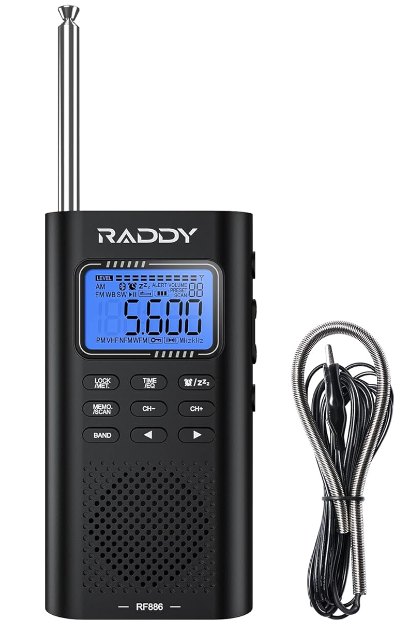
I started feeling the itch for a new radio. The Raddy RF886 sells for about $26, but Amazon had two 10% off coupons. It fits my Swiss Army Knife category as a radio, computer USB speaker, USB speaker and a flashlight with SOS siren. The radio side has MW, SW, FM, VHF and Weather with alerts. It lacks AIR band and MP3 capability.
It’s supposed to arrive tomorrow (August 14).
I found a manual on the Raddy website, dated March 5, 2024 that is significantly expanded and corrected beyond an earlier one I found Amazon. Here it is for reference:
It looks like the major problem will be tuning. There’s obviously no direct frequency entry, nor are there any shortcuts beyond a meter band button for shortwave. It has auto tune storage (ATS) and perhaps that’s the way to go.
The Raddy RF75A is notably less sensitive on shortwave than my other radios and I’m anticipating the same here, but I’ll have to wait and see. The manual says it has a 5W speaker, so it could be quite loud.
My first shortwave radio was a Nanaola 10NT-5-4 circa 1965. It didn’t have much of a manual, but it didn’t need much because there weren’t that many controls.
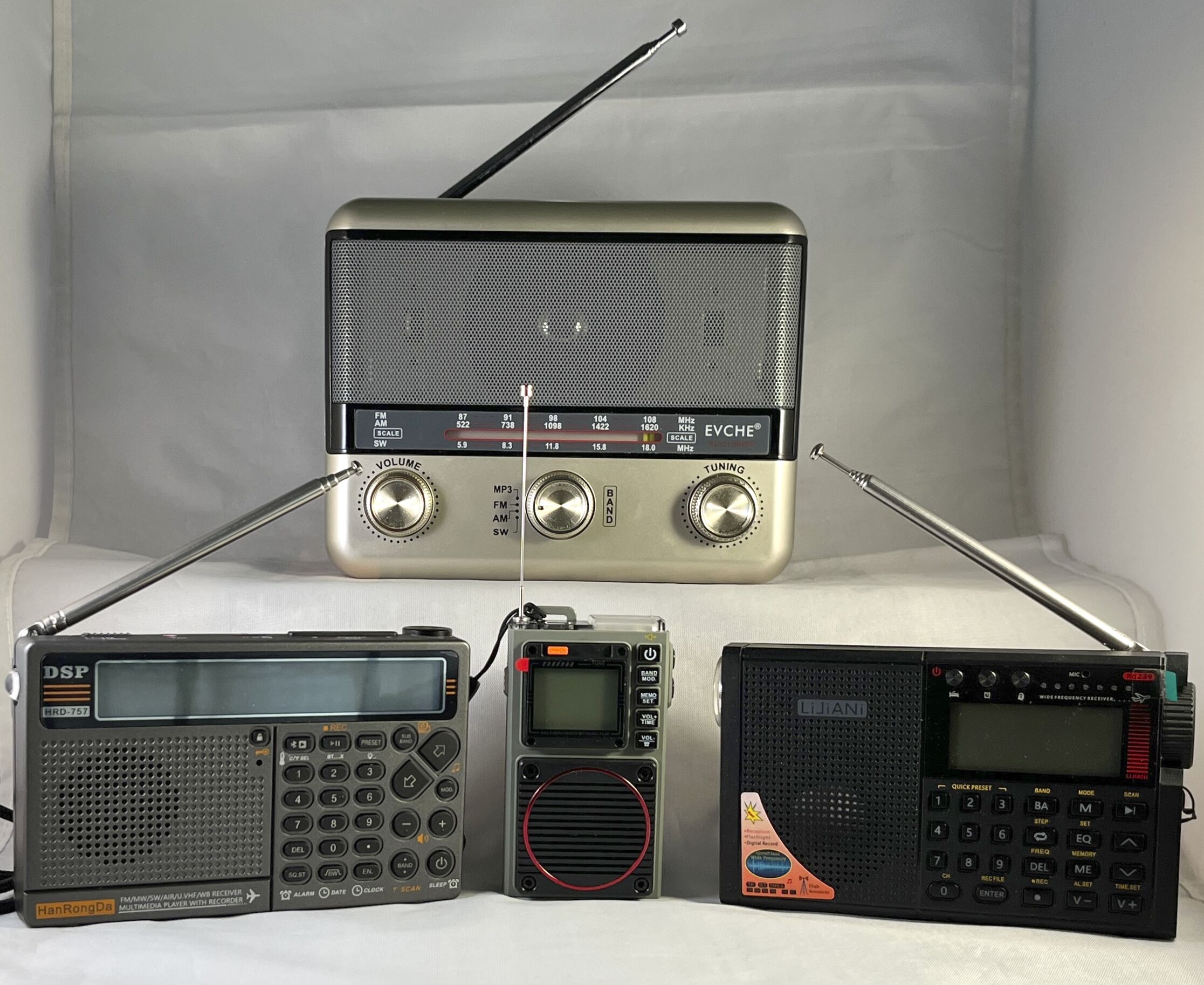
Since then I’ve owned over 100 radios and see many manuals. Some radio manuals leave questions unanswered, and some just don’t make sense. Some of them were top notch, for example the Tecsun PL-330, and some were pretty bad, like the XHDATA D-808. The D-808 manual irritated me so much that I rewrote it from scratch.
To their credit, XHDATA is in the process of replacing the manual according to an email I got from them. I’ve also given Qodosen some suggestions to improve their DX-286 manual.
Writing a Manual
The D-808 manual was written using Microsoft Publisher because it’s designed for publications. It’s good for booklets and brochures. However, it is not something I’m all that familiar with and it’s used less often by non-professionals like me. Microsoft Word is more familiar and more commonly used. I’m engaging in this thought process because I encountered a truly awful manual this week, from a company known for their truly awful manuals, HanRongDa. The radio is the HanRongDa HRD-757. I won’t go into further details about that manual and its problems here — that’s not the point of this article. It’s about writing a replacement.
Audience
I’ve decided for my next manual not to attempt to design something for printing, but solely for electronic viewing. That simplifies the process and removes page layout tasks. I’m assuming that the reader wants to know what the product can do, and how to use it.
The HanRongDa HRD-757 Project
The manufacturers manual for the HRD-757 is divided into two main parts: describing the display/buttons and explaining how to accomplish certain tasks. The problem is that one has to look in multiple places to find things. That’s complicated by the character set the PDF file uses that renders it non-searchable. I can’t copy and paste either:
I’ve started using the phrase, Swiss Army Knife™, to describe some radios. I thought it would be worth some time talking about the concept and applying it to some examples I have. The general term refers to a useful tool that performs many functions, as do the Swiss Army Knives made by Victorinox in Switzerland (who owns the trademark).
VN16795XXL Victorinox Swiss Army Knives Swiss Champ XXL
My working definition is: a shortwave radio that has at least two distinct non-radio functions, but is not generally considered a “weather radio,” although it might have a weather band. I’ve already presented my Thunderous Clash of the Weather Radios article for weather radios. Examples of a second function might include a flashlight or a music player (Bluetooth or MP3). I saw a radio for sale once that included a bottle opener.
AI generated content may appear occasionally in articles and will be denoted with the 🤖 [robot emoji] symbol. Content comes most often from Microsoft Copilot, but may also come from Perplexity, ChatGPT, Duck.ai, Grok or Deep Seek.