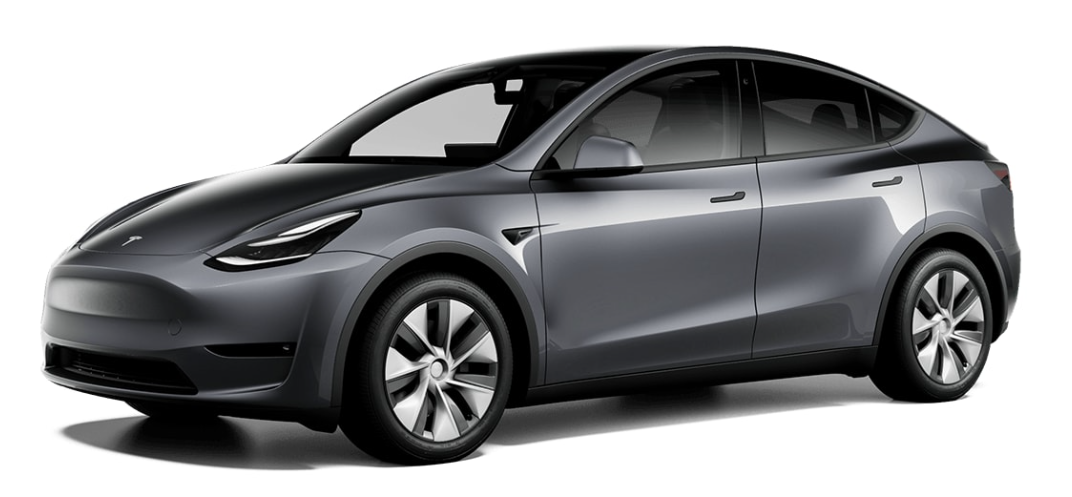
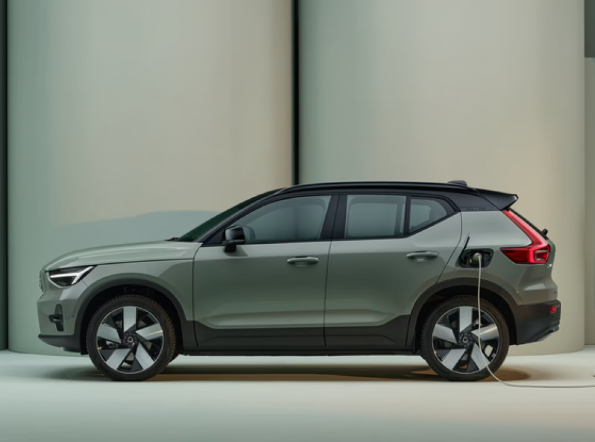
I’m an electric vehicle enthusiast. Today some website advertised Volvo all-electric vehicles, and I thought I would compare their XC40 Recharge offering with a Tesla Model Y. Both are hatchbacks. I want to see how they stack up.
Tesla no longer offers a single-motor Model Y and Volvo’s single-motor version of the XC40 Recharge starts with the 2024 model year. So we’re comparing dual motor versions for both.
Tesla Model Y – Photo from Tesla
Volvo XC40 Recharge – Photo from Volvo
The Bottom Line
When one thinks of an electric vehicle, the two things that seem to come up first are price and range. According to this Volvo company page, the XC40 Recharge has a starting MSRP of $53,550 (in another place it’s $54,645) and an EPA range of 223 miles. Just for fun, I clicked on their inventory link and found that the nearest Volvo dealer didn’t have any in stock, but one in Midlothian, Virginia, did (and that’s fairly close to where my nearest Tesla store is) and they had the Core model for $56,440. The Volvo comes in 3 trim levels: Core ($54,645), Plus ($57,345) and Ultimate ($60,595). The upper trim levels offer various features like a moon roof, 360° camera, adaptive cruise control and a premium audio system.
A Tesla Model Y starts at $47,740. I don’t use the term MSRP because Teslas don’t have suggested prices; they have prices. You order the car online and that’s what it costs. One can sometimes get a little off on what Tesla calls an “inventory car,” but there are not many of those; most Teslas are shipped directly to the customer delivery point from the factory. Teslas have an added advantage this year because they qualify for a $7,500 federal tax credit. Volvo cars don’t because they are foreign made, so the Tesla this year in the USA is considerably less expensive. EPA range for the Model Y is 279 miles. (There is a Long Range variant of the Model Y with 330 miles of range for $2750 more.)
Details
Performance? Volvo gives the 0-60 time of a brisk 4.7 seconds. Tesla is a little slower at 5.0 (the Long Range variant is 4.8). Volvo doesn’t give a top speed on its Learn More page; the Tesla’s is 135 mph. I have read that Volo in general limits all its cars to a top speed of 112 mph because of safety concerns.
Both cars have a central touch screen for controls. Here are photos:
Volvo XC-40 controlsTesla Model Y Controls
I suppose one notices immediately that the Tesla screen is bigger (15″) and the overall layout of the controls much simpler. Which one prefers is a matter of taste.
Specifications
Now for the tedious part, the specifications in tabular form
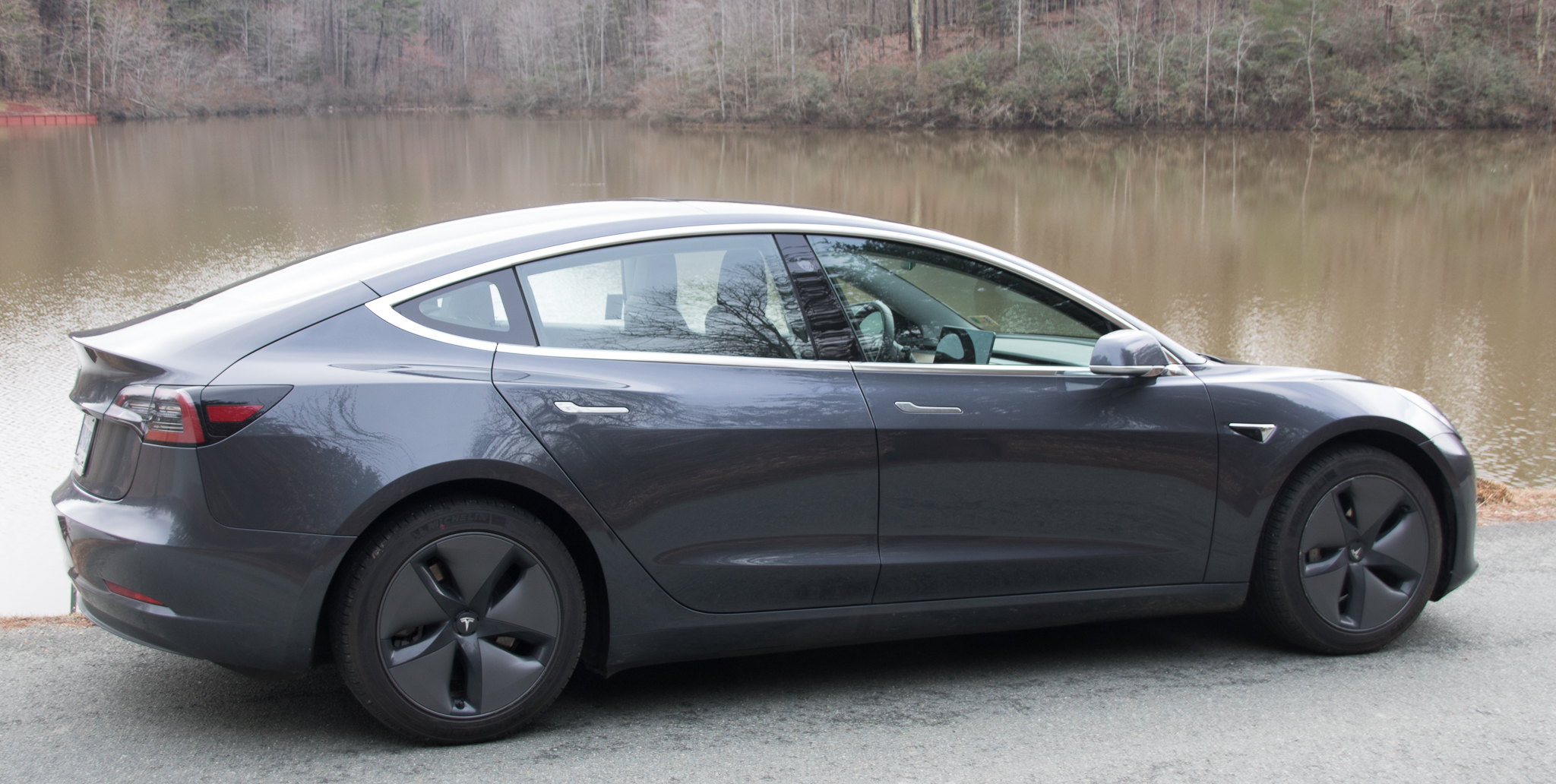
Seven years ago this month, I wrote Prius to Tesla transition about the experience moving from a hybrid electric vehicle to a fully-electric one. It talked about the decision making process, my expectations and the emotional ride. It made sense to write it then before there were millions of Teslas on the road. Since that was written, we traded in our 2nd car, a Toyota gasoline model, bought a 2018 Tesla Model 3 Long Range rear wheel drive. I drive the Model 3 now and my wife drives the larger Model S. I actually ordered my Model 3 in 2016 before it was available to get on a waiting list for delivery in the summer of 2018.
I bought the Model 3 with the intention of never buying another car. It had Tesla’s Full Self-Driving feature that would supposedly keep me mobile even after I was too old to drive myself. I’m still waiting for that feature to be fully implemented, but it’s improving. The battery was supposed to last 350,000 – 450,000 miles.
2018 Tesla Model 3
Upgrade
Both those cars were purchased before I had experienced a winter in Virginia where I live now, with a driveway I cannot climb after it snows, so the main driver to switch was to get an AWD car.
Here is a partial list of features I gain by switching to a 2023 Model Y:
All-wheel drive
Heat pump (greater efficiency, especially in winter)
Heated steering wheel
Higher resolution HW4 cameras
Faster Full Self-Driving computer
Faster infotainment computer (Ryzen chip)
Wireless phone charging
USB port in the glove box for dash cam SSD
Lithium ion 12-volt battery that should last the life of the car (rather than replacing a lead acid battery every 4 years)
External speaker, including pedestrian warning
Powered trunk lift gate
More USB ports. My Model 3 had 2 USB A ports in the front that had to be shared between phone charging and a dash cam drive, plus 2 rear seat USB A charging only ports. Model Y has separate wireless charging for two phones, a USB A port in the glove box for the dash cam, two USB C charging ports in the front and two in the back.
Carpet padding inside the doors and acoustic side window glass (overall the Model Y is reported to be quieter)
Heated windshield wiper channel
Dual jet wiper spray
Chrome delete
12V outlet in the trunk
Matrix LED headlights
Better side support on the seats
Bioweapons Defense Mode
And there are losses:
Radar
Ultrasonic sensors
Premium connectivity for life (ouch!)
Temporary unavailability of Full Self-Driving Beta and some regular FSD features, like Summon.
5 mph slower top speed (only 135)
Demand lever
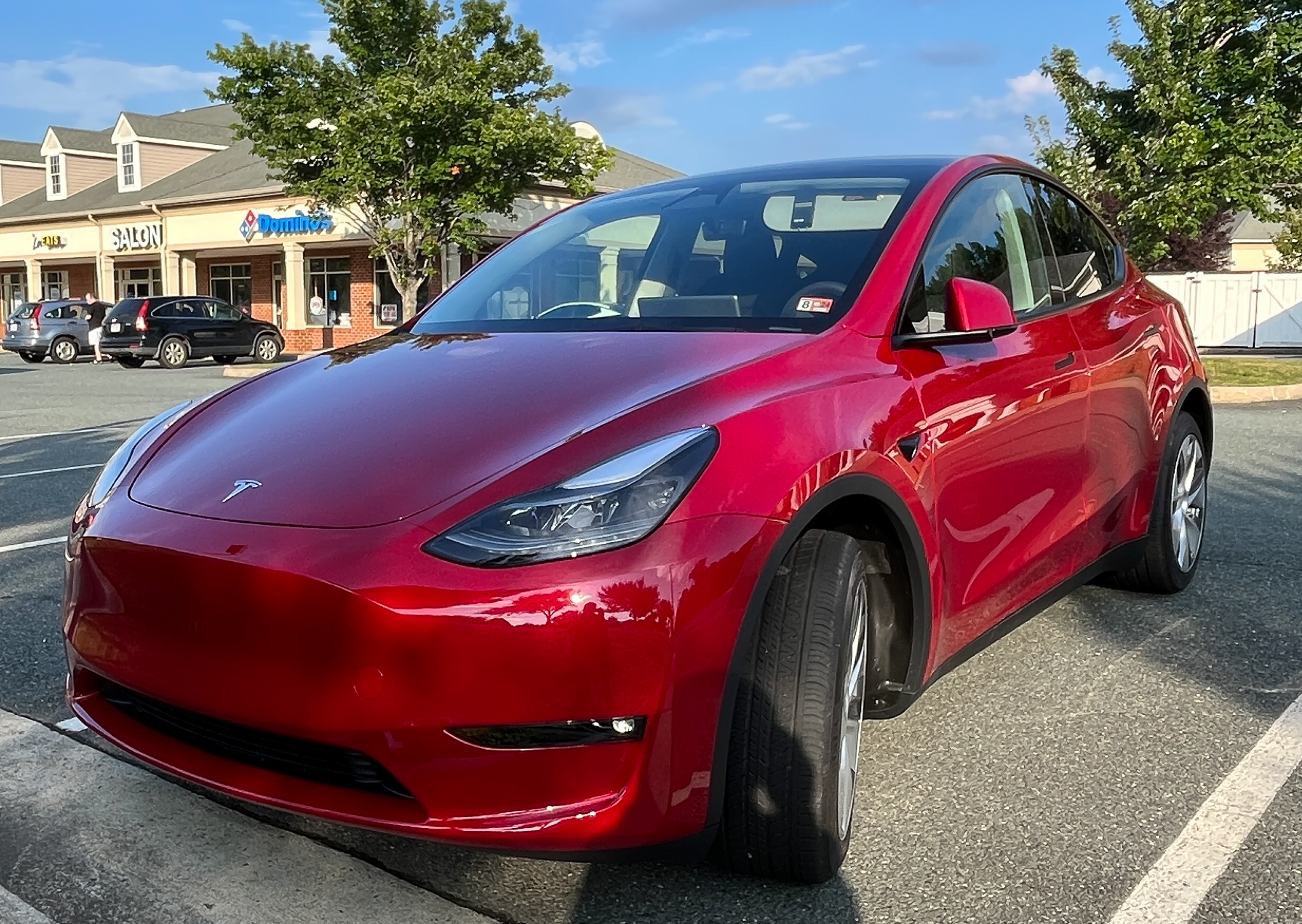
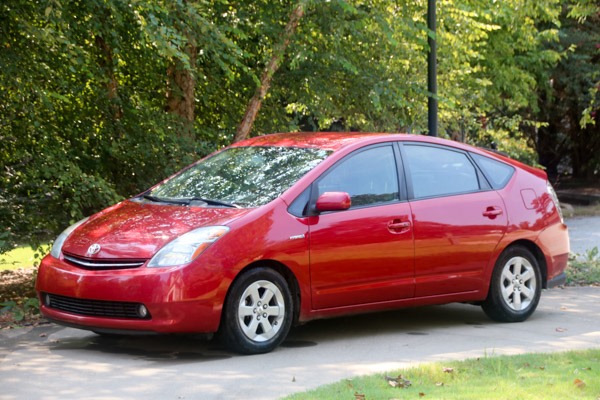
Tesla pulled a demand lever in Q3 2023 by allowing owners to transfer Full Self-Driving to new purchases. Meanwhile the US federal government is offering a $7,500 tax credit for ordering an EV (a benefit I got on the other two Teslas also); a $22,500 incentive was pretty hard to pass up. The new car will be red, same as my 2007 Prius.
One reason for pulling the lever is that a new version of Model 3 is about to start manufacture, with Model Y not far behind. Without a little kick, folks might hold off buying a new car, and Tesla likes for those numbers to look strong. (Disclosure: I own Tesla stock, and I like those numbers to be strong too.)
Sales Experience
Buying a Tesla is not like buying a traditional car. The car is ordered online; there’s no haggling; the price is the same for everyone. The buyer just picks the car and options, then clicks a button to place the order on the Tesla website, paying a $250 order fee. Once the order is placed, just about everything from sales to operation to service relies on the Tesla app. If you’re trading in a car, that’s through the app too. I filled in a few details, took some pictures and got a trade-in offer.
Tesla is notorious for low trade-in values for non-Tesla cars. When I tried to trade in my great-looking 2007 Prius with 144,000 miles and one accident, they offered $2000 for it. I decided to donate the car to the SC ETV Endowment and they got $4500 at auction! When it came time to trade in our Toyota Camry, I just sold it to CarMax for exactly what I wanted. This time I’m trading in a Tesla so I got an offer from CarMax and one from Tesla. The Tesla offer was $23,500 ($1,500 higher than CarMax), so I’ll take that. A trade in is convenient because I can just drive to the sales center, leave one car, and pick up the other. I won’t have to worry about timing the money transfers.
Payment and financing is also handled through the app. In this case with the trade-in, there’s not all that much money to change hands, so I’ll pay by bank transfer, and that’s through the app.
Buying a car at a dealership is always a stressful experience. You never know whether you’re getting a good deal. The negotiation is a one-sided contest between a trained professional salesman and someone who only buys a car a few times in their lifetime. I never want to go back to that.
Anticipating Delivery
My second Tesla delivery was pretty low key compared to the first one. With the first I got swag — a coffee mug and an umbrella. Nothing came with the Model 3. I just sat around a little while while they completed the paperwork. They still gave a little training on operating the car, pairing the phone with the car (the phone acts as the key) and answering any questions. I was already pretty familiar with Tesla when I got number 2. Model 3 and Model S are pretty much the same car except for the shape, and Tesla keeps the older cars up date with firmware downloads. I probably won’t have many questions. [Update: no training this time, just signing the paperwork and inspecting the car. During the ordering process Tesla sent links to videos on basic operation and features.]
Details
There are some loose ends. The Model Y doesn’t come with the HomeLink feature my Model 3 has to open my garage door. It has to be ordered and installed after delivery. I’m not able to order it yet. A Tesla advisor said there was a known glitch in the Tesla app, which is the only way to order this particular option. [Update: I think the Tesla advisor just made that up. Tesla is intentionally not allowing this item to be ordered until the purchaser takes delivery of a car compatible with it. As soon as I accepted delivery, I was able to order HomeLink through the app, and Tesla Mobile Service will come out and install it.] [Update 2: Then installed it.]
I have to figure out Premium Connectivity — mobile internet access built into the car. Older Model 3s came with Premium Connectivity for life; now it’s available for a monthly free ($9.99 + tax) with the first 30 days included. I’m going to try to do without it, using my mobile phone as a mobile hot spot to give the car internet access if I need it. Satellite maps require it, but I never use that feature. I normally listen radio rather than stream. Connectivity for the app and navigation is included and I can probably connect to Wi-Fi at places where I charge the car on the road. I can use the mobile hot spot from my phone. I could also pay for Premium Connectivity in the month for any road trips I take.
If I recall correctly, I have a week or so to transfer my insurance, and I’ll to enroll the car in VA Mileage Choice to pay my road use fee based on odometer readings rather than an average mileage that’s more than I drive. They can take odometer readings remotely.
Full Self-Driving
I got Tesla’s FSD Beta Christmas Day in 2022, a limited release to owners who purchased the feature and passed a safety score test. Today it’s available to everyone who buys it; however, there is a complication. My car will come with a new version of the FSD cameras and computer (Hardware 4 it’s called) that only works with the latest versions of the Tesla FSD Beta software, and that software only comes with slightly older versions of the car’s firmware. New cars come with new firmware, so it’s entirely likely I will temporarily lose FSD Beta. That leaves me with the older FSD feature that doesn’t do automatic driving on city streets; basically, it doesn’t do turns. I hope that the delay will not be too long. I hope the announced Beta V11.34.7 will be available soon and available to me. [Update: as of September 12, I still don’t have FSD Beta. Beta V11.4.4 is compatible, but very few cars have gotten a firmware update including it. [Update 2: I finally got the firmware update including FSD V11.4.4, or most of it. My car doesn’t have ultrasonic sensors, so it current lacks Summon, Smart Summon and Autopark. It’s been 3 months without those so far.]
I got some bad advice on the internet that said I should purchase FSD with the new car, and when I picked it up, they would reduce the price based on my transfer from the old car. That may work, but it adds complication to the delivery with them having to change the price and recompute tax. The correct procedure is to order the car without FSD and obtain, sign and submit an FSD transfer form from Tesla in advance. A Tesla advisor was able to remove FSD from my order and upload my form very efficiently.
Talking to a human being
This isn’t the easiest thing I’ve done. Sometimes and in some situations you can chat online during the sales process, but most of the time you fill out a form and someone calls you back, sometimes days later. What I did was to locate the phone number of the nearest Tesla Store to me, and call that. I’m fairly sure my call was transferred to corporate offices, but it still worked and I got all the information I needed, including adjusting the time for the delivery, something you schedule through the app, but cannot change there. Delivery is 2 PM, August 25.
Delivery
I had all my ducks in a row and delivery was simple. A delivery specialist got me to sign a pile of paperwork (mostly to do with my trade in and title transfer) and he told me that my car’s “birth date” was August 6. The last time I bought a Tesla I think that the car didn’t show up in the Tesla app until some hours later, but now it appears the moment you click “Accept” in the app and your “phone key” starts working immediately. The firmware I received is 2023.20.200. The release that end 100, 200, 300 are factory releases.
Just a few minutes after accepting the car, FSD transferred from my old Model 3 to the new Model Y. After the cameras calibrated I had original FSD — basically Navigate on Autopilot plus stop light control. It’s pretty basic stuff for someone who has driven the Beta for almost 2 years. I will have to wait until the FSD Beta makes it into a current firmware branch that I can download. [Update: Version 2023.26.11 has started to roll out with V11.4.4 in it. There is some delay between delivery and Teslas starting to get firmware updates. Hope springs eternal.]
My Tesla Model Y on its first pizza run
Naming the car
Tesla cars can be named (it’s a setting). Choosing a name is not as momentous as naming your first-born son since it’s changeable at any time, but I did think about it for a couple of weeks with nothing coming to mind. I arrived at some clarity on the 50-mile drive to the Tesla store and named the car “Nell-E.” The reader will probably have guessed already that the “E” is for “electric.” I’ll leave the first part as a puzzle.
Impressions
Here are my first impressions from a 60-mile drive home from the delivery:
I like the red color.
The car is really easy for me to get into and out of.
The car is tall. When I got it into the garage, I realized for the first time how really big this car is!
The old Full Self-Driving software (not Beta) is a huge step backwards.
Regenerative braking is noticeably stronger in this dual motor Tesla.
I was not impressed at the noise reduction over Model 3. I’m sure part of that is going from 18″ to 19″ tires and perhaps from Michelin to Continental tires.
When I activated the turn signal, the side car image appeared on the touch screen and remarkably the sky was blue! (This is supposedly due to a change in firmware and not the HW4 cameras.)
Some if the controls, like the window switches look rather plain and flat compared to my Model 3.
I really miss the shelf in the center console. The prices for some Tesla accessories are more expensive than I think they’re worth. I found a pair of center console shelves on Amazon for $23 that I will try.
It’s hard to park in the garage because the sides of the car aren’t visible from the driver’s seat and it’s difficult to gauge your position. (I’ve had parking problems with most new cars.)
Those matrix headlights are really something. My old Model 3 headlights weren’t very good. The new matrix lights look like there is a straight line across the horizon between where the lights illuminate and where they don’t. But the completely different appearance will take some getting used to.
I like the car a lot so far.
Diary
August 21: State Farm is sending me a Drive Save & SaveTM transponder.
August 22: The car is now paid for through the app.
August 25: Picked up the car (see below)
August 27: Installed the DS&S transponder and hooked it to the State Farm app
August 30: Tesla Mobile Service installed HomeLinkTM garage door opener.
August 30: Center console organizer inserts arrived from Amazon — installed.
August 31: Trunk mats arrived from Tesla, made by WeatherTech. Amazon has less expensive ones.
September 1: Removed old car from Virginia Mileage Choice program
September 1: Installed first firmware update to car (2023.26.9, but it doesn’t have a version of Full Self-Driving I can use.
September 13: Installed second firmware update to car (2023.32.4) with V11.4.4 of the Full Self-Driving Beta. Yea!
To Do
There are still some things to do:
Waiting for registration documents from the state of Virginia.
Install permanent license plates.
Add car to Virginia Mileage Choice program (it reads odometer to get road use tax information).
Get barcode for my subdivision.
Get Full Self-Driving installed.
Remove screen protector from touchscreen.
OK. Everything’s done. I am transitioned.
Afterthoughts
So why did I trade for a Model Y again? Model Y is bigger, meaning bulkier. It takes up a little more room in the garage. It costs a little more. The reason I got Model Y, I remind myself, is because it’s easier to get in and out of and I’m getting older — and more importantly at this moment, it’s easier for my older friends to get in and out of. And of course all-wheel drive for when it snows.
After the roaring success of my Battle of the under $50 shortwave radios (36 views! ROFL) I’m inspired to up the ante and review models that could be purchased today with shipping between $50 and $100. The contestants this time are definitely more interesting:
The R-9700DX is about $55 with shipping from Kaito USA on eBay. The PL-330 is around $80 on Amazon. The ATS-405 can be found on Amazon for $73; its price varies. The XHDATA D-808 has become popular with shortwave listeners and it’s price has shot up about 30% in the last 5 months. It can still be purchased direct from the XHDATA website for slightly under $100.
Breaking news! The ZWS-A320 was defective; the antenna joints were frozen together in two places. I returned it and reordered. The second one’s antenna joints were frozen together in one place. I returned it. I’ve given up on this radio. ZHIWHIS customer support says that I’m the only one reporting the problem. (What are the odds?)
More news! This article was originally published in 2023 before a very important entrant appeared on the US market, the Qodosen DX-286. These articles are points in time, but sometimes things are important enough to go back and update the record.
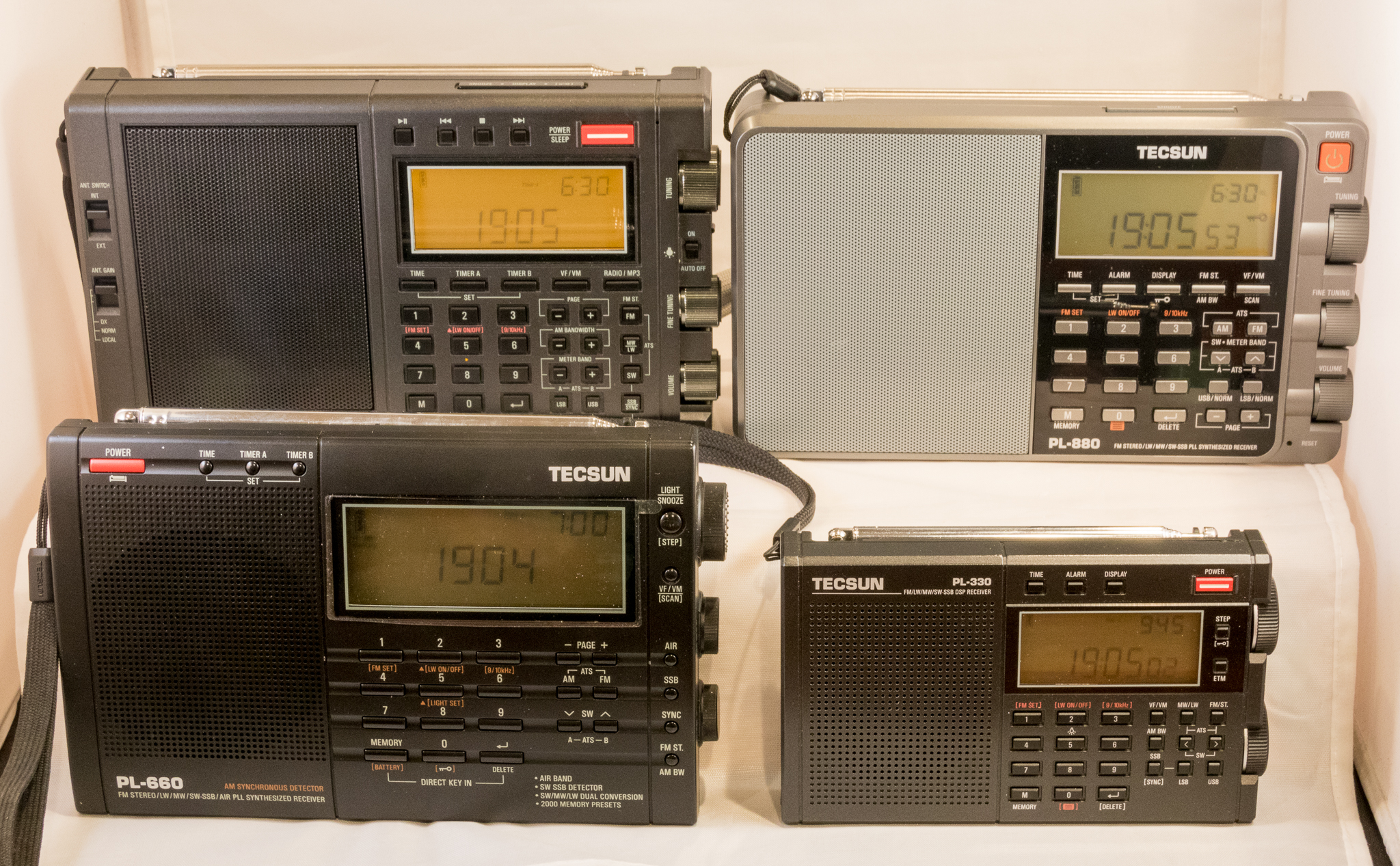
Here I compare 4 great Tecsun radios; Three are still in production, and the PL-660 can still be purchased new.
PL-660 Introduction
The PL-660 was introduced in 2010 and I’ve owned mine since December of 2011; it’s been a great radio and continues to perform magnificently. The PL-660 is a dual-conversion phase locked loop synthesized superheterodyne analog radio that covers LW/MW/SW/FM and AIR bands (this is the only radio on the list with AIR band). It receives SSB and supports synchronous detection. It has auto tune storage (ATS). Mine is firmware version 6601, an earlier model that doesn’t have the memory sorting and duplicate deletion feature; the other radios have the feature.
It’s been included in several articles at Blog or Die!:
My next acquisition was the PL-330, introduced in 2021, and bought soon afterwards as a travel radio to replace my PL-380, adding some useful features, most notably SSB and frequency coverage up to 29.999 MHz. The PL-330 is an all-digital radio based on a digital signal processing (DSP) chip. Mine is firmware version 3306. I haven’t done a proper review of the PL-330, but I have included it in some articles:
Editorial note: This review was written in July in 2023, a year and a half ago, and I do not know why it was not published. I’m reviewing it and publishing it now.
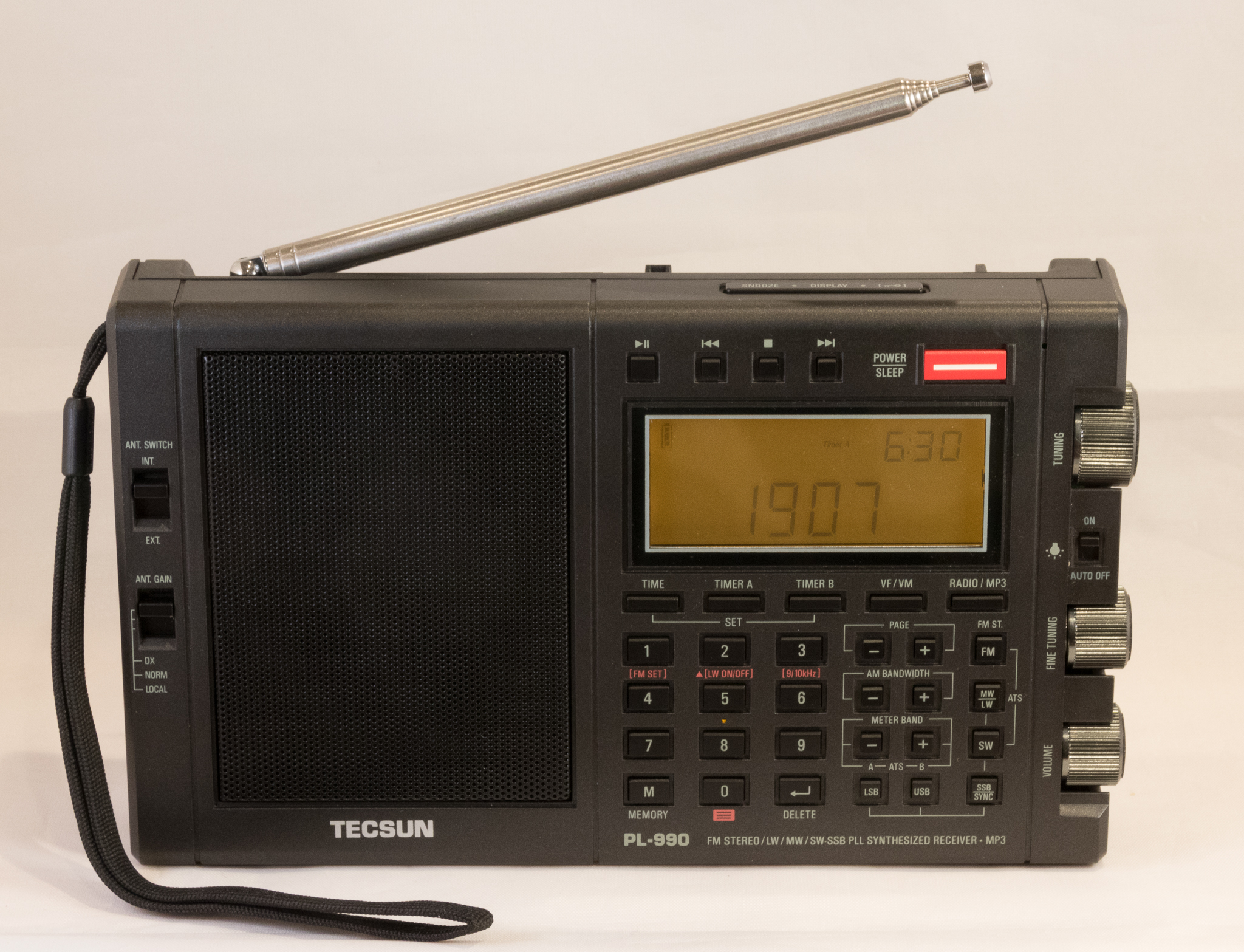
The Tecsun PL-990 is one of the top radios from the Tecsun product line. It was introduced in October of 2020 as a long-awaited upgrade to the PL-880. While it has a great deal in common with the PL-880, it adds Bluetooth and MP3 play, synchronous tuning, and reportedly an improved noise floor. I prepared a separate comparison of the PL-990 to three other Tecsun radios: the PL-330, PL-660, and PL-880 earlier.
Tecsun PL-990 radio / music player
I bought my PL-990 used from the Kaito USA store on eBay for about $80 less than a new one. The condition was superb, as you might be able to see in the photo preceding. The box has printed on it “2020 Ver. 1”. The serial number indicates it was made in August of 2021, but the package seal says 2022. My used version came with Bluetooth enabled (this is normally a hidden feature).
There is also an “export version,” the PL-990X. My reading suggests that the two radios are mostly the same except that when the MW channel spacing is set to 9 kHz, there is a change in the lower frequency limit of the LW band (goes down to 50 Hz).
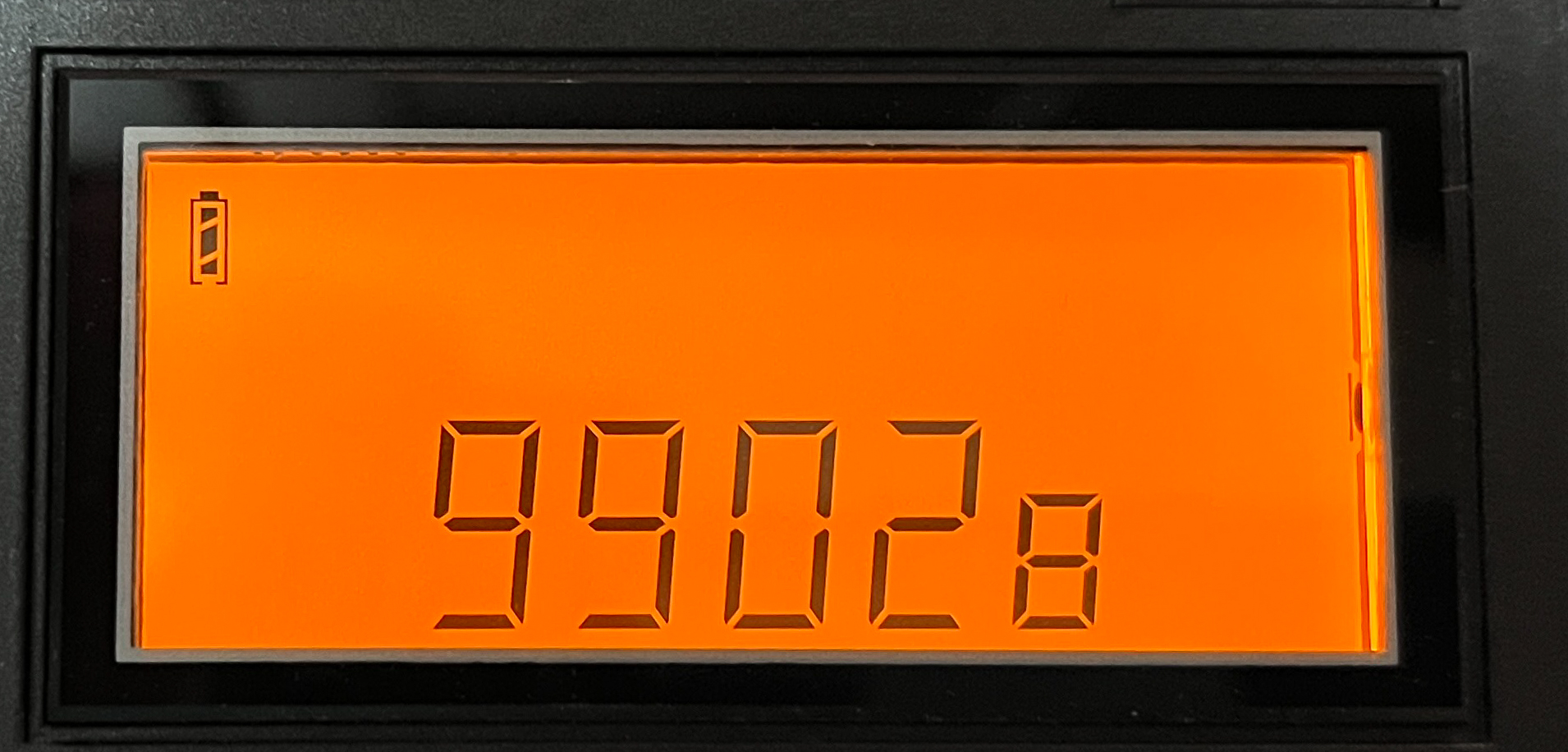
Various “hidden feature” lists exist for the PL-990, at least one of which purports to show how to access the firmware version. They did not work on my radio, rather an approach very close to how it’s done on the PL-880 worked. Press and hold the AM Bandwidth (-) key for 5 seconds, release, and press for 5 seconds more to display the value. The radio showed the firmware version as 9902b (I’m calling it a “B” instead of an “8”). Mine has fairly old firmware; I found one with “9904e” on the internet that may not be the latest either.
Goodies
Along with the radio, the Tecsun PL-990 comes with a zipper carry case, an AN-03L reel antenna, an English language manual, a Quick Start guide/amateur radio call sign prefix map, ear buds, a USB Micro charging cable, a USB power adapter and a Tecsun-branded 2500 mAh 18650 lithium ion rechargeable battery. Mine also included a 16 GB MicroSD card with one piano selection.
Basic features
The PL-990 is a PLL synthesized analog-tuned triple-conversion superheterodyne radio with a digital signal processor for decoding the signals and controlling bandwidth. It receives LW, MW, FM stereo and shortwave signals up to 29.999 MHz. The radio has has 4 bandwidth settings (9, 5, 3.5 and 2.5 kHz) for AM and 5 options (4, 3, 2.3, 1.2 and 0.5 kHz) for SSB.
The PL-990 features auto tune storage (ATS) that can search the shortwave bands and save stations it finds in one of 3150 memory locations divided into 25 memory pages. This generous number of pages creates the possibility of one memory page for each hour of the day, but other organizations are possible. The radio can also scan for the “next” available station and pause to let the user sample it with the option to store the station in memory.
It has a separate Fine Tuning control, a dial light switch, an external antenna jack (with a switch to select either the jack or the whip antenna), LINE OUT audio jack, Bluetooth speaker capability, a tone control, an always-on clock with seconds display and a sensitivity control. It has two alarms and a sleep timer.
The PL-990 features synchronous tuning that is useful in receiving signals with strong fading. With synchronous tuning, the radio substitutes an internally generated carrier rather then the one from the station.
The radio is powered by a single 18650 Lithium ion battery that can be charged in the radio with a Micro USB cable.
Hidden features
Like other Tecsun radios, the PL-990 has some “hidden features that work very well and are a great advantage. Various lists of hidden features exist for the PL-990. I’ll provide some links:
One peculiar feature is the ability to switch between the internal ferrite antenna and an external antenna on MW/LW. It works exactly the same as it does on the PL-330. The strange thing is that the PL-990 already has a front panel switch to swap antennas, so why the hidden feature? I found in testing that the hidden feature does work for MW and that the mechanical switch also works, but the signal strength from the external antenna is a little stronger with the switch than with the hidden feature.
Bluetooth
The stock radio has a button to switch between Radio and MP3 modes; however, a long press of this button with the radio off (keep pressing until the BT symbol appears and the radio says “ON”) enables a third option, and the button thereafter cycles between Radio, MP3 and Bluetooth. In Bluetooth mode the radio automatically allows pairing, and you only need to select it (the radio’s name is “TECSUN PL-990”) and it works. The radio’s play/pause controls now work with the source device (I used Windows 11) to play/pause audio or video. The sound is very good.
MP3
The MP3 function works well, and supports large song selections and MicroSD cards up to 128 GB. FLAC / WAV / APE / WMA and MP3 formats are supported. The user interface is a bit more sophisticated than what one commonly sees with the addition of albums (file folders). The Tuning knob switches albums and the Fine Tuning knob pick sounds within album.
On pretty much all other radios with MP3/Bluetooth capability, the Play/Pause button mutes the radio portion, but not the PL-990. Here one has to manually turn down the volume control to mute radio.
The Manual
The Kaito USA eBay listing for my radio said that it did not come with a manual, but that the buyer could download one if they wanted. I found the Operation Manual from from Tecsun Australia, a good source for Tecsun manuals, before the radio arrived. Kaito, however, did include a manual with my radio that was versioned: “2020.8 VER.1.” Besides the company logos on the back page, I didn’t see any difference in the two.
While one might quibble over the wording in a few places, the manual is very well done, attractive, literate and helpful. I give it an “A” grade.
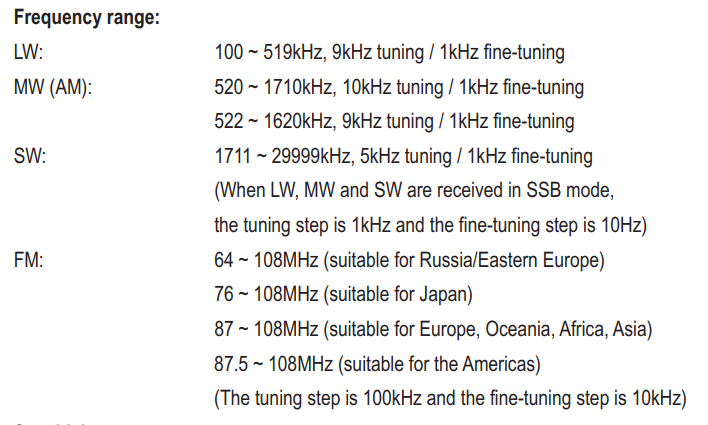
Specifications
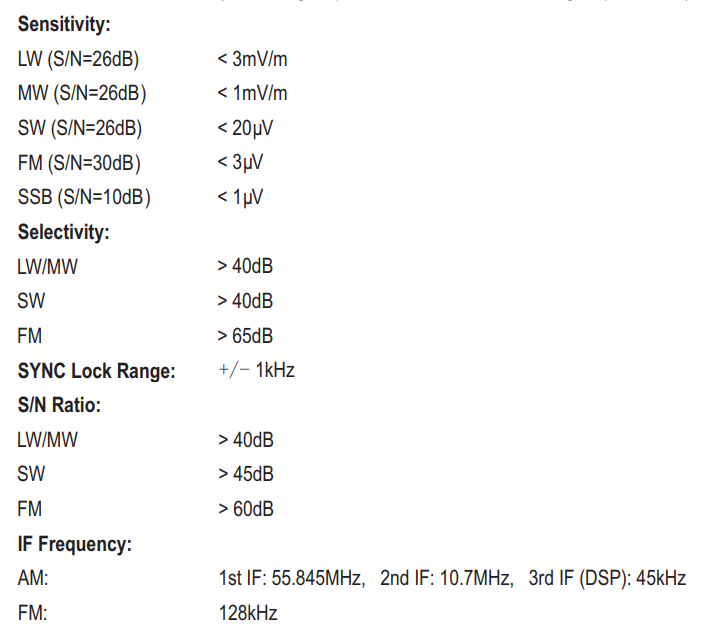
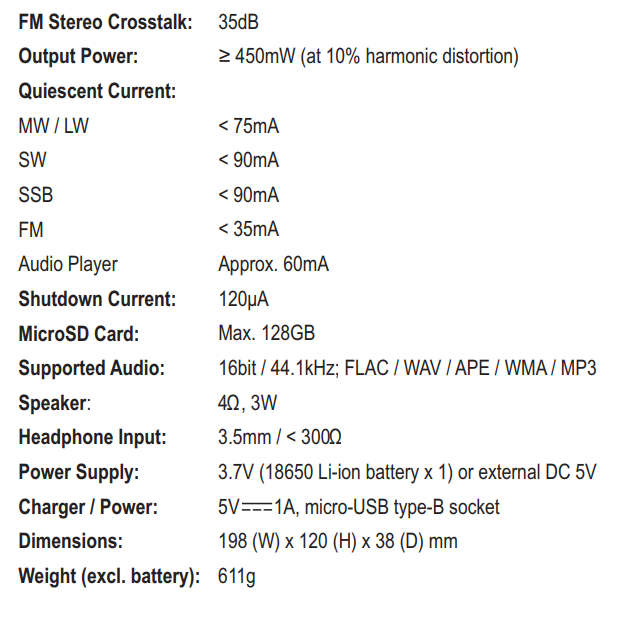
From the product manual:
Operation
While the PL-990 introduces more buttons than ever before, it still lacks one that I really want, separate VF and VM buttons (like the XHDATA D-109). Here one has to figure out what mode they’re in before deciding to push the button. With two buttons, one could just pick a mode directly.
The radio has an odd quirk in VM mode. To move through the memory locations, one turns the tuning knob. On my other radios, the channels change rather quickly. Here, one has to turn the knob between a quarter and a half a turn just to move one station. I might have thought this was a fault in my radio, but apparently not, as the manual says:
Rotate the [ TUNING ] knob with some vigor to browse through the station list.
Speed and vigor is not the issue so much as just a long stroke.
Performance
I started this product review some time ago and put it aside. In the meantime I finally decided to sell my PL-880 and keep the PL-990. More recently I read something online saying that users had been disappointed in the PL-990, expecting it to perform better than it did. I haven’t felt disappointed. I really like the way the radio works; it’s a dream to operate, but the question remains: does it get more stations? Conventional wisdom says that modern premium radios all get about the same stations. High environmental nose levels make this even more true. The difference is in things like AGC, SSB and convenience.
I like to compare things, and that’s going to be tough because what I have to compare it with are less-expensive radios. I don’t have a Sangean ATS-909X2 or any of those ICOM models. I don’t have a fancy antenna either — just a 20-foot wire up a tree (WUT) and an MLA-30+. I compared the PL-990 to other Tecsun radios in my article: Tecsun PL-ease: Comparing the PL-330, PL-660, PL-880 and PL-990 Shortwave Radios.
MW/FM
All my radios get the Daytime MW/FM band scan test and I’ll republish the latest version. [Note: I have updated all my radio articles with the Daytime Band Scans table to access the same graphic, so that any time I add a radio, it will appear everywhere.] I have a low MW signal level here and I test all my radios the same way, counting the number of audible signals on the two bands using the radio’s internal antenna. The radios are all oriented in the same direction (northeast / southwest) for MW and not rotated to improve reception. ( I ignore longwave because there’s aren’t any broadcasts where I live.)
As one can see, the PL-990 is at the top of FM reception and in the upper tier on MW. I would have hoped for a better MW score given the size of the radio and price point.
Shortwave
One of my favorite stations for testing is CFRX 6070 kHz in Toronto, about 400 miles from where I live. It’s not too strong, but audible most of the time. I went outdoors with my 4 best receivers, the PL-990, PL-660, XHDATA D-808 and Eton Elite Executive to check it out using just the telescopic antennas. The PL-990 was awful — until I realized that the sensitivity switch wasn’t in the DX position. After that, things evened out. There was no runaway winner in the group, except that all of the radios just about had to be turned up as loud as they would go, except that wasn’t needed by the PL-660. This is another of those situations where signal strength varies from minute to minute. I believe that if one spent the entire time on any of these radios, the experience would be similar. One variable here is that the tone switch was set to Treble on the PL-660 and Bass on the PL-990. The other two radios don’t have tone settings.
Tecsun PL-990 Comparisons on CFRX
This next video compares the radios using a Sangean ANT-60 reel antenna strung out to its full length of 23 feet (7m). I got the impression in this test that the PL-990 was a little better, but the reader can be the judge. The target was Radio Exterior de España on 9690 kHz. This is often a booming station, but not at 16:36 today.
SSB
My big SSB performance review (SSB!) was done before I bought the PL-990. Probably the best thing to do is update that rather extensive article to include the PL-990 rather than copy all that material here.
Audio
A radio with MP3 and Bluetooth capability ought to have good audio and the PL-990 is about the best I have encountered, second only to the PL-880 whose bass vibrates the table. Here is a sample, although it sounds better in person than in the video.
Tecsun PL-990 MP3 Audio Sample
Conclusion
Well, it looks like what I said at the beginning is more or less correct. All radios I’m considering get pretty much the same shortwave stations; the difference is in operational convenience, extra features and personal preference. ATS is awful on the D-808 and isn’t even supported on shortwave by Eton Elite Executive. The PL-990 has the best speaker, hands down and that’s good since it’s the only one designed to be an external speaker for other devices. The PL-660 has the edge on SSB. The two Tecsuns allow direct frequency entry without extra keys. The PL-990 is the only one in the group without AIR band. The XHDATA and the Eton support FM RDS, which might be useful if you’re into FM DXing. On the other hand, the PL-990 is the only one that supports an external MW antenna, which might be useful if you’re into MW DXing.
The PL-990 has become my “go to” radio for home use (the more compact PL-330 is my travel favorite). This conclusion is subject to change without notice.
Update
A year and a half later there isn’t much to say different. Since that initial review I’ve gotten a Qodosen DX-286 (that’s included in the MW/FM station count chart). The DX-286 has become my go to radio because it’s pocket sized. The PL-990 remains the FM champ, and the one with the best speaker. I use the PL-990 for SSB and for music or FM DXing.
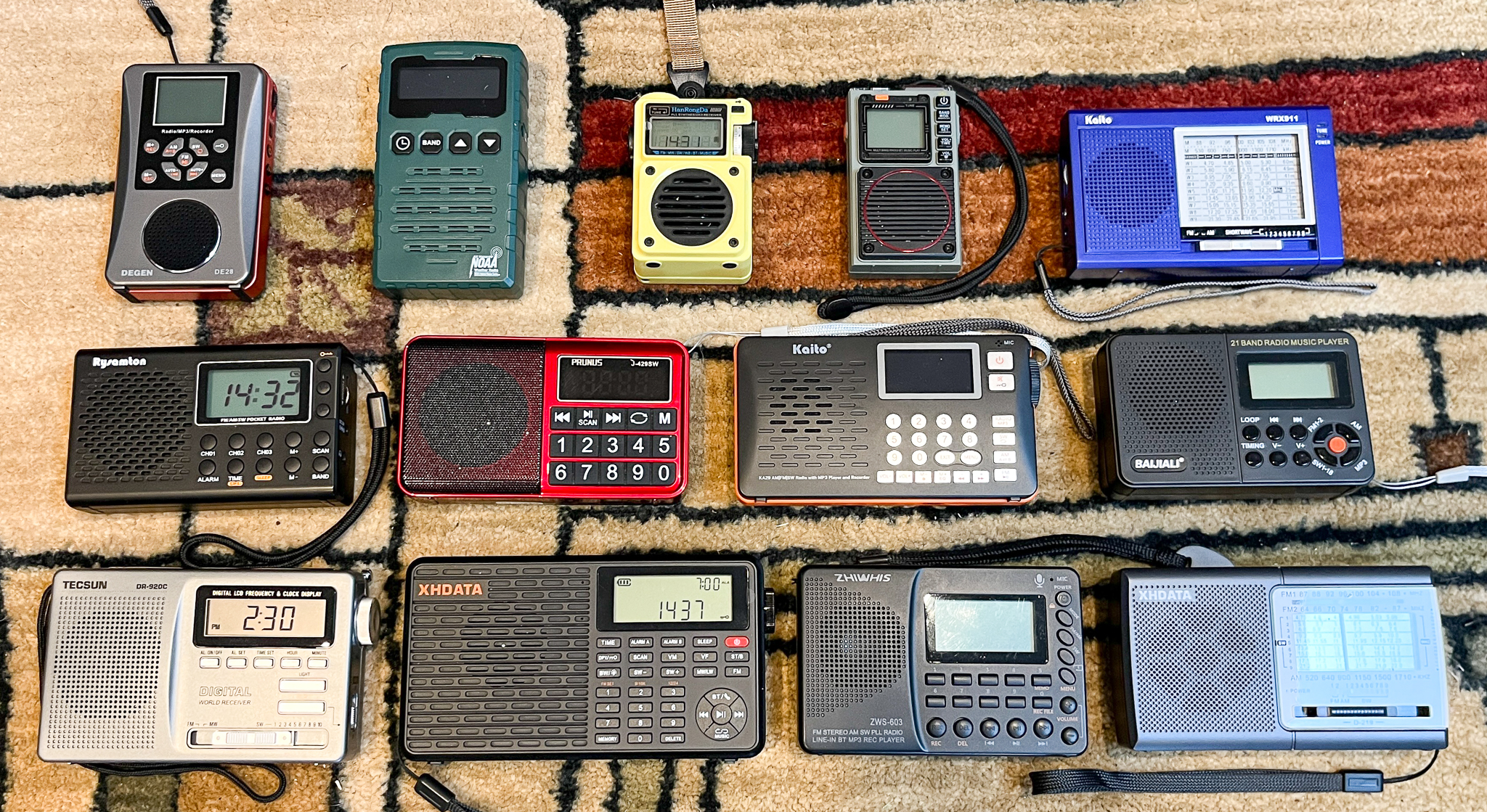
Today we’re looking at my current bottom-tier radios, ones with shortwave coverage that I could buy new today (July 16, 2023) delivered to me in the US for under $50. One radio in particular barely gets excluded, the Tecsun R-9700DX whose best price appears to be about $55 delivered from Kaito-USA. I am including the Raddy RF75A that can be purchased from Amazon by a Prime customer for $47.69 as of this writing although it’s usually a little over $50. The included Mesqool CR1015 old version is no longer for sale, but there is a similar updated model for around $19. There are notable radios in the category that I don’t have to test, like the Retekess V115, Tecsun PL-310ET, PL-360, PL-380 and R-9012. I particularly regret I don’t have one of the Tecsun DSP radios to include.
Contenders left to right, top to bottom: Degen DE28, Mesqool CR1015, HanRongDa HRD-701, Raddy RF75A, Kaito WRX911, Rysamton YK-M03, Prunus J-420SW, Kaito KA29, Baijiali BJL-166, Tecsun DR-920C, XHDATA D-109, XHDATA D-219, Zhiwhis ZWS-603
There are two types of DSP radios represented here, ones tuned by the absolute position of the tuning control and ones controlled by the relative changes in position of the control. They are indicated by DSP-A and DSP-R respectively in the table below (ones with no suffix don’t have a tuning knob). The physical position of the knob matters in the former type — you can change the frequency setting with the radio off, and the knob will have a definite beginning position and ending position. Radios with absolute positioning generally lack automatic scanning and storage.
In an attempt to give each of my radios at least a little love, I pulled down my Rysamton YK-M03 from the shelf today and gave it a whirl.
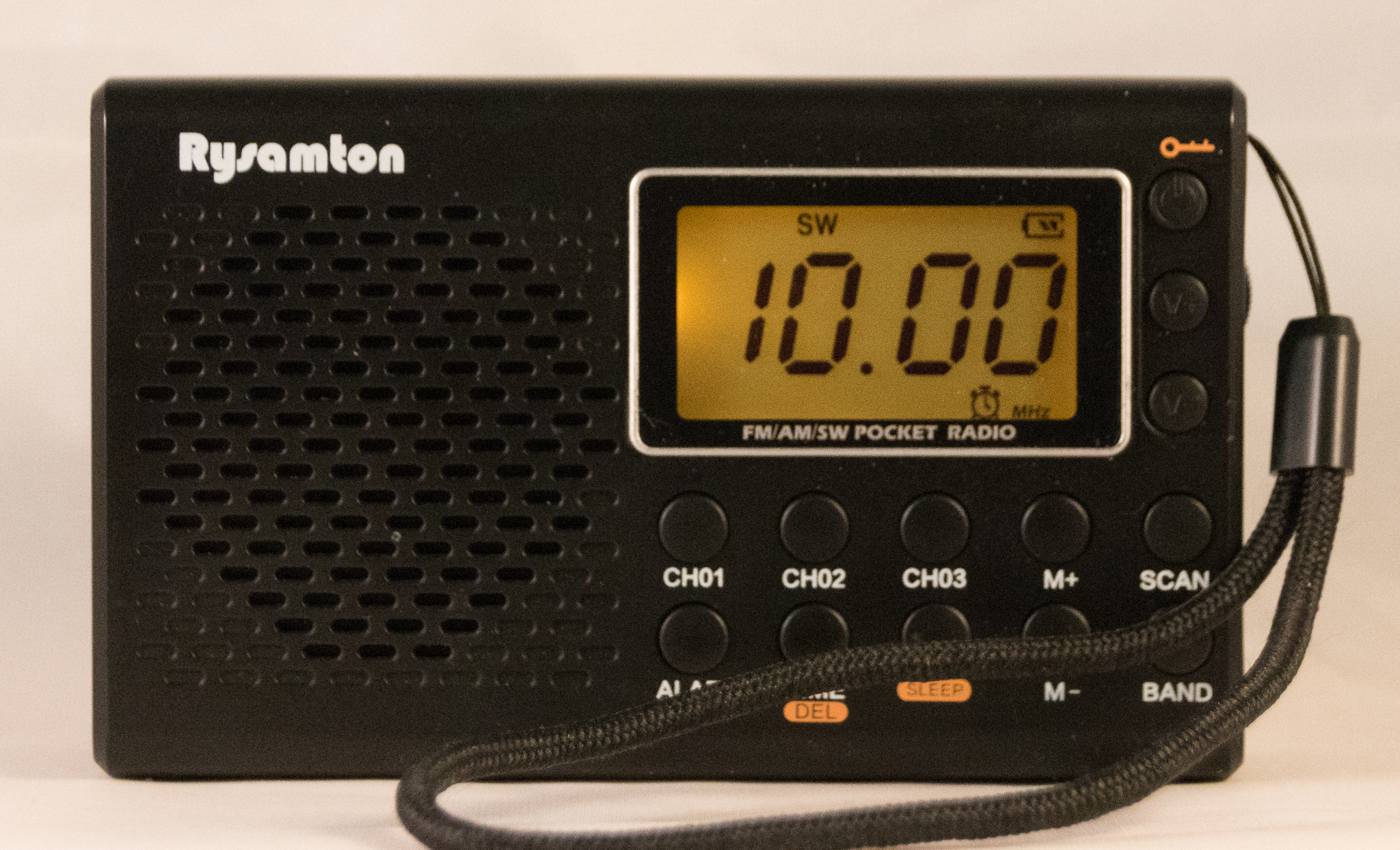
Rysamton YK-M03
Features
For something with this basement price it has quite a few features including: 12/24 hour click, alarm, sleep timer, earphone jack and earphones (included), dial light, auto tune storage, favorite station buttons, digital frequency display, carry strap, English manual and a lock button. It supports both US and European frequency ranges for MW/FM. There is FM stereo with headphones. The clock is visible with the radio off, and can operate for months on a battery charge. The display and button labels are very easy to read, as can be seen in the photo.
The photo preceding is with the radio off, where only the time, alarm, lock status and battery status is shown. When on, the radio indicates the sleep timer, alarm, frequency, stereo battery status, key lock, MHz/kHz and band. Dimensions are 115 x 70 x 31 mm.
Tuning is accomplished with a tuning knob, plus the ability to skip through the SW bands (long press the BAND button). Shortwave coverage is a fairly generous continuous spectrum from 3.0 to 21.85 MHz.
AI generated content may appear occasionally in articles and will be denoted with the 🤖 [robot emoji] symbol. Content comes most often from Microsoft Copilot, but may also come from Perplexity, ChatGPT, Duck.ai, Grok or Deep Seek.