The 5-2 diet

I’ve had this blog for years, but never had a “Health” category before. It seems that as you get older, health is something that you don’t take for granted any more.

Personally, I’m on the borderline between overweight and obese, and my blood sugar is high. I’ve tried various diet and exercise programs over the years, and all of them worked, except that they were hard to stay on. Here are some of them:

  1. Atkins diet
  2. Orange Creamesicle diet
  3. Food diary / computer diet
  4. 40-mile (cycling per week) exercise

So, I’ve started a new diet based on some Michael Mosley videos that were on PBS a few weeks ago. They are supposed to have all sorts of health benefits including weight loss, lowering cholesterol, growing new brain cells, and reducing the risk of cancer. The diet is basically eating 600 calories a day (500 for women) two times a week.

At first one might think that eating just 600 calories a day is uncomfortable. Actually it is only that way the first time you do it. The second time, it’s not much trouble at all. Some diets are hard to follow because they require special foods. This one doesn’t. What I also found is that once you do a “fast day,” you’re not as hungry and you feel satisfied with smaller portions on the other days. If you need motivation, just remember that on the non-fasting days, you can eat whatever you want.

Mosley also introduced a rather remarkable 3-minute a week exercise program that for some people has remarkable benefits, including increasing insulin sensitivity. I haven’t started this one yet. Basically you get on an exercise bicycle and pedal your heart out for 20 seconds, cool down, and repeat for a total of three times (1 minute). Do this three times a week. That’s 12 minutes a month. Again, this is a program that should be easy to stay with because it doesn’t take a lot of time. The only problem is the special equipment.

Posted in Health | Tagged | Leave a comment

Senator Graham wants crazy people to buy their guns privately

I just listened to a telephonic town hall meeting with South Carolina Senator Lindsey Graham, who voted to block a universal background check bill in the Senate. Graham told a story of a woman who was determined to be mentally unstable in court, but whose status was never entered into the federal background check system. She later bought a gun legally and tried to shoot up a school in Charleston, but the gun didn’t work. Graham says that people like this need to be in the federal background check system.

In fact state participation in the federal system is spotty, particularly when it comes to mental health data. It’s a big problem.

Graham admits that there are people out there who are dangerous who can buy guns, and the current background check system won’t stop them. Graham’s answer is to get these people in the system. If they are in the system, then these dangerous people will have to buy their guns from private unlicensed sellers online or at gun shows.

It doesn’t do any good to have every dangerous person in the federal background check database, when not every gun purchaser is checked against that database.

Posted in Products | Tagged | Leave a comment

Stupid Windows tricks: Shaky-Shaky

OK, here’s a trick that works with Windows 7.

If you have several Windows open on your desktop, give this a try. Take your mouse and left-click and hold on the title bar (top) of one of the Windows, as if you were going to drag it. Instead of just dragging it, shake it back and forth vigorously. All the other Windows will minimize. Shake it again, and they will restore.

Update: This trick finally stopped working on Windows 11.

Posted in Technology | Tagged , | Leave a comment

Charter fights spam

Usually I’m critical of my Internet service provider when I can’t do what I want to do. In this case I was trying to forward email spam to a spam-reporting service. Charter Internet, who is my provider, blocked my sending the email, saying it was spam.

A lot of email spam comes from home computers, connected to high-speed Internet services, that have been compromised (hacked, pwned) by spammers. What Charter appears to be doing is blocking that illicit activity. This is the kind of corporate responsibility I applaud.

What was a bit curious, however, is that Charter figured out that the email was spam. It was so deeply obscured that my own spam filter, including a well-trained naive Bayesian classifier, didn’t catch it.

Posted in Technology | Tagged , , , , | Leave a comment

Oblomov

I am please to announce completion of my latest audio book, Oblomov, by Ivan Goncharov. When I started this project, I thought it would be a fairly uninteresting reading of an unknown work by a little-known author. That’s not how it turned out. This is a book that literally everybody was reading in Russia when it came out, and I think it has something to say to modern people as it deals with questions of work and leisure. Here’s my summary (with help from the Wikipedia):

Oblomov is the best known novel by Russian writer Ivan Goncharov, first published in 1859. Oblomov is also the central character of the novel, often seen as the ultimate incarnation of the superfluous man, a symbolic character in 19th-century Russian literature. Oblomov is a young, generous nobleman who seems incapable of making important decisions or undertaking any significant actions. Spoiled as a child to the point of not even being able to put on his own socks, Oblomov is unprepared to deal with the smallest difficulty of adult life. In his fevered dreams he sees the words “Oblomovstchina” (“Oblomovism” or in this translation “the disease of Oblomovka”) in flaming letters on the ceiling putting a name to the disability of which he is all too aware.

This romantic novel was considered a satire of Russian nobility whose social and economic function was increasingly in question in mid-nineteenth century Russia, and from it the word “Oblomovstchina” entered the Russian vocabulary.

Posted in Audio Books, Books | Tagged , , | 5 Comments

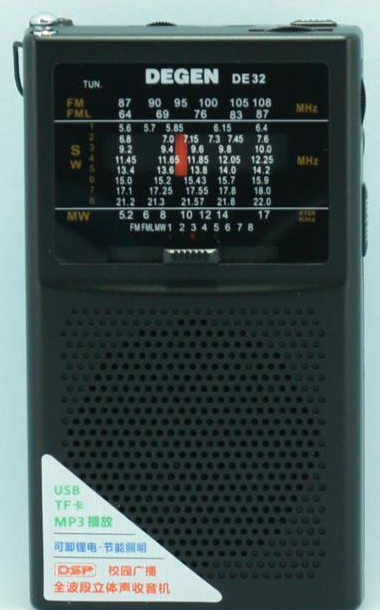
Degen DE32 AM/FM/SW radio/MP3 player

imageThis is an interesting little shirt-pocket radio available on eBay for under $30. It has a few nice features and some drawbacks too.

The radio covers the US FM radio band as well as the low FM band (64-87 MHz) used in some parts of the world. It covers AM (MW), and shortwave in 8 bands from 5.6 – 22 MHz. The tuning and display is analog.

Sensitivity is not stellar. Because of the radio’s size, the internal AM antenna is small and not very effective. The telescoping whip antenna only reaches 13 inches, again limiting sensitivity. The dial is very tiny, making it difficult to tune precisely and there is considerably play in the tuning wheel, which means it’s hard to position precisely. If you tune just a touch past a station, you have to turn back a lot to find it again. One inexcusably bad design point is that it is extremely difficult to tell which band the radio is switched to by looking at it unless the radio is lit dead on. The indicator is down in a hole.

There are also some nice things to note with this radio. First, it uses a digital signal processor for improved selectivity. In fact one finds clear separation of stations, and stations tend to snap into tune as one turns the dial. There is an effective LED tuning indicator also. Another feature of the radio is that it doubles as an MP3 player with a slot to plug in a MicroSD card. With headphones, I was extremely pleased with the sound of MP3 playback with the only complaint being no booming bass. The sound of FM, however, was a little tinny and no one would want to listen to anything on the internal speaker.

Other nice features include:

  • Flashlight (although no dial light)
  • The tuning knob is accessible from both the top and the side of the radio
  • Built in rechargeable battery (supplied). It uses the Nokia BL-5C battery that can be replaced for under $10.
  • Battery charges from mini USB cable (supplied)
  • Stable, and does not tip over easily

If you want to combine a shortwave radio and an MP3 player in one, then this is a good low-cost option. If you don’t need the MP3 player, then you can get the Degen DE321 with some rechargeable batteries (which you have to charge externally) for $10 less . The DE321 has a bigger dial and the same digital signal processing feature.

Posted in Product Reviews, Radio | Tagged , | 2 Comments

Dealing with telemarketers

Here’s some plain talk about telemarketing. Lots of web sites offer advice, but it’s mostly useless.

About the only thing you can do in the US is to register with the National Do Not Call Registry. Register your mobile phone too. It will stop some calls, but charities and criminals are not deterred.

Just say no

I find it hard to understand why anyone in the 21st century would buy anything from a telemarketer. There are always better options. You would do better to spend money locally and help your neighbors. Online you can easily compare prices and check the ratings of the seller. When you buy, you should be in control. Somebody who just calls you up could be anybody, from someone in China trying to scam your credit card, to a local criminal who wants to rob your house. What you can be sure of is that when you’re on the Do Not Call Registry, the caller is a criminal, and you obviously don’t way to buy from a criminal. So take the pledge:

I will never buy anything from a telemarketer, not ever.

Virtually all the calls I get start off with a recording (which is illegal in South Carolina where I live). It’s really easy to say “no” to a recording. In some places, the telemarketer actually dials your number and tries to ingratiate himself with you and then starts the sales pitch. Some folks report that the telemarketer won’t take “no” for an answer. There are two simple solutions: the simplest is simply to hang up. The other is to remove the phone from your ear so you cannot hear the telemarketer and then say “I never buy anything from telemarketers. Do not call me again.” Then hang up. This is not being rude. Telemarketing is not a conventional social interaction; it is a business transaction or a crime in progress.

If everybody took that pledge, telemarketing would end, plain and simple.

File a complaint

If you get 2-3 calls a day like I do, you might think the Do Not Call Registry is a waste of time. It may be; they refer just a handful of cases each year for prosecution, but filing a complaint at least provides a justification for lobbying for better enforcement. (See US v ADT Security Systems for one successful prosecution. Here’s one from 2008. )  As of 2012 there were a staggering 217 million phone numbers on the Do Not Call Registry, and the FTC received 3.8 million complaints from consumers. That means that only a small percentage of people who are illegally called actually file complaints. Don’t be part of the silent majority. Complaints are easy to file on the donotcall.gov web site. So take the pledge:

I will file a complaint for every call I get.

Asking to be removed from a calling list never works. “Punch 2 to be removed from the list” never works. Getting angry never works. As of late, I have said “www dot do not call not call dot gov click file a complaint” which will get the telemarketer to hang up as quickly as the equally-effective, “help, I’ve fallen and I can’t get up” and “hang on, there is someone at the door.” While it might be marginally satisfying to attempt to keep the telemarketer on the line to cut their productivity, it’s a futile effort and in the long term it gets you nowhere. Just one telemarketer made 46 million illegal calls, and you’re not going to make a dent in an operation like that.

If the telemarketer is a local business that you recognize, you can take action. A local newspaper kept calling me asking me to subscribe to their newspaper. I filed a complaint with the state consumer affairs commission under a state law regulating telemarketing and mailed  a copy of the complaint to the general counsel of the newspaper. There is also a federal law, The Telephone Consumer Protection Act of 1991 (47 U.S.C. § 227) that allows you to recover $500 per call after you have asked someone to stop calling you. You have to sue to get this and it’s only going to work if you can find the telemarketer in the first place.

Personally, I suggest complaining to the phone company in writing. All machine-dialed marketing calls to cell phones are illegal in the US, and there has got to be a way using technology for a phone company to detect that and shut it down. They could do it. Why won’t they? They could provide a *22 that you could dial after an illegal call and the phone could investigate after a few thousand complaints, or refer the case to the FTC Sentinel Database.

Technology solutions

In fact, there are all sort technology-based solutions that could be implemented. The issue is the will to do it. I suggest lobbying Congress and the FTC to take a more-proactive role in preventing illegal telemarketing activity.

Newer cordless phones have the ability to block some number of unwanted callers. My Panasonic phone can store up to 1,000 numbers and has a feature to challenge any caller it doesn’t recognize to enter an access code. Autodialers can’t enter the code.

I recently dropped my landline phone in favor of VOIP and use Google Voice to receive my calls. It has a spam filter. This is new for me and I’ll be watching how well it works.

Political calls

What I haven’t covered yet is the other telemarketing scourge, the political robocall. During the last presidential primary season I was getting 10 calls a day, mostly from the Mitt Romney campaign. I finally had to leave a message on my answering machine: “I have had to shut down my telephone system due to the massive number of political calls. Please leave a message, and I will call you back.” I turned off the ringer on the phone and regained a margin of peace for the duration.

Read more:

Posted in Bad Commerce | Tagged | 5 Comments