Qodosen SR-286: First Impressions

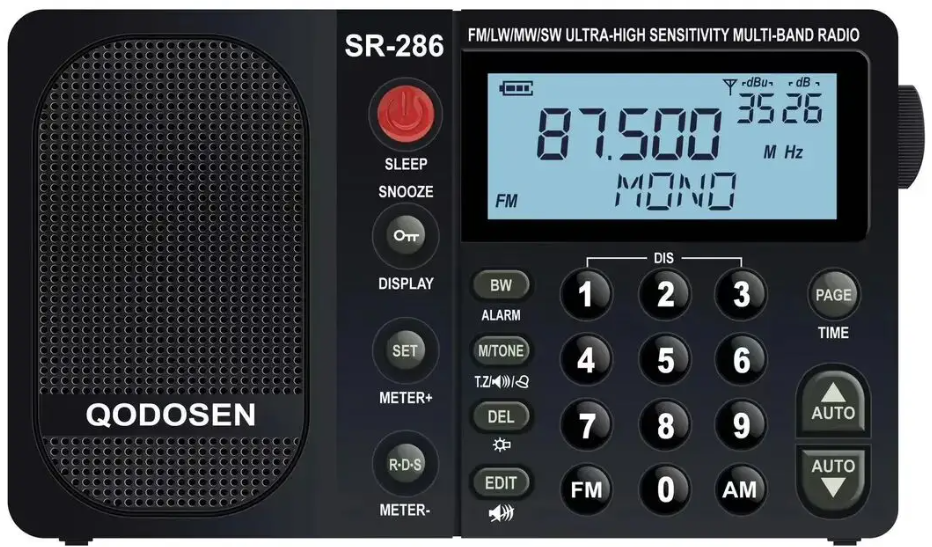
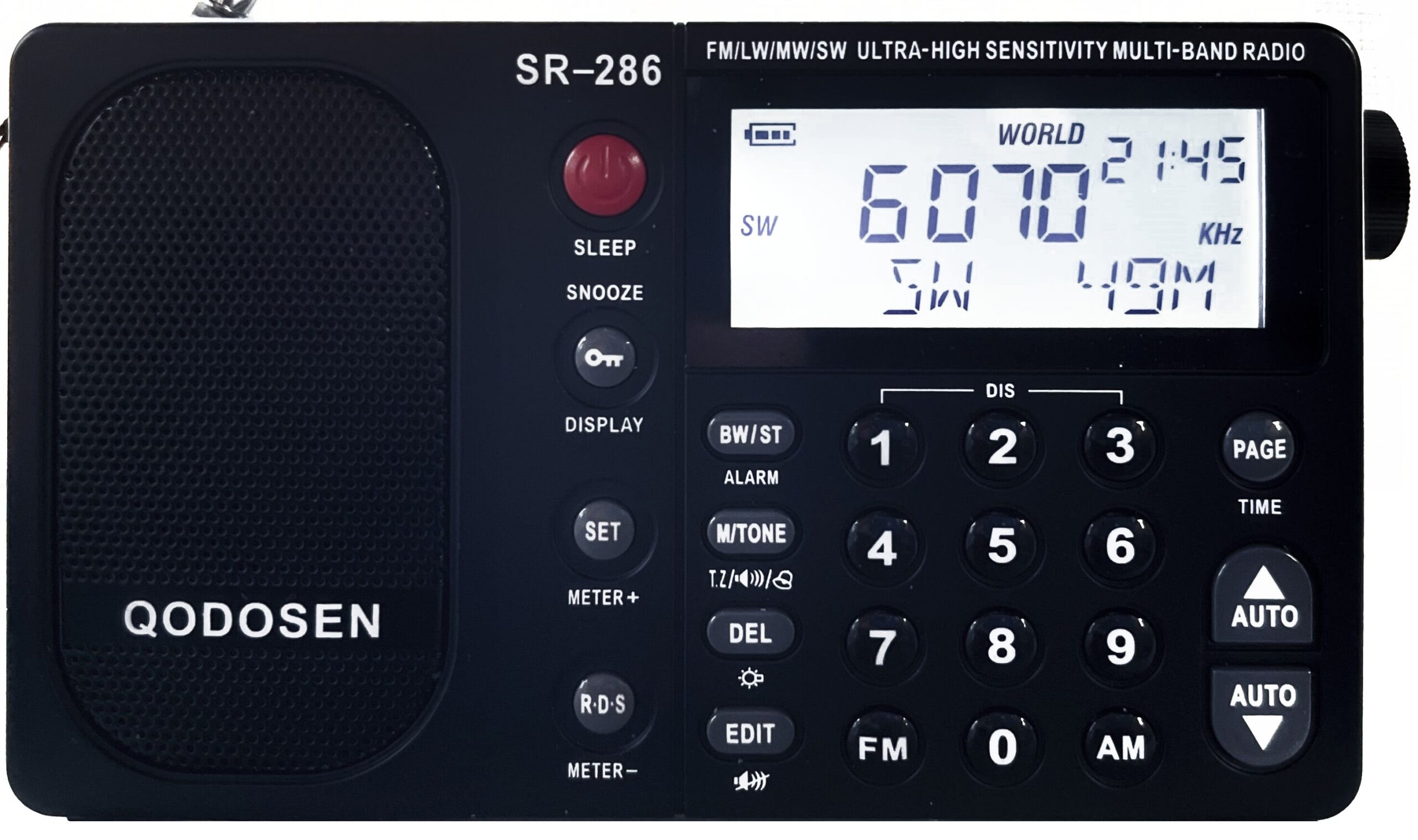
Qodosen SR-286 (photo by author)

I’ve been waiting for 21 days for the radio to arrive and in that time I wrote a blog article in anticipation and studied the manual. Now that it’s here I want to share my first impressions. During the wait I researched and decided that I was going pronounce the brand, “CHO do sen.”

First, the radio felt heavy, but really isn’t particularly heavy; it’s just small. It actually weighed 8.6 oz. with the battery installed. I checked and yes, it has rubber feet. It comes in a fold over Velcro fastened case, sort of a khaki color. I like having a case. The kit also includes a USB Micro charging cable. What aren’t included are earphones, a product box and a manual. Good thing I found a manual on line. The manual says that the radio comes with a manual. OOPS.

The radio is small, in fact identical in size to the Sihuadon R-108, with the same 19 1/4″ antenna length.

I quickly noted that I really like the way this radio tunes. You don’t have to set a band. If you want 351 kHz LW, just punch in 351 and hit AM. If you want 1070 kHz MW, just punch in 1070 and hit AM. If you want 6070 kHz SW, just punch in 6070 and hit AM. If you repeatedly press AM without entering a frequency, it will skip from LW to MW to SW. The buttons feel good too.

Continue reading
Posted in Product Reviews, Radio | Tagged , | 2 Comments

Sihuadon R-108: an overlooked radio

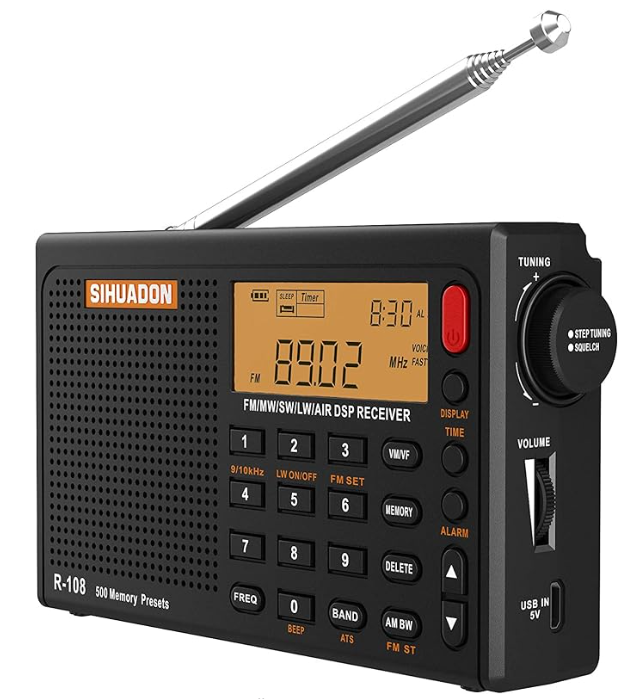
I’ve seen nice things said about the Sihuadon R-108 radio for some time, but I never bought one because it seemed redundant for my personal use. The radio is quite small (5″ L x 1.2″ W x 3″ H), it convenient to pack or carry. It’s powered by a BL-5C battery and sports LW, MW, FM, general coverage SW and AIR bands.

Sihuadon R-108 Receiver (Amazon product photo)

I thought that if I had the XHDATA D-808, I wouldn’t have any use for this scaled down version without SSB and without RDS. And that made sense, but not everyone has a D-808, and those who don’t might want a review of the R-108.

Pricing

I’m always looking for the best price and this radio’s price has varied quite a bit. Today on Amazon US it costs $59.90 less a 12% coupon, or $51.71. On the XHDATA website it’s $52.90 less 30% promotion plus around $6.50 shipping from China, or $43.53. I paid $49 for mine including shipping from XHDATA.

Continue reading
Posted in Product Reviews, Radio, Technology | Tagged , , , , , , , | 2 Comments

Charging Radios – USB-C

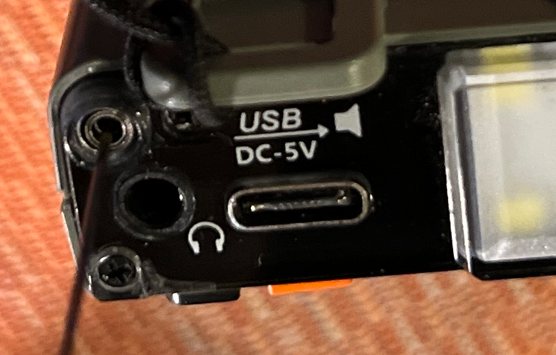
USB-C connector – Raddy RF75A

Houston, we have a problem.

A reader commented on a problem charging an XHDATA D-808 radio with a USB-C to USB-C cable. The XHDATA supplied USB-A to USB-C cable worked, but not the other.

This reminded me of something from a user guide:

TYPE-C input
a. TYPE-C data cable… Please connect 5V charger, computer interface, standard USB output port, etc. Please do not connect the phone fast charger; the phone fast charger output has 9V or 12V. It may burn the machine. This machine has done this protection, but the risk still exists. …

— LiJiANi Rd239 User Guide (V3.0)

I’ve been doing some testing with a standard USB-C end-to-end cable with 4 USB chargers:

Continue reading
Posted in Radio, Technology | Tagged , , , | 1 Comment

Radio Confusion

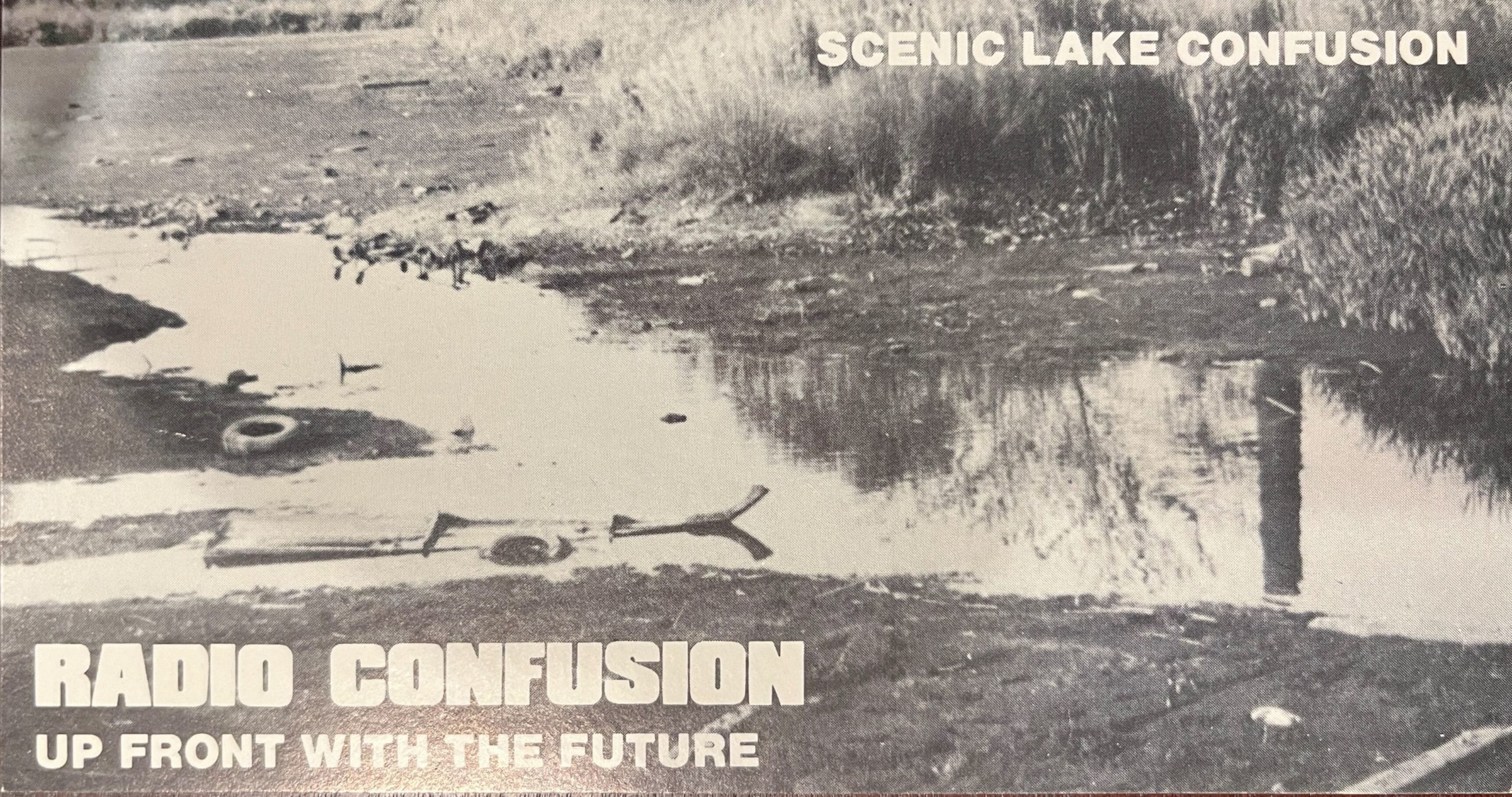
And no, I’m not talking about the clandestine radio station that sent me this QSL card.

Radio Confusion QSL from 1980

My confusion is over is the frequency range for FM radio in the United States. This should be an easy question, and the official answer is:

The FM broadcast in the United States starts at 88.0 MHz and ends at 108.0 MHz.  The band is divided into 100 channels, each 200 kHz (0.2 MHz) wide.  The center frequency is located at 1/2 the bandwidth of the FM Channel, or 100 kHz (0.1 MHz) up from the lower end of the channel.

Federal Communications Commission

And further research indicates that there other frequency ranges in other parts of the world.

In Europe and Africa (defined as International Telecommunication Union (ITU) region 1) and in Australia and New Zealand,[1] it spans from 87.5 to 108 megahertz (MHz) – also known as VHF Band II – while in the Americas (ITU region 2) it ranges from 88 to 108 MHz. The FM broadcast band in Japan uses 76 to 95 MHz, and in Brazil, 76 to 108 MHz. The International Radio and Television Organisation (OIRT) band in Eastern Europe is from 65.9 to 74.0 MHz, although these countries now primarily use the 87.5 to 108 MHz band, as in the case of Russia. Some other countries have already discontinued the OIRT band and have changed to the 87.5 to 108 MHz band.

Wikipedia

To simplify, US starts at 88 and Europe/Africa/Oceania starts at 87.5 MHz.

My confusion comes from dealing with real radios. Many portable radios with FM have a setting for the FM range, allowing the radio to function in a familiar way in different regions. On some of those radios, the FM setting also controls other things like the MW step (10 kHz in the Americas and 9 kHz most everywhere else) and sometimes the temperature scale, C or F.

Continue reading
Posted in Radio | Tagged , , , , , , , | 4 Comments

Incoming Radio! Qodosen SR-286

If all goes well, I’ll be receiving a Qodosen SR-286 (aka Xiaoqiang SR-286) radio mid-February from AliExpress. I learned about it from RadioJayAllen’s review and it pushed a few of my buttons.

First off, the SR-286 is small: 128 x 75.5 x 38 mm. I like a portable radio to be portable.

Qodosen SR-286 Product Photo (AliExpress)

Allen says that this is the best portable for FM that he’s seen, and the addition of RDS gives me an opening for more DXing on that band. I also like the fact that the external antenna can be used for all bands, including LW/MW. With tax and shipping from China, my order totaled $134.78, not exactly a bargain radio, but much less than a Tecsun PL-990 or Sangean ATS-909 X2.

Continue reading
Posted in Radio | Tagged , , | 7 Comments

Visiting McGrath, Alaska

I’ve been taking surveys for the YouGov polling company for some years now (you can sign up here) and for the past year or so at least one poll a week asks the question, “What did you do last weekend?” and of the possible answers is always, “Visited McGrath, Alaska.”

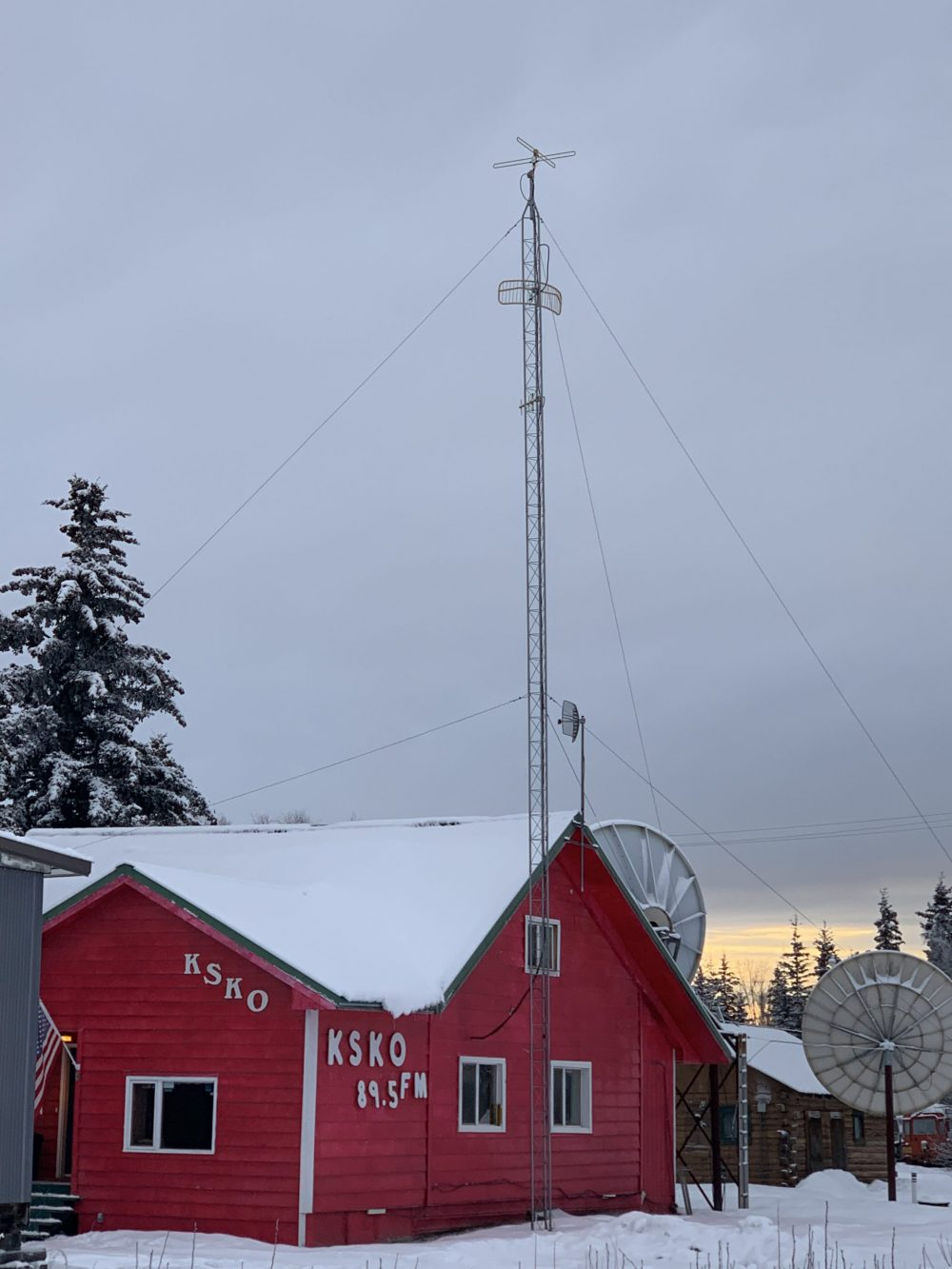
With temperatures at -40° (at that temperature Fahrenheit and Centigrade are equal), I’m not about to travel there, but there was an event this afternoon involving McGrath that caught my attention after seeing the name so many times in polls. The local McGrath radio station KSKO today started a regular experimental transmission to occur every Friday afternoon at 4 PM Eastern Time (21:00 UTC) that relays their local broadcast via Space Line, Bulgaria, on 5900 kHz shortwave.

Station KSKO (photo from SWLING.COM)

I headed down to the pond to see if I could hear it. There was nothing at 21:00 but gradually the signal grew until the point that I could listen to it on an inexpensive radio using its whip antenna. Who knew?

I have lots of recordings from my radio travel adventure involving various antennas and radios, but much of it is copyrighted music and I don’t want the hassle of defending a fair use claim, so I’ll just include a bit from the weather report.

Posted in Radio | Tagged , , , | 2 Comments

Thinking About the New XHDATA D-608WB

Disclaimer: I am testing a presale version of the radio provided to me by XHDATA in exchange for helping them improve the user manual. I am under no obligation to review the radio online, much less say nice things about it.

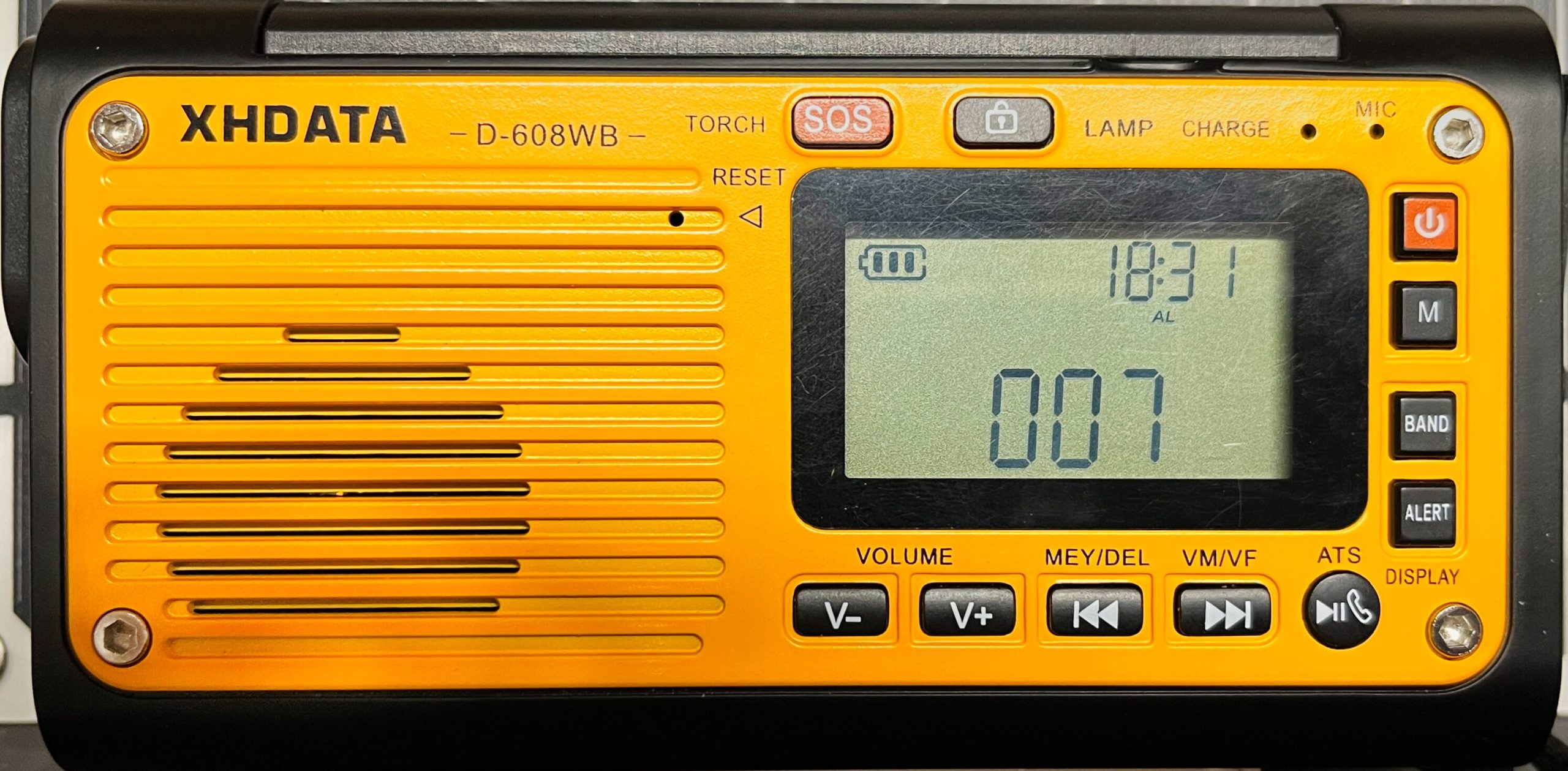
XHDATA D-608WB Weather Radio

When I first saw online mention of the upcoming XHDATA D-608WB radio, a few questions came to mind:

  1. Could I finally replace my Mesqool CR1009 Pro weather radio, that I really don’t like, with something better?
  2. Is it as good as some other radios from XHDATA like the R-108 and D-109WB?
  3. How much is it going to cost?

The last question has been answered, and I was surprised at how inexpensive it is direct from XHDATA.

Given that it has a premium 18650 battery, solar cells, crank power generator, premium speaker (more on that later), flashlight and a reading light on top of what their regular D-109WB radio has, I would have expected something at least as expensive as the D-109WB ($55), but not so. I really don’t know why it has the price it does — but in the great divide of the universe between things that are my problem and things that are not my problem, this falls in the latter category.

Continue reading
Posted in Product Reviews, Radio | Tagged , , , , | 6 Comments