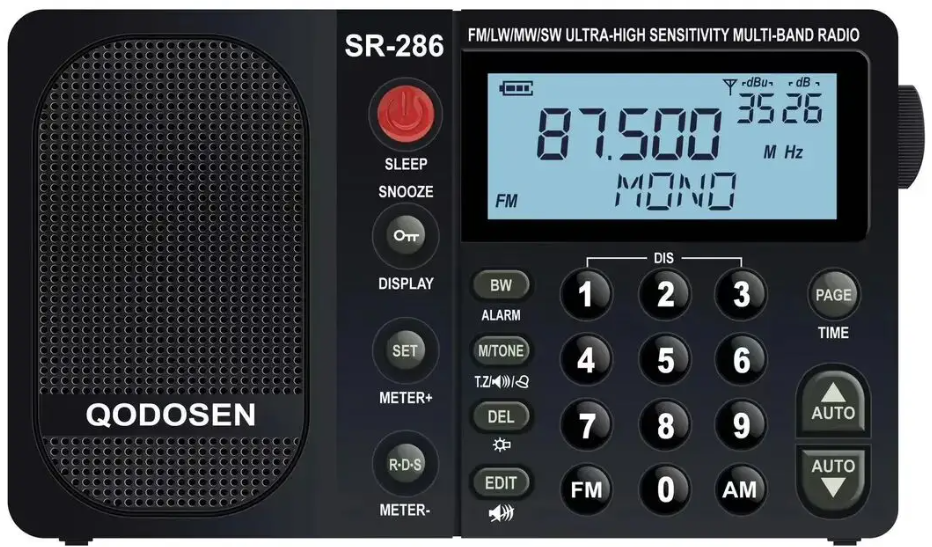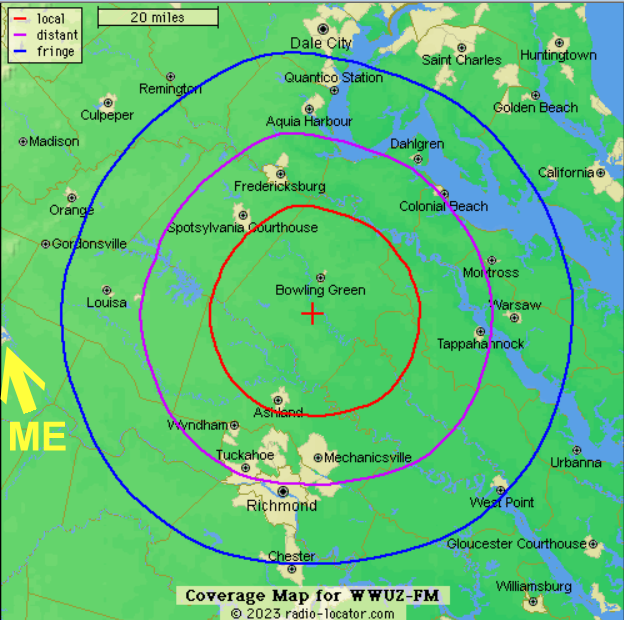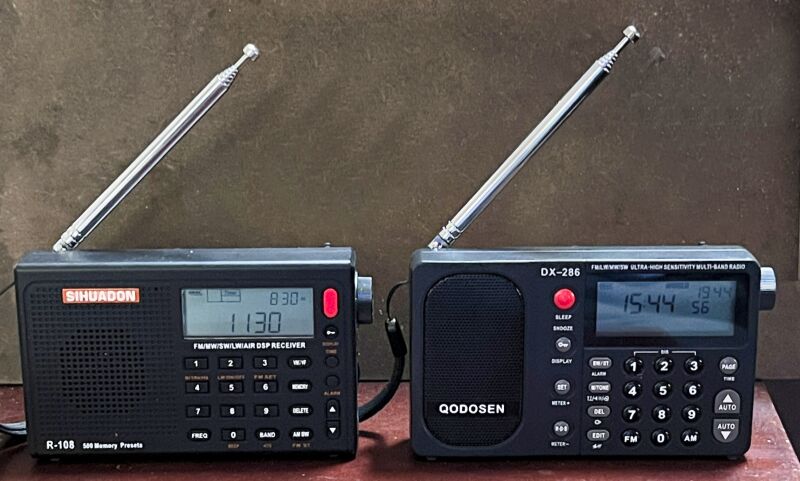
If all goes well, I’ll be receiving a Qodosen SR-286 (aka Xiaoqiang SR-286) radio mid-February from AliExpress. I learned about it from RadioJayAllen’s review and it pushed a few of my buttons.
First off, the SR-286 is small: 128 x 75.5 x 38 mm. I like a portable radio to be portable.
Qodosen SR-286 Product Photo (AliExpress)
Allen says that this is the best portable for FM that he’s seen, and the addition of RDS gives me an opening for more DXing on that band. I also like the fact that the external antenna can be used for all bands, including LW/MW. With tax and shipping from China, my order totaled $134.78, not exactly a bargain radio, but much less than a Tecsun PL-990 or Sangean ATS-909 X2.
I’ve been taking surveys for the YouGov polling company for some years now (you can sign up here) and for the past year or so at least one poll a week asks the question, “What did you do last weekend?” and of the possible answers is always, “Visited McGrath, Alaska.”
With temperatures at -40° (at that temperature Fahrenheit and Centigrade are equal), I’m not about to travel there, but there was an event this afternoon involving McGrath that caught my attention after seeing the name so many times in polls. The local McGrath radio station KSKO today started a regular experimental transmission to occur every Friday afternoon at 4 PM Eastern Time (21:00 UTC) that relays their local broadcast via Space Line, Bulgaria, on 5900 kHz shortwave.
I headed down to the pond to see if I could hear it. There was nothing at 21:00 but gradually the signal grew until the point that I could listen to it on an inexpensive radio using its whip antenna. Who knew?
I have lots of recordings from my radio travel adventure involving various antennas and radios, but much of it is copyrighted music and I don’t want the hassle of defending a fair use claim, so I’ll just include a bit from the weather report.
Disclaimer: I am testing a presale version of the radio provided to me by XHDATA in exchange for helping them improve the user manual. I am under no obligation to review the radio online, much less say nice things about it.
XHDATA D-608WB Weather Radio
When I first saw online mention of the upcoming XHDATA D-608WB radio, a few questions came to mind:
Could I finally replace my Mesqool CR1009 Pro weather radio, that I really don’t like, with something better?
Is it as good as some other radios from XHDATA like the R-108 and D-109WB?
How much is it going to cost?
The last question has been answered, and I was surprised at how inexpensive it is direct from XHDATA.
Given that it has a premium 18650 battery, solar cells, crank power generator, premium speaker (more on that later), flashlight and a reading light on top of what their regular D-109WB radio has, I would have expected something at least as expensive as the D-109WB ($55), but not so. I really don’t know why it has the price it does — but in the great divide of the universe between things that are my problem and things that are not my problem, this falls in the latter category.
When I was a young shortwave listener 56 years ago, I had a Lafayette KT-340 desktop radio with connectors on the back for an antenna and a ground. I always hooked up my 75-foot long wire to the ANT post and connected the GND post to a water pipe or something. Life was good.
Me with Lafayette KT-340 desktop radio (lower left)
Nowadays, I have many portable radios and, with the exception of my vintage Panasonic RF-085, there aren’t any explicit ground connections. Still, several of my portables have an external antenna jack that take a phone plug with a sleeve and a tip connection (the tip to the antenna and the sleeve theoretically to the ground). One reads online not to bother with a ground on these radios, but I’ve had a different experience sometimes, and in this blog article, I want to describe one of them.
I’ve often said that I don’t get longwave where I live — there is just nothing on. Today, I was trying to receive an experimental broadcast on LW; I took my Tecsun PL-990 radio outdoors to my 20-foot wire up a tree (WUT) antenna where there is also a copper ground rod to see if I could catch the station. No luck, but as I was scanning LW just for grins, I came across a very strong AM Morse signal repeating “MSQ” on 351 kHz. It’s located in Culpeper, Virginia, broadcasting with a reported power of 25W (elsewhere I’ve seen 10W). This is no once in a lifetime DX reception, as that airport is only 43 miles from me.
Non-directional beacon MSQ, Culpeper VA
Now here’s where it gets interesting. As I said, the station was quite strong on my PL-990 with the WUT antenna connected to the external antenna tip and the ground rod to the sleeve (and the radio switched to use the external antenna). When I attempted to receive the station on the internal ferrite antenna, there was nothing whatever, zilch, nada. I went back to the external antenna but disconnected the ground. The station was barely audible. Signal strength with the ground was 19-20 dBμ, and without 4-6.
OK, I had to have a radio under the Christmas tree, and as the last thing I really needed for Christmas was another radio, I went to the bottom of the barrel for this Semier SM-838 at the sale/coupon price of $9.99 plus tax (battery included). The sale price on Amazon today is $16.49 without coupon. So, is it better than its price-equivalence in Happy Meals?
Semier SM-838 (Amazon product photo)
Features
It’s a shirt-pocket MW/FM/SW radio plus MP3 player. It covers the MW band from 520 – 1720 kHz with 10 kHz step, FM from 70 – 108 MHz and shortwave from 2.3 – 21.95 MHz. It comes with an instruction sheet, internal battery, USB-C charging cable, wrist strap and earbuds. The radio has a lighted display with 5 buttons, two side wheels and a switch. The non-user-replaceable lithium-ion is described as 1000 mAh. There is no clock.
Functional features include Auto Tune Storage (ATS) on each band. The instruction sheet doesn’t say how many ATS memories there are, but the number seems to be 50 on each band. It has only 2 digits to the right of the decimal for shortwave frequency display, leaving the resolution at 10 kHz, although it seems like the radio tuning wheel clicks twice between each advance in the display. The instruction sheet says that the SW step is 10 kHz. I was able to receive a strong station on 7.355 MHz when tuning the radio to 7.35 and 7.36.
The instructions say max audio output is 3W, and indeed the radio can be turned up very loud. The battery is only 1000 mAh, so operating the radio at its higher volume levels will deplete the battery fairly soon. This is less of an issue for personal listening or when using the supplied earphones.
This radio is tiny: 101.7 *18 * 56 mm. The antenna is 250 mm (10″).
When I write a review of a radio for Amazon, I’ll often try to gain credibility by saying “I’ve owned over 100 radios…” and that’s true. I currently have 39 radios (not counting car radios and clock radios). What happened to the rest of them? Let’s see:
It became obvious some time ago that it made no sense to own both a Tecsun PL-880 and a PL-990 portable shortwave receiver. I knew one of them should go — but which one?
The PL-880 had the best speaker of any radio I’ve owned. The bass was fantastic. It was also smaller than the PL-990. The PL-990, on the other hand, has the ability to use an external antenna on MW and supports synchronous detection. In the end, I found myself using the PL-990 and not using the PL-880 very much.
The PL-880 sold on eBay for a stunning $141.
I’m eyeing an XHDATA D-608 to buy with some of the proceeds when it finally goes up for sale. It’s a yellow emergency radio (solar and crank power) that seems to be similar internally to their D-109WB. Then the Mesqool CR-1009 Pro will go down to the Goodwill Store (it works OK but it’s now well-designed for shortwave).
Update: XHDATA sent me a free D-608WB in exchange for my help in improving the manual (or maybe just because they think I’m an influencer). In any case, I don’t recommend it.
AI generated content may appear occasionally in articles and will be denoted with the 🤖 [robot emoji] symbol. Content comes most often from Microsoft Copilot, but may also come from Perplexity, ChatGPT, Duck.ai, Grok or Deep Seek.