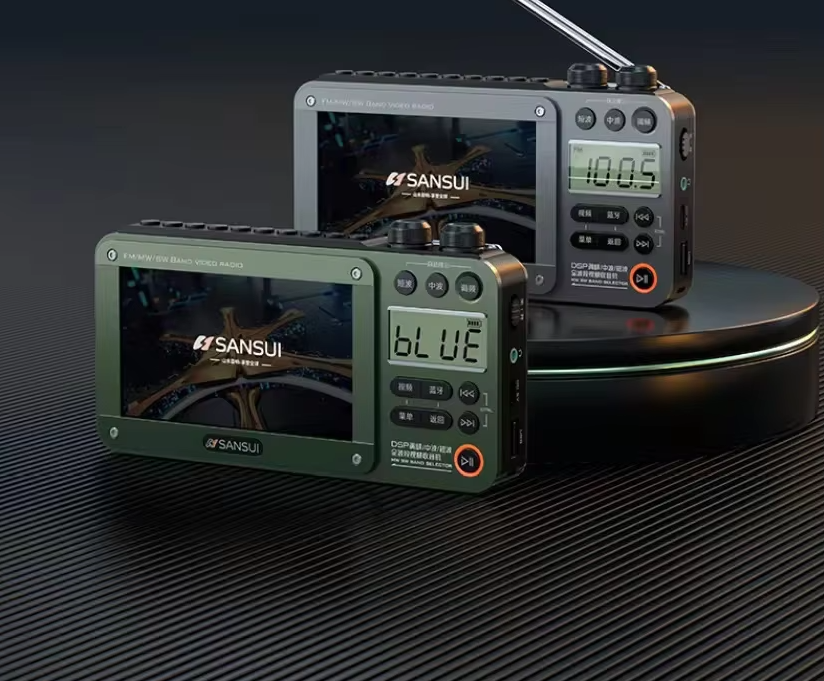
Just hours after saying I wasn’t going to buy another radio, I bought another radio. I almost hesitate calling this a radio because most of the real estate is devoted to playing media. I frankly don’t understand how someone can manufacture a media player with a 4.3″ diagonal high definition screen plus an AM/MW/SW radio and ship it from China to the US for under $40.
Sansui F50 (it comes in green and grey)
Some of the controls on the device are in Chinese and the manual is in Chinese. Thanks to Fred in the Shed, I have some quick start instructions in English, enough to get the menu system to switch from Chinese to English.
I don’t know if MW is going to be stuck at 9 kHz channel spacing. The seller on Banggood says it can be changed, but their wording suggests that they are guessing. Fred says FM has hiss all the time. Shortwave is from 2.3 to 22 MHz, which will cover enough frequencies to be interesting. It has ATS on all bands.
If this gets into daily use, it will likely be used for watching YouTube videos offline. One odd bit is that it is powered by 3x 18650 1200 mAh batteries. That’s a lot of batteries. I’ll likely replace them with much larger capacity cells, again, if it gets into daily use.
Anticipated receipt March 25, 2025, from AliExpress. Also available at a higher price from Banggood.
Update:
The AliExpress seller (Outdoor Fashion Speaker -z13 Shop Store) responded to my query about a PDF version of the manual. I was hoping for a Chinese version that I could run through some sort of automated translation process. Instead they sent a manual for a similar model (MR-50) in English. I think it’s the same as the F50.
I’ve taken the manual and rewritten it (with the help of Microsoft Copilot), and I added instructions for changing the menu language. Following is my draft user manual.
I wanted to test a collection of “comparable radios.” Given that we’re comparing a vintage radio to newer ones, there’re not exactly comparable. The Tecsun PL-660, bought not long after my original G4000A, is the only one with similar technology. Most radios these days are DSP based. Here is the field:
In honor of our newcomer, I’m using the Grundig branded 23-foot reel antenna that comes with this radio for the comparisons. It plugs into all of the group except the Sangean where it has to be clipped onto the telescopic.
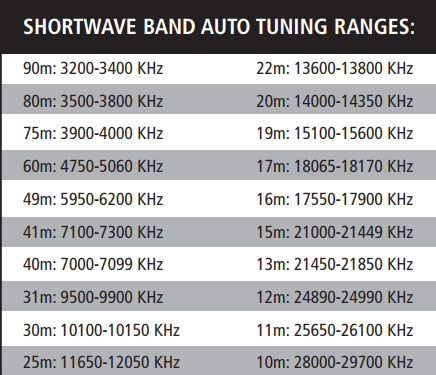
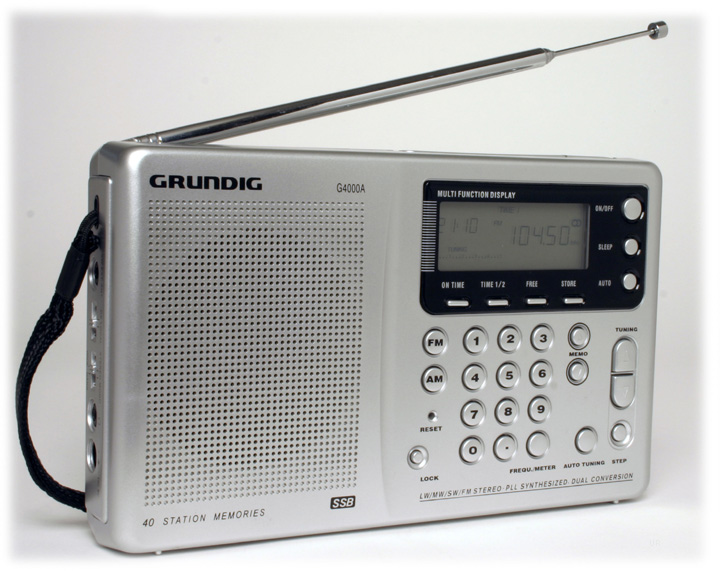
I keep having this feeling that the G4000A is somehow kin to my Sangean ATS-405. Superficially that’s true in that both have a silver colored case and they have round buttons. Neither has a tuning knob, relying on up and down buttons for tuning (the G4000A has a fine tuning knob just for SSB). The G4000A shares the one thing I dislike most about the ATS-405, band scanning. Both of them only scan within the current meter band and then cycle back to the beginning of the band. You have to manually select the next band to scan it; however, the ATS-405 has a METER button that will advance to the next band; the Grundig does not. To go to the next band on the Grundig, you have to look at the frequency, turn the radio over, search for the range on the printed table with very fine print, read the next band, turn the radio back over, key in the meter band and press the FREQU/METER button. Neither of the two radios has automatic tune storage (ATS).
Excerpt from G4000A manual
Testing
I like to test with the time stations WWV and CHU, plus commercial broadcast station CFRX 6070 almost exactly 400 miles away in Toronto, Canada. The time stations are great because of consistent program content that makes comparisons easier. In the afternoons, Ifrikya FM from Algeria is a nice choice.
Before doing the comparisons, I tried a brief test of the G4000A in the backyard. CFRX came in quite well on my 20-ft. wire up a tree (WUT) antenna. The time stations were good. I even tried some SSB. I’m clumsy when it comes to SSB, but I was able to get a very natural sounding decoded SSB signal.
Even with my new outdoor antenna and shielded cabling, I am plagued by noise, and no one is interested in how well a radio picks up noise. I had planned a new location location, but I checked it out in advance and found a couple of young people there practicing their communication skills and decided not to disturb them. The post office’s 2-day overdue delivery shot my schedule all to pieces, created conflicts and wasted some gorgeously warmer weather. So instead of a more exotic location, we have the back yard, the 20-ft WUT antenna and a shorter session in the chill air.
Frankly 8 radios are a lot to compare. By the time the tests are run, reception conditions can have changed, so don’t make too much of this small sample. Later on, I’ll do more videos with 2-3 radios.
One issue became obvious: the G4000A display is impossible to view in some lighting, and the display has no illumination option.
Grundig G4000A Plus 7 New Friends Back Row: Tecsun PL-660, PL-990 Middle: Sangean ATS-405, Grundig G4000A, Eton Elite Executive XHDATA D-808, Qodosen DX-286, Tecsun PL-330
Ifrikya FM, 13855
It must have been a little early for Ifrikya FM (20:04 UTC, 16:04 local). The signal was pretty weak. I started and ended the video with the G4000A.
Time Stations
Next I ran through the list of all my regular time stations, WWV on 25000, 20000, 15000 and 10000 and CHU on 3330, 7850 and 14670. 10000 and 14670 were particularly weak on all the radios. It got a little tricky when the zero was on a different place on some of the keypads, and each radio had its own rules on frequency entry.
Audio Impressions
The G4000A speaker, rated at 600 mW can be turned up quite loud, and this is an advantage for a weak station. I guess the automatic gain control (AGC) is limited. I had the G4000A set for narrow bandwidth and the TONE switch was set to low. On FM music stations, results were unimpressive and there was a total lack of bass. That was helped some with a good set of headphones that revealed the higher bass, but the really low stuff was not there.
Overall Impressions
For someone who lives and breathes meter bands, and knows all the frequencies in their head, this radio might be fine, but scanning is worthless, both because a) there is no ATS, b) the radio selects noise more likely than it does stations and c) the scan only works within one shortwave meter band. Direct entry of frequencies is, however, very efficient. The extremely dim display light is a major limitation. The size and weight (1.5 lbs.) makes it less attractive for travel. FM overload is a significant issue that I noticed and that has been reported by other users.1
MW and SW is sensitivity is very good. SSB sounded very natural as well.
Given that the radio has full SW coverage and that it offers SSB, I think the $44.88 plus shipping wasn’t unreasonable. There are G4000As on eBay for a good bit less than that. Still, given that the radio chuffs, you’re not getting anything unavailable in a more modern radio.
I hesitate to use the phrase “product review” for something that’s been out of production for a long time. I used the Wayback Machine to scroll through the listings of the G4000A at Universal Radio. They announced it as discontinued on the archived page for February, 2008, but it reappeared a few years later and was once again discontinued, with their last blow-out sale unit offered in May of 2012. I bought my previous one in 2011.
I was listening to a shortwave radio with a 40-foot long wire antenna tuned to 11900 kHz at 9:17 AM local time today here in central Virginia USA. There was a male-sounding announcer in English and the content was news. What station am I likely receiving?
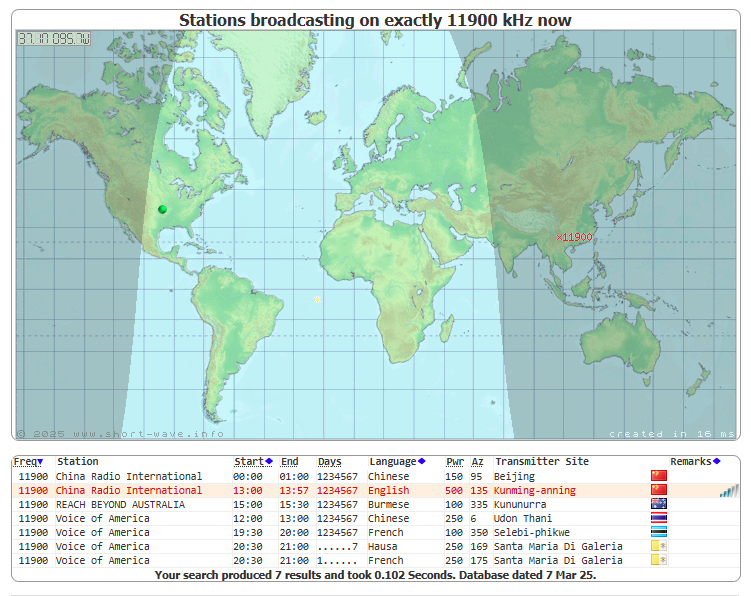
Short-wave.info suggested the answer was China Radio International transmitting from Kunming-Anning:
Short-wave.info search result for 11900 kHz
Other schedule services quickly determined that CRI is the only station that fits the frequency and time.
GPT-4o
I asked GPT-4o through duck.ai. Here’s the response:
At 11900 kHz, you are likely receiving a broadcast from the Voice of America (VOA) or possibly another international broadcaster. The frequency is commonly used for English-language news broadcasts, and VOA often operates on this frequency, especially during the morning hours. Other possibilities could include stations like Radio Free Asia or various other international broadcasters, depending on the time and content. If you can provide more details about the content or the style of the broadcast, it might help narrow it down further.
I rely heavily on shortwave schedules to help me figure out what I’m listening to on the radio. While we may not be as well off as our forebears in terms of international shortwave stations to listen to, we are certainly fortunate in our ability to get information about the broadcasts we have. I have a few tried and true sources, but there are more out there.
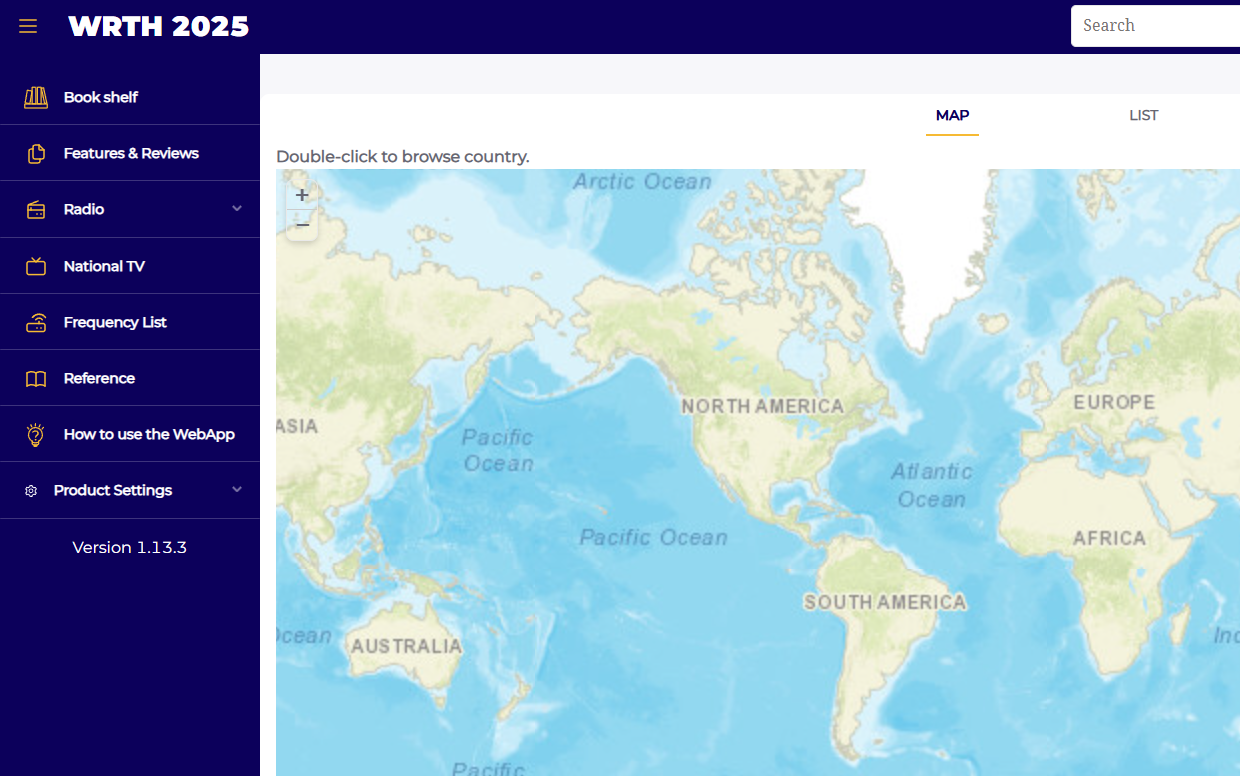
WRTH
I’ve purchased the World Radio TV Handbook off and on every few years for a very long time. The last paper copy was in 2021. It has program schedules, contact information for the stations, articles of interest and advertising. In 2023 they introduced their “Web App” making all the information, with updates schedules during the year, available online. My 2023 version kept updated with new schedule changes until the end of 2024, and I now have th3e 2025 version. It allows access by country and by and by frequency. Sometimes WRTH has listings others do not. It covers MW and FM, not just shortwave. It costs $21.41 US for 2025.
Users can select station from the map (click to expand)
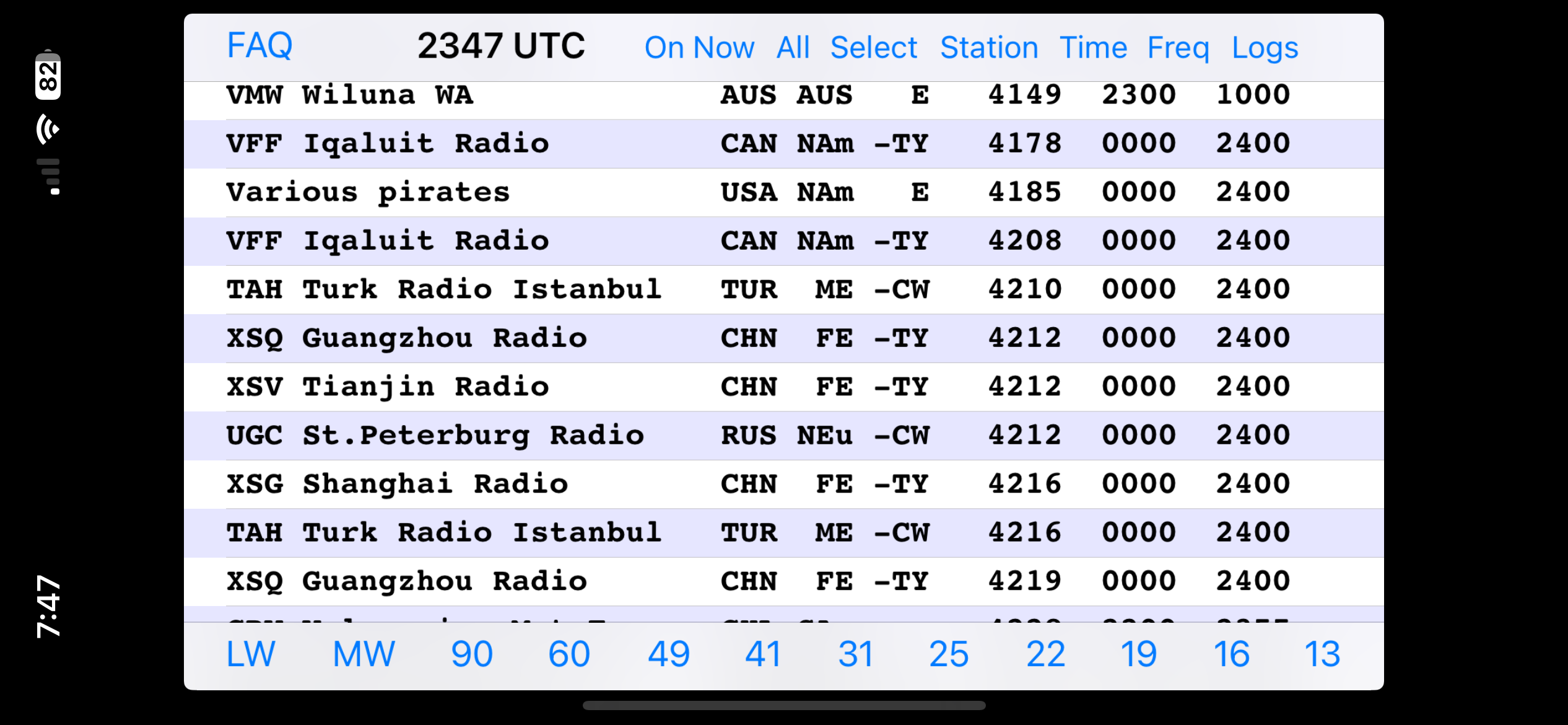
SWBC Sked
SWBC Sked from Black Cat systems is a phone app, an iPhone in my case. It costs $2.99 in the App Store and comes with frequent automatic schedule updates. This is often my first place to look. The one significant shortcoming is that it does not show the transmitter site; NHK might be coming from Japan or from France. Still, it’s efficient and handy. It also has a rudimentary station logging feature.
I guess this is a case of seller’s remorse and the “sharing the love” thing. I originally bought one in July of 2011, but I sold it during the great disgorgement a few years back, and I have been a bit sad about that one because while most of those radios were just accumulation, I actually used the G4000A for a number of years, and in fact mentioned it as my “main receiver” in an article here in 2011. I never wrote a piece dedicated to the G4000A, but I mentioned it rather often by way of comparison to something else.
This exercise in nostalgia led me to some old spreadsheets and old Amazon orders. I bought the G4000A in July of 2011 for $99.32 and subsequently bought a Tecsun PL-660 for $109.99 the following December. In 2025 money, they would be $142.44 and $157.84 respectively, rather a lot, I think. I’m guessing that the PL-660 took over the premier slot and this explains why the G4000A didn’t get an article. Assuming the radio works, that oversight will be remedied.
What am I going to do with this radio?
I only have one other dual conversion PLL radio, the Tecsun PL-660, and I want to compare those two, including on SSB, which both have. I’m rather interested in how it compares to newer radios as well. And when I say newer, this take into account that the G4000A is essentially the same radio internally as the Grundig Yacht Boy 400, introduced in 1994! This is 30 years old!
There are other G4000As on eBay currently under $50.
Update:
I’ve been reading the manual. It took me back to the days when radio manuals not only told you how the controls worked, but helped the reader get into the hobby of shortwave listening. I’m also very impressed with how the controls work. They’re well thought out.
Today was one of those days when I was grateful to have a radio in my car. An appointment finished early and I was driving home past Pleasant Grove Park in Fluvanna County, Virginia, a fantastic facility for walking, hiking and listening to radio. The temperature was in the mid-40s (F) but I had a coat, and my trusty Qodosen SR-286 with me. Also rummaging around the bottom of the car’s center console I found a Tecsun AN-03L compact reel antenna that came bundled with one of my Tecsun radios.
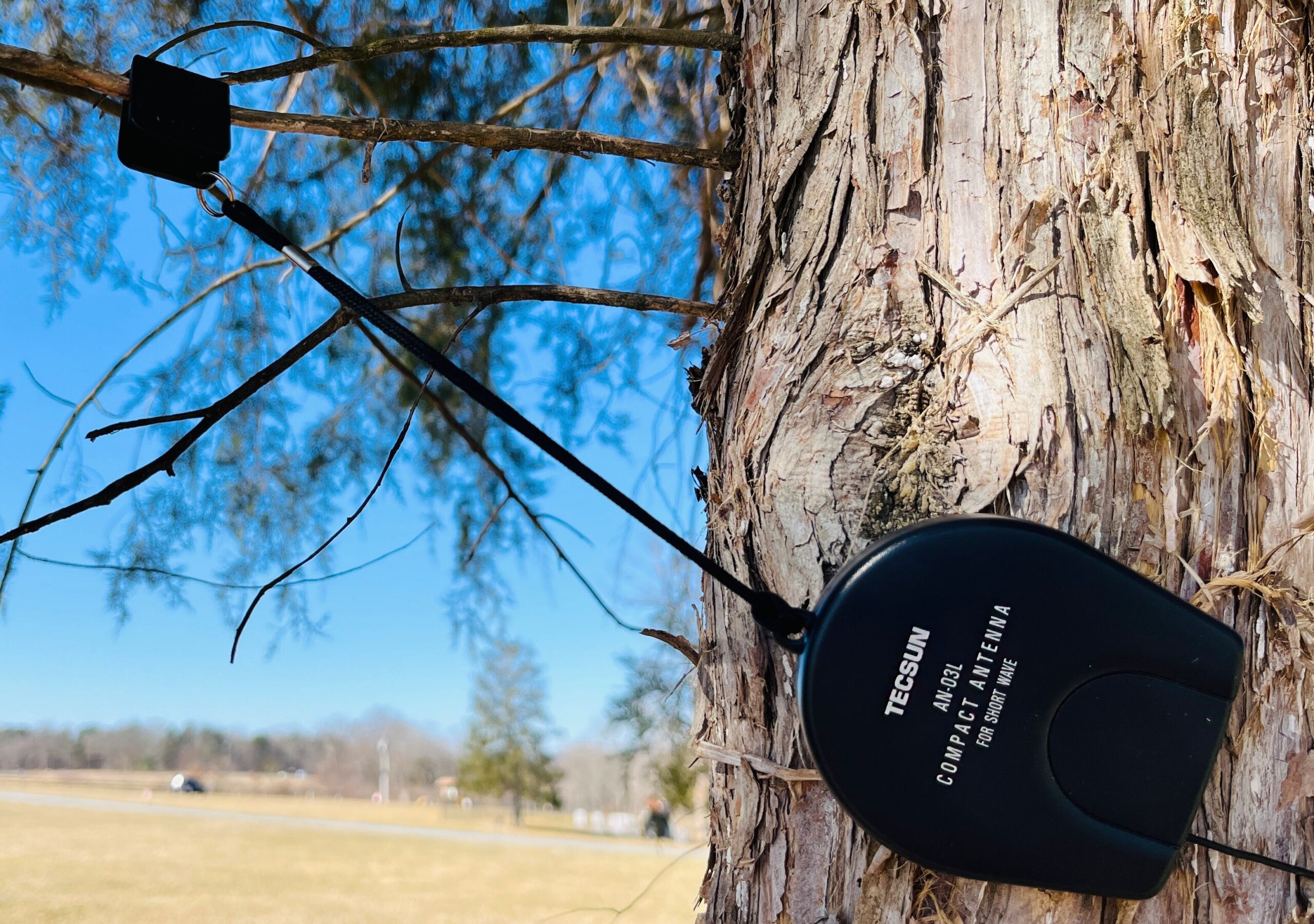
I clipped the antenna to a tree.
Tecsun AN-03L Compact Antenna
It’s around 7 meters (23 feet) long.
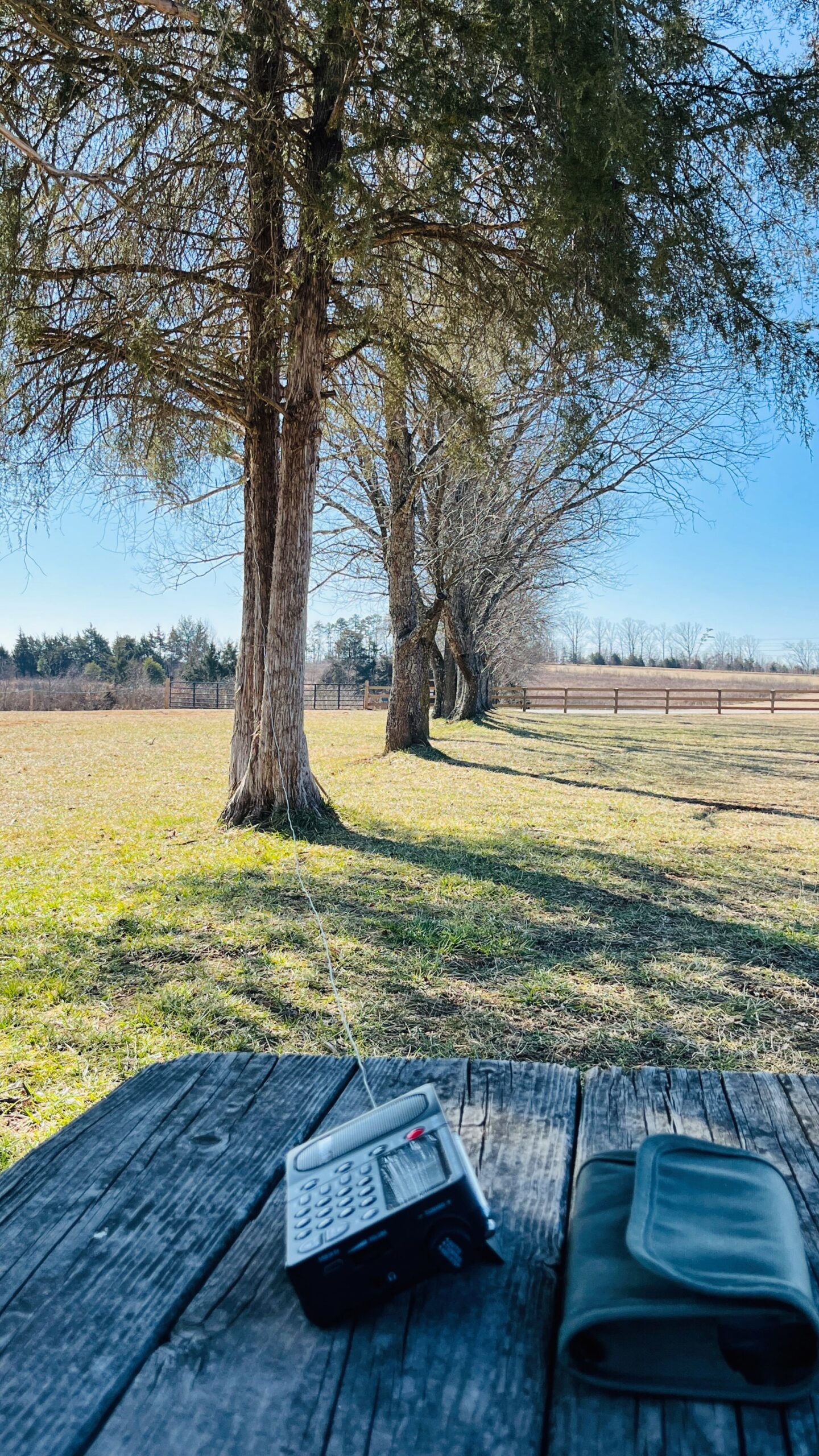
Wire makes it to the first tree
While there are some high tension powerlines not too far away, they don’t cause a noise problem. The picnic table is convenient too.
I used the SR-286 Auto tuning feature, something I really like on this radio. Each turn of the tuning knob advances to the next station. Before I started the official scan, I tuned three LW nondirectional beacons and then continued with shortwave starting at 1171 kHz. At the end, I added the US and Canadian time stations, WWV and CHU. WWV really sounded great on 25 MHz.
The viewer might want to take a shot at identifying some of the stations. Obvious there was CRFX, Toronto (right at 400 miles away). I think I got Radio Habana and Radio Marti both and a couple from China. One feature the reader can use to their advantage is the clock that is always on with the SR-286/DX-286. It’s correct within less than a minute.
AI generated content may appear occasionally in articles and will be denoted with the 🤖 [robot emoji] symbol. Content comes most often from Microsoft Copilot, but may also come from Perplexity, ChatGPT, Duck.ai, Grok or Deep Seek.